RNG audits publish yearly; the slot's paytable changed last Tuesday
An annual RNG certificate doesn't cover paytable changes pushed to live slots without a new audit, leaving players with a narrower assurance than assumed
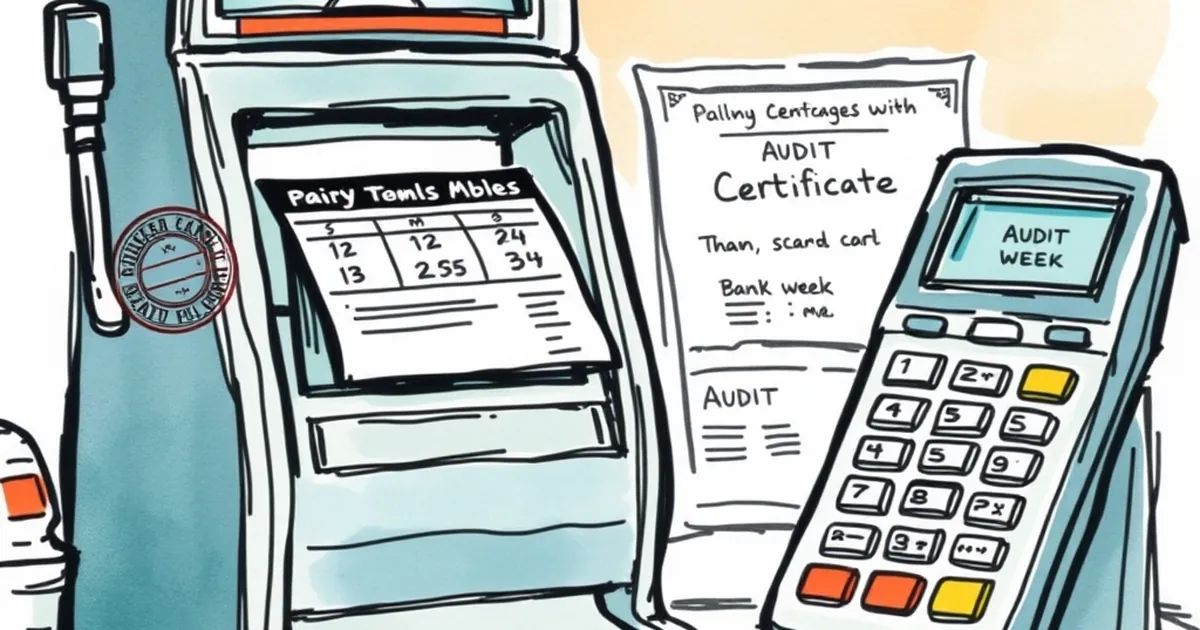
A slot's annual RNG certificate tells you the random number generator behind it passed an independent audit at some point in the last twelve months. It says nothing about the paytable sitting in front of you right now. Providers routinely push paytable and math-model changes to live games without a new audit cycle, without a version bump players would notice, and often without anything more than a line in the terms. The certificate is real. It's just answering a narrower question than most players think it is.
What an RNG audit actually certifies
The typical setup involves a testing lab — eCOGRA, GLI, BMM, sometimes a jurisdiction-specific auditor — checking that the random number generator produces outcomes within expected statistical bounds and that the game logic maps those outcomes to the published paytable correctly. The output is a certificate with a date on it, and that date is what gets stamped onto the game's info screen or the operator's fairness page.
Read the scope language carefully and you'll notice the certificate is tied to a specific build of the game. A version identifier, a math-model reference, a configuration hash. The audit says: this version, as tested on this date, behaves as described. It does not say the version you're spinning today is the same one.
That distinction matters because the RNG and the paytable are separate objects. The RNG produces a stream of numbers. The paytable — reel weights, symbol frequencies, pay values, bonus trigger probabilities, the whole math model — determines what those numbers mean. You can swap the second without touching the first. The generator still passes. The game plays differently.
The reels are weighted, and the weights are editable
Most modern slots don't use physical-style reel strips where every symbol has an equal shot at every position. They use weighted reels, where the probability of each symbol landing is set in the math model. Those weights are configuration. Change a weight on the top-paying symbol from 0.4% to 0.3% and the RTP drops — often by a fraction of a percent, sometimes more depending on the game's structure. The RNG keeps producing uniform random numbers. The mapping from those numbers to outcomes is what moved.
A concrete example of the scale involved: on a 5-reel, 243-ways game with a base RTP of 96.2%, trimming the scatter frequency by roughly 8% can pull the return down toward 95.5% while leaving the visual reel strips identical. Players see the same symbols, the same animations, the same "feel." The number in the help screen — if it's updated at all — is the only tell.
Why "last Tuesday" doesn't trigger a re-audit
Audit cycles are annual, sometimes semi-annual, and they're expensive. Labs charge for the testing, the documentation, and the certification. Providers with libraries of hundreds of titles aren't going to re-certify every game every time a client asks for a regional variant, a promotional configuration, or a tweak to hit a target margin.
So the industry runs on a distinction between certified and changed. A provider can ship a new math model to a live game under an existing certificate if the change falls within whatever tolerance the lab and the jurisdiction agreed to — or, in looser markets, if nobody's checking. Some regulators require notification of material changes. Many don't define "material" tightly enough to catch a 0.5% RTP adjustment.
This is where the annual certificate becomes a kind of comfort blanket. It's not fraud. The generator really is random. The outcomes really do fall within statistical bounds. But "within bounds" is compatible with a paytable that's been quietly tuned since the last audit, and the certificate's date won't tell you when that happened.
The regional variant problem
If you play from more than one country, you've probably already encountered this without knowing it. The same game, same name, same art, can carry different RTPs depending on the market. A title might run at 96.1% in one jurisdiction and 94.3% in another, because the operator or provider configured it to hit a different margin in a market where competition or regulation allows it. The RNG certificate is often shared across both versions. The paytable is not.
This is legal in most markets, disclosed in the help screen of each version, and almost never surfaced anywhere a player would actually look. The audit doesn't flag it because the audit isn't comparing your version to the other one. It's checking that each version behaves as its own documentation says.
Where the disclosure actually lives
Three places, in order of how easy they are to find:
- The in-game help or info screen. This is the canonical location for RTP, and in regulated markets it's usually accurate. It's also frequently buried two taps deep, sometimes behind a scroll, and occasionally not updated when a config change ships.
- The provider's game sheet. Most studios publish a spec PDF or web page listing RTP, volatility, max win, and hit frequency per title. Useful, but it often lists the default configuration, not the one your operator is running.
- The operator's terms. The least useful in practice. Generic language about "games may be configured differently by jurisdiction" covers a lot of ground without committing to anything specific.
If you want to know what you're actually playing, the in-game screen is the only source that reflects the live configuration — when it's maintained. Cross-check it against the provider's published default. If they differ, you've found a variant, and now you know which one you're on.
What this means for how you read RTP
The 96% figure you see quoted for a slot is a long-run average over the game's full outcome distribution, and it assumes the configuration you're playing matches the one being described. A 100,000-spin sample on a 96.4% game will land somewhere in a band around that number — the variance is wide enough that a 1% RTP difference is essentially invisible in a session or even a few thousand spins. That's precisely why paytable changes are hard to detect from play and easy to ship quietly. You can't feel a 0.7% shift. You can only read it.
Which means the practical move isn't to distrust every game. It's to check the in-game RTP before you commit a session's bankroll, and to treat a provider's headline number as a default rather than a guarantee. If a game's help screen doesn't state RTP at all, that's information too — and in regulated markets it's increasingly rare.
The open question
The uncomfortable part isn't that paytables change. Games get tuned, markets get localized, margins get adjusted — that's the business. The uncomfortable part is that the audit infrastructure was built to certify randomness, and randomness was never the thing that was going to cost you money. The paytable was. So the question worth asking isn't whether the RNG passed its audit. It's why the certificate that gets displayed so prominently covers the one variable that isn't in dispute, while the variable that determines your expected return gets a line in a help screen that may or may not have been updated since last Tuesday.