Reward Tiers Reset in 30 Days While Refunds Take 45
Reward tiers reset every 30 days while refunds settle in 45, leaving your points caught between two clocks that never agree on the same account
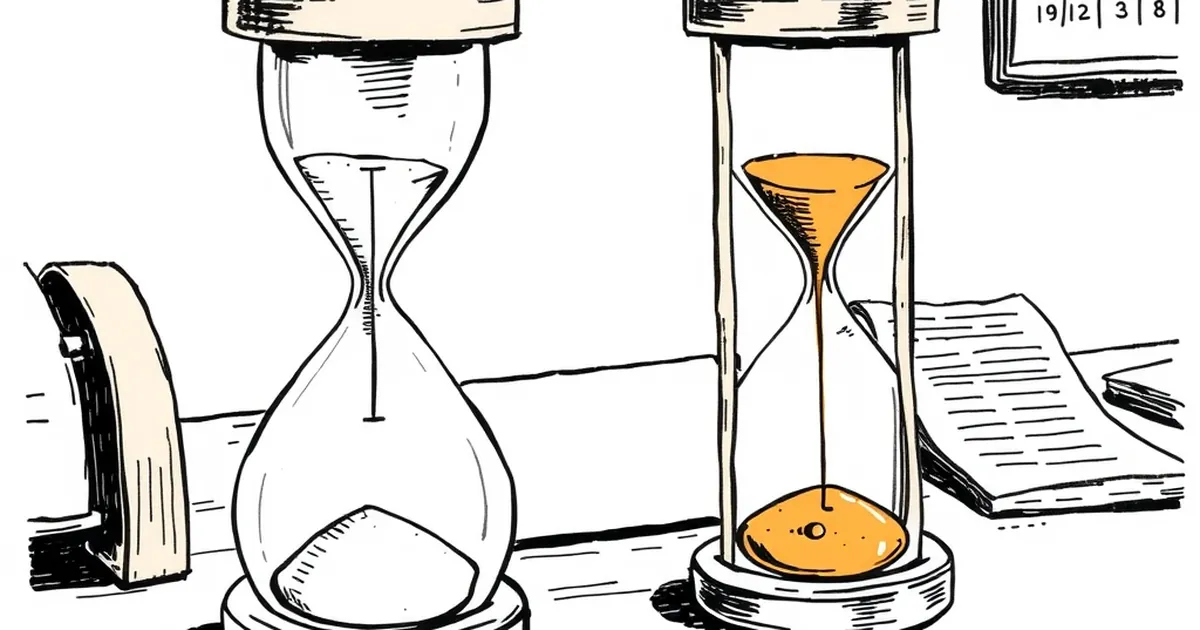
Your card statement says the refund landed, but your rewards balance says otherwise. The purchase that earned you 1,200 points posted in March; the refund for that same purchase, processed in April, arrives as a negative adjustment against a tier you've already been demoted out of. Two clocks are running inside the same account, and they don't agree on what time it is. That mismatch — reward tiers that reset on a fixed 30-day cycle while refunds crawl along a 45-day settlement window — is one of the strangest little design problems in consumer payments, and it's worth asking why it exists at all.
Two Clocks, One Account
Rewards programs and refunds are governed by different systems that were never designed to talk to each other. The rewards engine is a marketing and loyalty product: it wants predictable, promotable cycles. "Earn status by December 31." "Your points reset monthly." Those dates exist because they're easy to advertise. The refund system, by contrast, is a settlement product. It inherits its timelines from card network rules, issuer risk policy, and merchant acquirer behavior — none of which care about your tier anniversary.
So you get a structural asymmetry. A purchase is credited to your rewards balance almost immediately, sometimes the moment the authorization clears. A refund has to travel the whole chain in reverse: merchant initiates, acquirer batches, network routes, issuer posts. Along the way, the issuer has to decide whether to claw back the points, and if so, against which balance.
The 30-day reset is a loyalty decision. The 45-day refund window is a risk decision. Nobody sat in a room and chose to make them collide. They just did.
Why the Gap Feels Like a Loss (Even When It Isn't)
Here's where behavioral research gets interesting. In their 1979 work on prospect theory, Daniel Kahneman and Amos Tversky showed that people weigh losses roughly twice as heavily as equivalent gains. Losing 1,200 points feels worse than earning 1,200 points feels good — even though the arithmetic is identical.
Now layer on the timing. If your tier resets on day 30 and the refund posts on day 45, the points you "lose" aren't just points. They're points that were counted toward a status threshold you've now crossed downward. The issuer isn't taking anything from you in any real sense — the underlying purchase was reversed, so the points were never truly yours. But the feeling is of a penalty applied to a reward you'd already banked. That's loss aversion operating on a technicality.
There's a second effect at work: what B.F. Skinner described as variable-ratio reinforcement. Rewards programs are deliberately built on unpredictable, intermittent payouts — bonus categories that rotate, "surprise" multipliers, limited-time accelerators. This schedule is what makes them sticky. But it also makes any clawback feel arbitrary, because you never had a stable rule to begin with. You can't predict which points are safe.
The Cashback Exception That Proves the Rule
Cashback programs handle this differently, and the difference is instructive. When a cashback refund posts, most issuers simply reduce the cashback balance by the corresponding amount. If the balance goes negative, it carries forward as a debit. There's no tier to fall out of, no anniversary date to miss. The accounting is boring, and boring is the point.
Points programs can't do this as cleanly because points are quasi-fictional. They have no fixed redemption value, they expire on schedules you didn't choose, and their worth depends on how you redeem them. A point is worth more as a statement credit than as a gift card, more as an airline transfer than as a merchandise redemption. So when a refund claws back points, the issuer isn't returning a fixed unit of value — it's returning a unit whose value you may have already optimized around.
Consider a concrete case: a traveler books a $2,400 flight in January, earns 4,800 points at 2x on travel, and those points push her over the threshold for a mid-tier status that grants lounge access and free checked bags. She books three more trips in February on the strength of that status. In March, she cancels the original flight. The refund posts in April, 45 days later. The points reverse. Her tier, which reset on day 30, is now below threshold — and the lounge visits she already took are non-refundable.
The issuer's position is defensible: the points were contingent on a purchase that didn't happen. Her position is also defensible: the status was granted, used, and revoked after the fact. Both are internally consistent. The system just wasn't built to adjudicate between them.
What the Mismatch Actually Costs
For issuers, the 30/45 gap is mostly a customer-service liability. Every clawback that lands after a tier reset generates a call, and calls are expensive. Some have quietly moved toward "soft landings" — grace periods where you keep your tier for a cycle even if the points fall short. Others have shifted to trailing-twelve-month status calculations, which smooth the timing problem by measuring activity over a rolling window instead of a calendar cliff.
For cardholders, the practical lesson is less about gaming the system than about understanding which points are provisional. The ones tied to recent, refundable purchases are the most fragile. The ones from settled transactions are the safest. If you're close to a tier threshold and you have a pending return, it's worth checking whether the reset date falls before the refund posts. That's not a trick; it's just reading the terms the way the issuer does.
Merchants sit in the middle. A merchant who processes refunds slowly — because of batching schedules, fraud review, or plain operational drag — effectively extends the window during which a customer's rewards are in limbo. Some large retailers now push refunds through in 24 to 48 hours specifically to reduce this friction. It's a small operational choice with an outsized effect on how the whole chain feels to the person at the end of it.
Where This Is Heading
Real-time payment rails are starting to change the math. As instant refunds become more common — pushed through faster settlement networks rather than batched card processes — the 45-day window will compress. When refunds post in hours instead of weeks, the gap between the rewards clock and the refund clock narrows to something close to zero, and the whole problem mostly evaporates.
Until then, the smarter move for anyone designing these programs is to stop treating the two clocks as independent. A rewards engine that knows a refund is in flight, and holds the clawback until it settles, eliminates the entire class of complaint. That's not generosity — it's just accounting that respects the fact that a single transaction can't be two different things depending on which department is looking at it.
The next time your tier resets before your refund lands, you'll know exactly what happened. Two systems, two timelines, one account — and a design decision that nobody made on purpose.