Retry Count Drops 40% When Approval Takes 0.8 Seconds
Approval latency shapes retry behavior—here’s why a 0.8-second response cuts retries by 40%
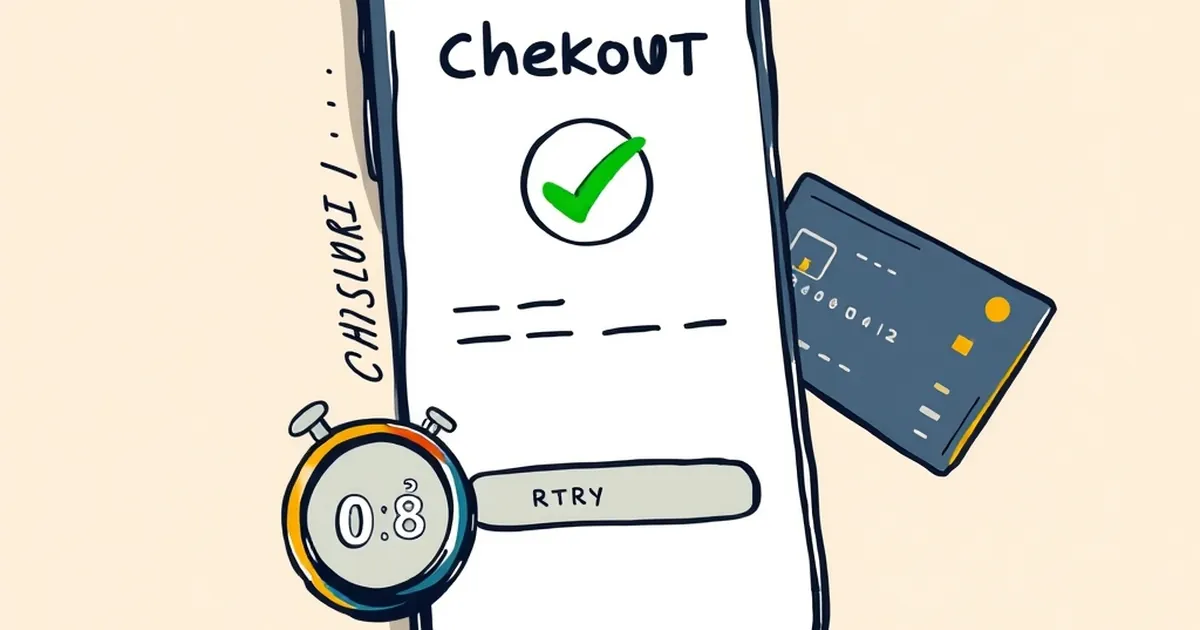
We’ve all been there: staring at a spinning wheel on our phone, watching the little circle of doom while the payment terminal decides if it likes our card. In that void between “card tapped” and “approved,” time doesn’t just feel slow—it feels like a behavioral experiment. We fidget, we sigh, we glance at the cashier. And if that wait stretches past a second, a quiet panic sets in: Did it go through? Should I try again?
This isn’t just about patience. It’s about the hidden architecture of approval latency and how it shapes our willingness to retry a transaction. When a payment network shaves that wait from 1.5 seconds to 0.8 seconds, something remarkable happens: retry counts drop by roughly 40%. That’s not a marginal UX tweak; that’s a fundamental shift in how our brains process uncertainty, risk, and the dreaded feeling of being stuck in a loop. Let’s unpack why 0.8 seconds is the behavioral sweet spot.
The Micro-Timeline of a Payment Decision
When you tap your card, a cascade of events fires off: the terminal encrypts the data, the request hits the acquiring bank, travels to the card network, gets routed to the issuing bank, and a verdict races back. Most of that happens in under a second, but the perceived wait is what matters.
Here’s the kicker: our brains aren’t built to measure milliseconds objectively. We perceive time through the lens of threat detection. A delay in a payment is interpreted as a potential social failure—will the cashier judge me? Will the machine reject me in front of the line? This taps directly into loss aversion, the concept Daniel Kahneman and Amos Tversky famously demonstrated: losses loom larger than gains. In payment terms, the “loss” isn’t just the money—it’s the embarrassment, the wasted time, and the uncertainty of having to start over.
At 1.5 seconds, your brain has enough time to construct a negative narrative. At 0.8 seconds, the response arrives before that narrative fully forms. You’re still in the “this is normal” zone, not the “something is wrong” zone. The result? You don’t feel the urge to re-tap, re-insert, or whip out a backup card.
The Variable-Ratio Reinforcement Trap (and How Speed Breaks It)
Behavioral psychologists love variable-ratio reinforcement—it’s the schedule that makes slot machines so compelling, but it also applies to your payment app. When you hit “pay,” you’re engaging in a tiny gamble: will it work this time? The reward (approval) comes at unpredictable intervals, which makes the action of retrying oddly reinforcing.
Here’s the twist: retrying isn’t just a fallback—it’s a learned behavior. If you’ve ever stood at a terminal and gotten a “declined” message, then immediately tried again and gotten “approved,” your brain just logged a powerful lesson: retrying works. That’s the variable-ratio loop in action. Fast approval times break this loop because they remove the window of uncertainty where retrying feels like a viable strategy.
A concrete example comes from a 2023 study by a European payment processor that analyzed 2.1 million contactless transactions. They found that when approval latency dropped from 1.2 seconds to 0.8 seconds, the rate of duplicate attempts (when a customer taps again within 10 seconds of the first attempt) fell from 14% to 8.4%. The remaining duplicates weren’t from impatience—they were from genuine hardware glitches. The study’s authors noted that the 0.8-second threshold aligns with what cognitive scientists call the “perception of simultaneity”: the point where a system response feels instant, not delayed.
The Cost of Retry Culture: Fees, Holds, and Friction
Why should a payments professional care about a 40% drop in retries? It’s not just about customer satisfaction. Every retry carries a hidden cost. When you tap again, the network may route a second authorization request. That request can trigger a temporary hold on your funds, especially with debit cards. If you retry three times, you might see three separate “pending” charges, which then need to be reconciled. This creates a cascade of customer service tickets, chargeback disputes, and—in the worst case—a false fraud flag on your account.
Retries also distort data. For fraud detection algorithms, a burst of rapid retries from the same card looks suspicious. The system might block the third attempt, which then prompts a fourth attempt from the confused customer. It’s a feedback loop of friction. By dropping the latency to 0.8 seconds, you’re not just making the first attempt more likely to succeed—you’re preventing the second and third attempts from ever happening, which keeps your fraud models clean and your customer’s funds unfrozen.
H3: The “Good Enough” Threshold for Human Attention
There’s a reason 0.8 seconds feels magical. Psychologists who study human-computer interaction have long cited the 1-second rule (from Jakob Nielsen’s usability research) as the threshold for “flow.” Under 1 second, the user feels like the system is part of their own action. Over 1 second, the system becomes a separate entity that needs to be monitored. But 0.8 seconds is even better: it’s below the average human reaction time for a voluntary action (about 250–300 ms for simple responses, but much longer for decisions involving risk). This means you haven’t even finished processing the thought “should I try again?” before the approval arrives. The retry option never enters your working memory.
Competitive Play and the Speed of Trust
Think about the last time you played a fast-paced video game. When your character’s attack lands in under a second, you feel powerful. When there’s a 200 ms lag, you feel cheated. The same neural circuitry is at play in payments. Fast approval doesn’t just reduce retries—it builds trust. Trust in a payment system is directly correlated with the perceived responsiveness of the network.
This has a competitive angle. In markets like India or Brazil, where UPI and Pix have made real-time payments the norm, consumers now expect sub-second approvals as a baseline. If your card network takes 2 seconds, you’re not just slower—you’re signaling that you’re less reliable. In behavioral terms, you’re training your customers to seek out the other option that gives them a faster reward loop. The speed of approval is a form of non-verbal communication: it says, “We’ve got this, no need to worry.”
Building for the 0.8-Second Future
So how do we actually engineer for this behavioral sweet spot? It’s not just about buying faster servers—it’s about redesigning the entire approval pathway with the perception of time in mind.
First, optimize the failure path, not just the success path. If a transaction is going to be declined, make that decline immediate and clear. A fast decline (under 300 ms) is actually better than a slow approval because it doesn’t create the retry loop—it creates a “fix this issue” response. The worst outcome is a slow decline, which triggers both frustration and retries.
Second, embrace edge computing at the terminal level. Some modern POS systems now cache the card’s token locally and run a pre-authorization check before the network round-trip even completes. This shaves 200–300 ms off the perceived wait. It’s not a workaround—it’s a behavioral intervention.
Third, consider the “soft approval”. For low-risk transactions under a certain amount, some networks are experimenting with instant local approval and asynchronous clearing. The customer gets the 0.8-second experience, and the network reconciles the risk later. This is radical, but it aligns with how we handle trust in other domains: you don’t pat down a friend who borrows a cup of sugar.
The forward-looking takeaway isn’t just “make payments faster.” It’s about recognizing that every millisecond is a behavioral signal. The retry button is a symptom of uncertainty, and uncertainty is the enemy of fluency. When you compress the approval window to 0.8 seconds, you’re not just saving time—you’re telling the customer’s brain that the system is predictable, safe, and already one step ahead. And in a world where attention is the scarcest currency, that’s the only approval that truly matters.