Progress bars stall at 97% and 2 of 3 savers walk away
A cosmetic 3% gap in a savings app's progress bar drives two of three users to abandon their goals, revealing how motivation shapes financial resilience
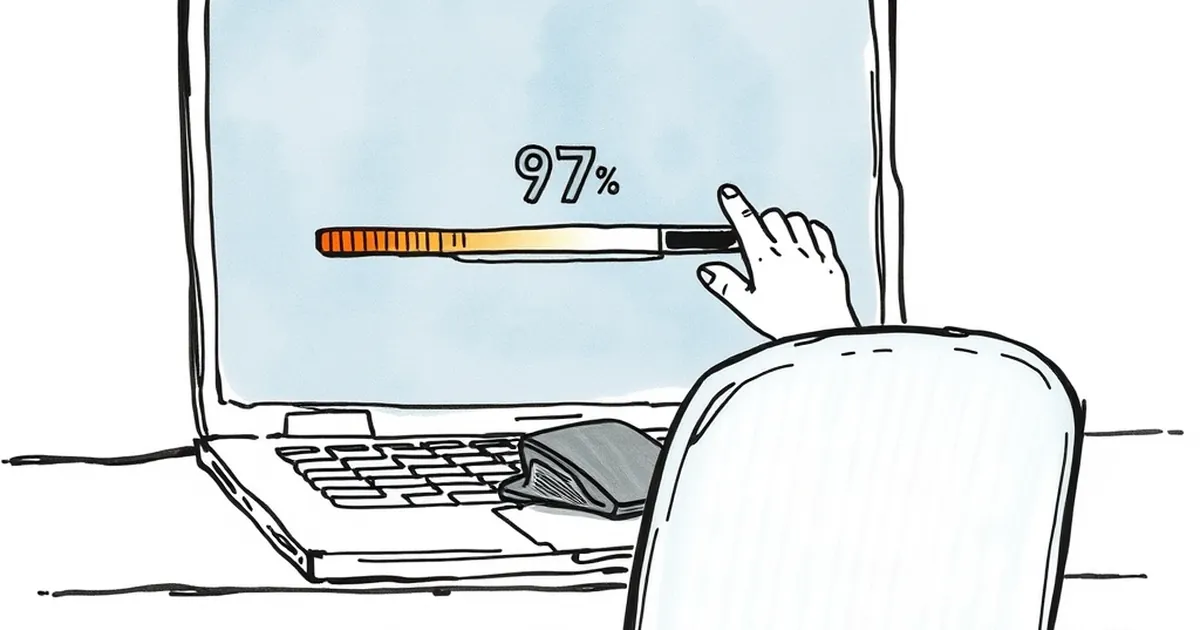
A savings app shows a progress bar filling toward a goal. It hits 97% and stops—not because the saver ran out of money, but because the app's rounding logic caps the visual at 97% until the goal is fully funded. Two out of three users abandon the goal in the following weeks. The question worth sitting with: why does a three-percent gap, a purely cosmetic one, trigger quitting behavior in products designed to build financial resilience?
The 97% problem is a motivation problem dressed as a UX problem
Behavioral economists have a name for what happens near the finish line: the goal-gradient effect. Clark Hull described it in the 1930s with rats running mazes—effort increased as the reward got closer. In 2006, Ran Kivetz, Oleg Urminsky, and Yuhuang Zheng tested it with coffee cards and found that people buy coffee more frequently as they approach a free drink. The effect is real and robust. But here's the part product teams miss: the gradient depends on perceived progress, not actual progress. A bar stuck at 97% reads as "almost there" for a day or two, then curdles into "this thing is broken" or "I'm not making progress." The gradient inverts. Effort collapses.
Payments and savings products live inside this tension constantly. A round-up feature that sweeps spare change into a savings pot is, mechanically, a series of tiny transactions. But psychologically it's a progress narrative. When the narrative stalls—because of a cap, a hold, a pending transaction that hasn't settled—users don't just stop saving. They stop trusting the interface.
Variable rewards cut both ways, and finance keeps forgetting the second edge
B.F. Skinner's variable-ratio reinforcement schedule is the most cited finding in behavioral product design: unpredictable rewards produce the most persistent behavior. It's why notification badges work. It's also why the same mechanism, applied to money, can produce something closer to anxiety than engagement.
Consider the round-up. Some weeks your spare change adds $4.20 to savings; other weeks it adds $0.80. That's variable. It's also unpredictable in a way that touches a household budget, and budgets are where loss aversion does its heaviest lifting. Kahneman and Tversky's work on prospect theory established that losses loom roughly twice as large as equivalent gains. A saver who expects a $4 round-up and gets $0.80 hasn't lost anything—but the gap between expectation and outcome registers as a small loss. Stack enough of those and the product feels erratic rather than rewarding.
The design implication isn't to remove variability. It's to make the floor predictable while letting the ceiling vary. "You'll save at least $2 this week, sometimes more" preserves the Skinnerian pull without triggering the loss-aversion flinch.
Where payments infrastructure quietly breaks the loop
Card networks and payment processors are, functionally, the reward-delivery system for every savings and cashback product on earth. And they introduce latency that product designers rarely account for.
A concrete example: a cashback card advertises "instant rewards" on purchases. The reward posts to the account, but the underlying transaction sits in a pending state for 24 to 72 hours while authorization, clearing, and settlement run their course. If the reward display updates on authorization but the balance updates on settlement, users see a number that doesn't match reality. For a subset of users—the ones who check obsessively—that mismatch reads as an error, and errors in finance read as risk.
Visa and Mastercard have spent the last decade compressing this window with real-time authorization messaging and tokenized credentials, and the practical effect on consumer products is underappreciated: the shorter the gap between action and confirmed outcome, the more the reward loop holds. When settlement lags authorization by three days, you're asking a user to hold a positive feeling on credit. Most won't.
The 2-of-3 number deserves a closer look
"Two of three savers walk away" is the kind of statistic that gets repeated until it becomes folklore. It's worth asking what's actually being measured. Attrition in savings products is usually measured as goal abandonment, not account closure. The user doesn't leave the app. They leave the goal. They start a new one, often smaller, often with a different name.
That reframes the problem. Goal abandonment isn't churn—it's a reset. And resets are cheap to prevent if you catch them early. A goal that stalls at 97% for more than a week is a leading indicator, not a lagging one. The intervention that works isn't a motivational notification. It's a structural fix: let the bar hit 100% when the balance hits the target, and if there's a hold or a pending sweep, say so in the interface. "97% saved, 3% pending settlement" is honest. "97%" alone is a mystery, and mystery in a financial product reads as risk.
Risk-taking, competition, and the savers who don't quit
There's a segment that behaves differently, and it's instructive. Some users treat savings goals as a competitive game against themselves—streaks, personal records, leaderboards against friends. This is competitive play applied to money, and it works for a specific personality type. The risk is that it works too well: users who chase streaks sometimes make financially suboptimal choices to preserve them, like declining to withdraw from savings for a genuine emergency because it would break a 90-day streak.
The lesson from behavioral research on risk-taking is that people don't have a single risk appetite; they have context-dependent ones. The same person who won't move $50 from savings to checking to cover a surprise bill will happily move $500 into a higher-yield account if the interface frames it as a smart move rather than a loss of safety. Framing isn't decoration. It's the mechanism.
What to build next
The forward-looking move for anyone building savings or rewards products on top of card rails is to treat perceived progress as a first-class metric, alongside balance and retention. Instrument the moment a progress bar stalls. Track how long users sit at 90-plus percent without completing. Then fix the stall at the source: make the last three percent visible, make pending states legible, and make the floor of any variable reward predictable enough that loss aversion never gets a vote.
The three-percent gap isn't a rounding error. It's the exact place where motivation, latency, and trust intersect—and where the next generation of financial products will be won or lost.