Poker rake caps at $5; the bad-beat fund keeps 1%
A $5 rake cap and a 1% bad-beat fund carve-out quietly shape your win rate in $1/$2 no-limit far more than small table average differences
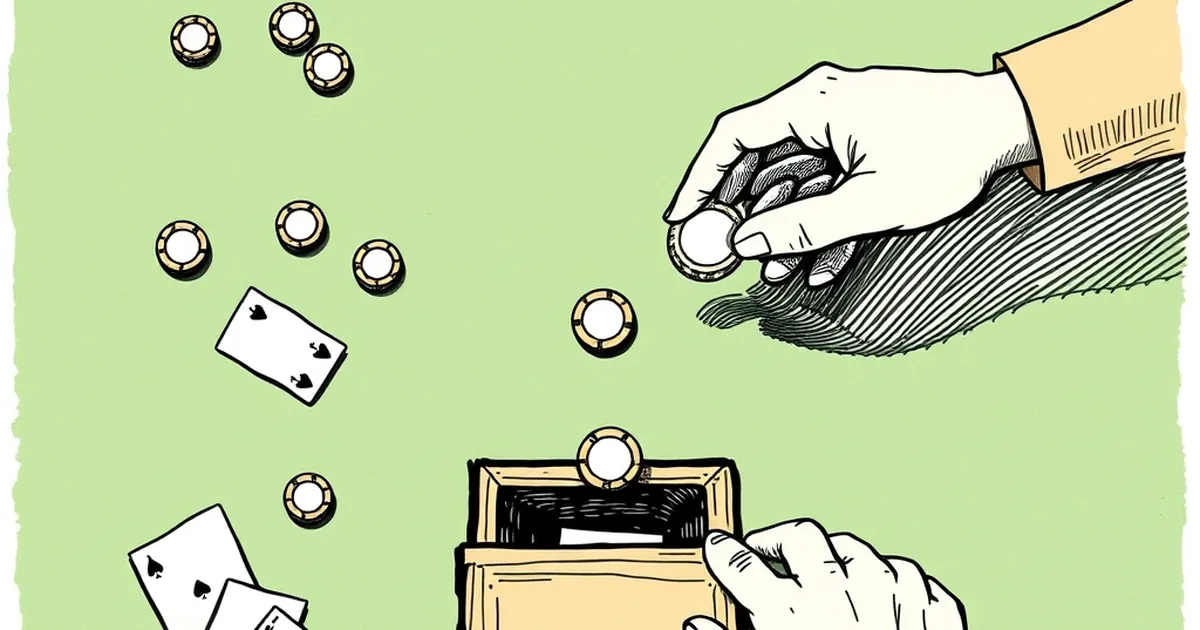
Walk into most $1/$2 no-limit games online and the maximum you can be charged for a single hand is $5, usually reached once the pot hits $100. And in rooms that run a bad-beat jackpot, roughly one percentage point of that rake gets carved off the top and set aside for the fund — a slice most players never see itemized. Those two numbers, $5 and 1%, do more to shape whether you beat the game than the difference between a 2.5% and 3% table average ever will.
The rake cap is the part everyone quotes and the part most players misread. A cap isn't a discount; it's a ceiling that only matters once the pot is big enough to hit it. Below that point you're paying a percentage, and that percentage is where the real cost lives.
What a $5 cap actually costs per hand
The cap only governs the top end. At $1/$2, a room charging 5% capped at $5 reaches the ceiling at a $100 pot. Everything under $100 pays the full 5% with no relief. A $40 pot costs $2, a $60 pot costs $3, and a $99 pot costs $4.95. So the cap is irrelevant in the majority of hands, because most pots at these stakes never reach three figures.
This is why "capped at $5" sounds friendlier than it plays. If your average pot is $35, you are paying closer to 5% per hand than to any capped rate. The cap starts working for you only in the hands where you've already built a pot worth contesting — which is to say, the hands you're most likely to win and therefore the hands where the fee stings least in relative terms but most in absolute dollars.
Compare a 5%-capped-at-$5 structure to a 4.5%-capped-at-$4.50 one. Per hand the gap is pennies. Over 60 hands an hour across four tables, those pennies become a line item. I've seen players obsess over a 0.2% difference in a slot's RTP while ignoring a half-point difference in rake that compounds every single orbit.
The threshold that matters
Find the pot size where the cap engages. At 5% and a $5 cap, it's $100. At 4% and $3, it's $75. At 6.5% and $3, it's about $46. That number tells you more about a room's real cost than the cap or the percentage alone. A generous-looking $5 cap attached to 6.5% rake is worse for small-pot grinders than a $3 cap at 4%, even though the headline number looks better.
Where the 1% goes, and why it isn't free
Bad-beat funds are usually described as a separate contribution, but in practice the money comes out of the same pot. A room might take its regular rake and then route roughly 1% of the pot — or a defined fraction of the rake — into the jackpot pool. Either way, it's value leaving the table that you don't get back unless you're the one who gets dealt the qualifying bad beat.
The math on jackpot equity is unkind. If 1% of every pot flows into a fund that pays out rarely and splits among a table (often 50% to the loser of the bad beat, 25% to the winner, and the rest spread across the table and the room), your expected return on that contribution is a small fraction of what you put in. The fund isn't a savings account; it's a lottery ticket bought with every hand, and the house keeps a cut of the payout too in most structures.
There's a second cost that's easier to miss. Bad-beat promotions change how people play. Players chase hands that qualify, call too much with small pairs hoping to make quads against aces, and slow down when they'd otherwise fold. That's not automatically bad for a sharp player, but it distorts the game you thought you were sitting in. You're no longer playing straightforward $1/$2; you're playing $1/$2 with a side bet baked in.
The rake you never see: time, tournaments, and the cap that isn't
Cash games with a per-hand cap are only one model. Many rooms charge time — a fixed fee per half-hour or per hour regardless of how many hands you play or how big the pots are. Time charges flip the math: at a fast table you pay less per hand, at a slow one more. If a room charges $6 per half-hour and you see 30 hands in that window, that's $0.20 a hand — cheaper than 5% of a $40 pot, which is $2. The same room charging $6 per half-hour at a table where you play 15 hands is $0.40 a hand.
Tournaments hide rake in the buy-in. A $100 + $10 event has 9.1% taken before a card is dealt, and that's before any add-on or re-entry. A $50 + $5 is the same 9.1%. The percentage doesn't move with the stakes, which means low buy-ins carry the same proportional burden as high ones — unlike cash games, where the cap at least gives big pots some relief.
Then there's the cap that isn't really a cap: rooms that apply a "no-flop, no-drop" rule but still collect on any hand that sees a flop, or that charge a smaller capped amount on hands that end preflop. Read the schedule. A $5 cap with a $1 preflop drop is a different game from a true no-flop-no-drop room.
Practical numbers to check before you sit
- Effective rate at your average pot. Divide the rake by the pot. If your average pot is $30 and you're paying $1.50, that's 5%. Compare that to the advertised cap.
- The cap threshold. Pot size at which the cap engages. Lower is better for you.
- Bad-beat contribution. Is it 1% of the pot, a fraction of the rake, or a flat drop? The three are not equivalent.
- Payout split. How much of the fund goes to the table versus the room, and whether the room takes an administrative cut.
- Time versus per-hand. At 60+ hands an hour, per-hand usually wins; at 30, time can be cheaper if the charge is modest.
One more anchor worth holding onto: a 1% bad-beat contribution on a table that plays 70 hands an hour at an average pot of $40 removes about $28 an hour from the table. Split across six players, that's roughly $4.70 each, every hour, win or lose. Over a 20-hour week that's close to $94 per player flowing into a fund most of them will never collect from.
The question the cap raises
If a room advertises a $5 cap and a 1% bad-beat fund, the honest question isn't whether those numbers are fair in isolation — it's what the effective rate is at the pot sizes you actually play. A $5 cap at $100 pots is generous. A $5 cap that only engages on one hand in five is mostly marketing. The players who beat these games aren't the ones who found the lowest headline cap; they're the ones who did the division and picked the room where their average pot, their hand volume, and their tolerance for a side bet all line up. Which raises the real question: if you tracked your own effective rake for a month, would the room you're in now still be the one you'd choose?