Playable balance shows $12; the wagering meter needs $480
A $12 balance beside a $480 wagering meter reflects two different figures, not a broken bonus, and explains why the gap rarely closes
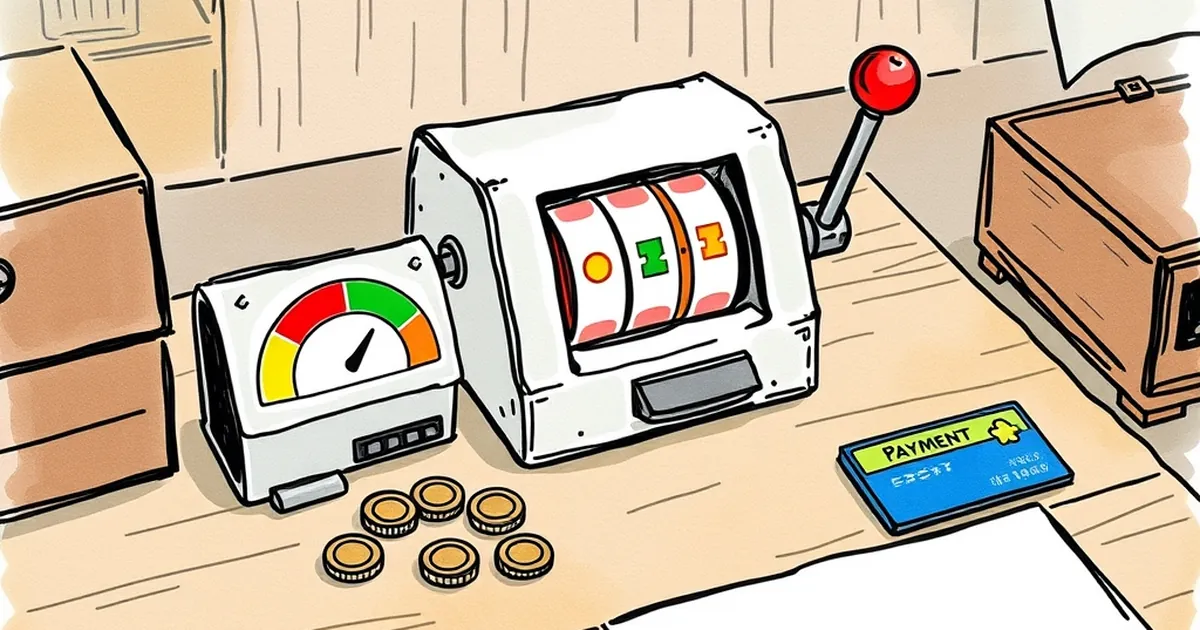
Your balance reads $12. The wagering meter wants $480 more in action before that bonus unlocks. Nothing is broken, nothing is hidden, and no support agent is going to make the number smaller because you asked nicely. This is the ordinary arithmetic of a bonus that was never really worth $12 in the first place.
The two numbers are measuring different things
A playable balance is money you can stake. A wagering meter is a debt you owe in turnover. They sit on the same screen, so players read them as one figure — "I have $12, and I need $480 more" — when in fact they describe different stages of the same transaction.
If you deposited $20 and took a 100% match with a 30x wagering requirement attached to the bonus, you're looking at $20 bonus × 30 = $600 in required turnover. You've already run $120 of it through. The meter shows $480 remaining. That's the whole story.
The part that catches people: the bonus funds are usually locked until you clear it. That $12 might be bonus money you can bet but not withdraw, or it might be a mix of your own cash and bonus cash with different rules attached. Read the balance breakdown before you read the meter. The meter is downstream of the balance, not a companion to it.
Where the multiplier actually lands
Here's where the math stops being obvious. A 30x requirement can mean 30x the bonus, 30x the deposit, or 30x the deposit plus bonus. Same number, wildly different outcomes.
- 30x bonus on a $20 bonus: $600 turnover
- 30x deposit on a $20 deposit: $600 turnover
- 30x (deposit + bonus) on $20 + $20: $1,200 turnover
Two of those look identical at the point of signup and diverge by a factor of two at the point of withdrawal. The terms page states which one applies, usually in a line that reads like boilerplate. It isn't boilerplate. It's the difference between a bonus you might clear in an evening and one you'll abandon by Thursday.
A useful sanity check: divide the remaining meter by your average bet size, then multiply by your average spin or hand duration. If the meter says $480 and you're betting $0.50 a spin, that's 960 spins. At roughly four seconds per spin including the animation, you're looking at about 64 minutes of continuous play — assuming you never bust. You probably will bust, at least partially, because variance doesn't care about your schedule.
Game weighting is the quiet variable
Not every dollar you wager counts as a dollar toward the meter. This is the single most common reason a meter moves slower than expected.
Typical weighting schedules look something like this:
| Game type | Contribution |
|---|---|
| Slots (most) | 100% |
| Video poker | 10–20% |
| Table games (blackjack, roulette) | 5–20% |
| Live dealer | 0–10% |
| Craps, baccarat | Often 0% |
So a $10 blackjack hand at 10% weighting moves the meter by $1. A $1 slot spin at 100% weighting moves it by $1. The slot spin costs you a tenth as much and does the same work. This is not a design flaw from the operator's perspective — it's a deliberate steering mechanism, and it's disclosed, just not loudly.
If your meter has barely moved after an hour of blackjack, check the weighting before you check anything else. There is nothing to dispute. The rule was in the table you scrolled past.
The expected cost of clearing $480
Now the uncomfortable part. What does $480 in turnover actually cost you?
Take a slot with 96.2% RTP. Over $480 in total wagers, the expected loss is $480 × (1 − 0.962) = $18.24. That's the average outcome across a large number of players running the same session. Your individual result will land somewhere between "cleared it and withdrew $40" and "cleared it and have $3 left."
The variance depends on the game. A high-volatility slot with a 96.2% RTP and a 25,000x max win will produce a much wider spread of outcomes over 960 spins than a low-volatility game with the same RTP. The expected cost is identical. The experience is not.
Run the same numbers on a 94.5% RTP slot and the expected cost over $480 is $26.40 — nearly 45% more expensive for a game that looks almost the same on the lobby tile. RTP differences of 1.7 percentage points sound trivial until you multiply them by your turnover requirement.
This is why bonus value should be judged after the wagering math, not before. A $20 bonus with a 30x requirement on a 96% game has an expected net value of roughly $1.76 if you clear it perfectly — before you account for the fact that most players don't clear it perfectly, and a meaningful share bust out entirely.
When walking away is the correct play
There's no penalty for abandoning a bonus, but there are usually conditions. Some operators void the bonus and any winnings derived from it if you withdraw before clearing. Others let you forfeit the bonus and keep your deposit. Others lock the whole balance until the meter hits zero.
The decision rule is straightforward. Estimate your remaining expected loss to clear the meter. Compare it to the withdrawable value you'd hold afterward. If the meter needs $480 and your expected loss is $18, but clearing it unlocks only $12 in withdrawable funds, you're paying $18 for $12. Forfeit the bonus, keep your deposit, and move on.
The counterargument — that you might run hot and clear it for far less than the expected cost — is real. Variance cuts both ways. But "I might get lucky" is a reason to play, not a reason to treat a negative-expected-value task as a positive one.
The number that should be on the screen
Some jurisdictions now require operators to display bonus terms in a standardized format, and a few have pushed for a "bonus value" figure that nets out the wagering requirement. As of early 2025, that's still the exception rather than the rule. Most meters show you the distance to the finish line without showing you the toll.
Which raises the question worth asking: if the meter showed the expected cost alongside the remaining turnover — "$480 to go, estimated cost $18" — how many players would still start? And how many operators would change the multipliers they advertise if they had to?