Payouts clear in 2 hours; the tax form takes 47 days
Online casino payouts now clear in hours, yet tax forms still take 47 days, exposing a structural gap between fast payment rails and slow paperwork
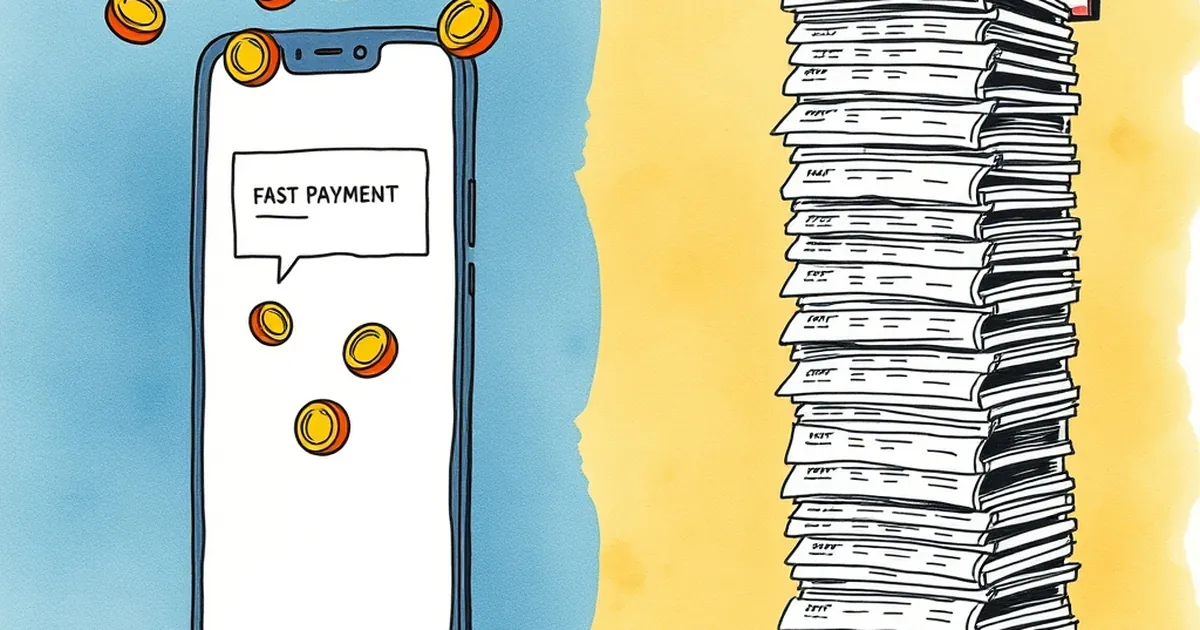
A player in Ontario can request a CAD 4,000 withdrawal on a Monday morning and see it land in their bank account before lunch. The same player will wait until late March — 47 days, if the calendar falls that way — for the slip that says the winnings are taxable in the United States but not in Canada. The money moves at fintech speed. The paperwork moves at fax-machine speed, and almost nobody in the industry wants to talk about the gap.
This isn't a complaint about slow support tickets. It's a structural mismatch. Payment rails have been rebuilt over the past decade by companies whose entire business model depends on speed: instant e-transfers, open banking APIs, crypto off-ramps, card networks that settle in seconds. Tax reporting, meanwhile, is governed by national revenue agencies that still treat gambling winnings as an edge case, a grey zone, or a line item to be sorted out by the player alone. The result is a weird split-screen experience that gets worse the more you win.
Why the payout side got fast
The shift started with regulation, not generosity. When the UK Gambling Commission tightened its licensing conditions in 2020, operators faced a choice: process withdrawals in a reasonable window or explain to the regulator why a customer's funds sat in limbo. Most chose speed. The same pressure arrived in other markets through different doors — the Netherlands' licensing regime in 2021, Ontario's launch in April 2022, Brazil's regulated rollout in 2025.
Speed also became a competitive weapon once the technology caught up. A payout that clears in two hours is a marketing asset. A payout that takes five business days is a churn event. Operators know the number: a player who waits more than 72 hours for a withdrawal is measurably less likely to deposit again, which is why the biggest brands now advertise same-day processing the way banks advertise mortgage rates.
The mechanics are unglamorous. A card withdrawal can't actually be reversed into a card faster than the card network allows, so operators route around it — e-wallets, bank transfers via open banking, or stablecoin payouts in jurisdictions that permit them. In practice, the "two-hour" claim usually means two hours after the operator's own risk review, which is a separate clock. That review can take a day on its own if a player's account trips an anti-money-laundering flag.
The fine print nobody reads
Read the withdrawal terms on any licensed site and you'll find a distinction between processing time and settlement time. Processing is the operator's job. Settlement is the bank's. When a site says "instant," it usually means the first half. The second half is why two players on the same platform can have wildly different experiences — one gets the money in 90 minutes, the other waits until Thursday because their bank batches transfers.
Why the tax side stayed slow
Gambling tax treatment is a patchwork, and the patchwork is the problem. In the United States, winnings are taxable income from the first dollar, reported on a W-2G for certain thresholds — USD 1,200 for slots and bingo, USD 600 for poker tournaments and horse racing when the payout is at least 300 times the wager. In Canada, lottery and casino winnings are generally not taxable, but a Canadian who wins in Las Vegas owes the IRS, and the 30% withholding can be reclaimed only by filing a US return and waiting for a refund.
That refund is where the 47 days lives. The IRS publishes no guaranteed timeline for processing a nonresident return claiming a treaty-based exemption. In practice, players report waits ranging from six weeks to six months, depending on whether the return is filed on paper, whether a taxpayer identification number is already on file, and whether the claim triggers manual review. A Canadian filing in early February for the previous year's winnings might see the refund in late March. Miss a document and the clock restarts.
The asymmetry is stark. The casino knows the win instantly — it's in the system before the player leaves the table. The withholding is deducted instantly. But the path back to the player runs through a filing system designed for annual, not transactional, reporting. Nobody at the casino can speed it up. Nobody at the payment processor touches it. The player is alone with a form.
When the operator becomes a tax intermediary
Some jurisdictions push the problem onto operators. Italy requires licensees to withhold on winnings above a threshold. Germany taxes certain operators directly. The UK doesn't tax player winnings at all, which is why British players are often baffled by the paperwork they encounter on a US-facing site. Each regime adds a layer, and each layer adds a delay that no amount of faster payment technology can fix.
What the gap actually costs
The cost isn't just time. It's the friction of managing two systems that don't talk to each other. A player who wins EUR 8,000 on a Malta-licensed site while resident in a country that taxes gambling income has to reconcile a foreign payout, a currency conversion, and a reporting obligation using documents that arrive weeks apart. Accountants charge by the hour. The effective tax rate on a mid-sized win can climb well above the headline rate once compliance costs are counted.
There's also a behavioural cost that operators quietly track. Players who've had a bad tax experience after a big win are less likely to withdraw large amounts in future. Some leave the balance in the account and keep playing, which is good for the operator and bad for the player. That's the uncomfortable part of this story: the slow tax side doesn't just annoy winners, it nudges them toward behaviour that benefits the house.
Responsible gambling advocates have flagged this for years. The advice is straightforward — set withdrawal limits, take the money out, deal with the paperwork — but the paperwork is exactly what makes the advice hard to follow. A system that punishes you for cashing out is a system that encourages you not to.
The crypto workaround, and its own paperwork
Stablecoin payouts have become the default answer for players who want to skip the banking layer entirely. A USDT withdrawal can settle in minutes on a low-fee chain, and the operator's obligations end when the transaction confirms. But the tax side doesn't disappear; it just moves. Many jurisdictions treat crypto received as gambling winnings at fair market value on the date of receipt, which means the player now has two reporting problems: the win and the subsequent disposal of the asset. The 47 days can stretch into a second tax year.
The question nobody has answered
Payment infrastructure improved because someone with money on the line demanded it — regulators, competitors, and players who voted with their deposits. Tax reporting hasn't improved because nobody with leverage has demanded it. Revenue agencies don't compete for customers. Operators have no incentive to volunteer for more withholding. Players, individually, have no bargaining power.
So the two-hour payout and the 47-day form will coexist until something forces them apart. The likeliest candidate is cross-border data sharing: if tax authorities can see a win the moment it's recorded, the filing burden shifts from the player to the platform. Some countries are already moving that direction. The question is whether the shift arrives before or after a generation of players decides that winning big isn't worth the paperwork — and what operators do when their best customers start believing that.