Odds boosters expire at kickoff; the stake stays locked 5 days
Odds boosts last until kickoff, but your stake stays locked for five days, revealing how the real cost of an enhanced price is buried in the terms
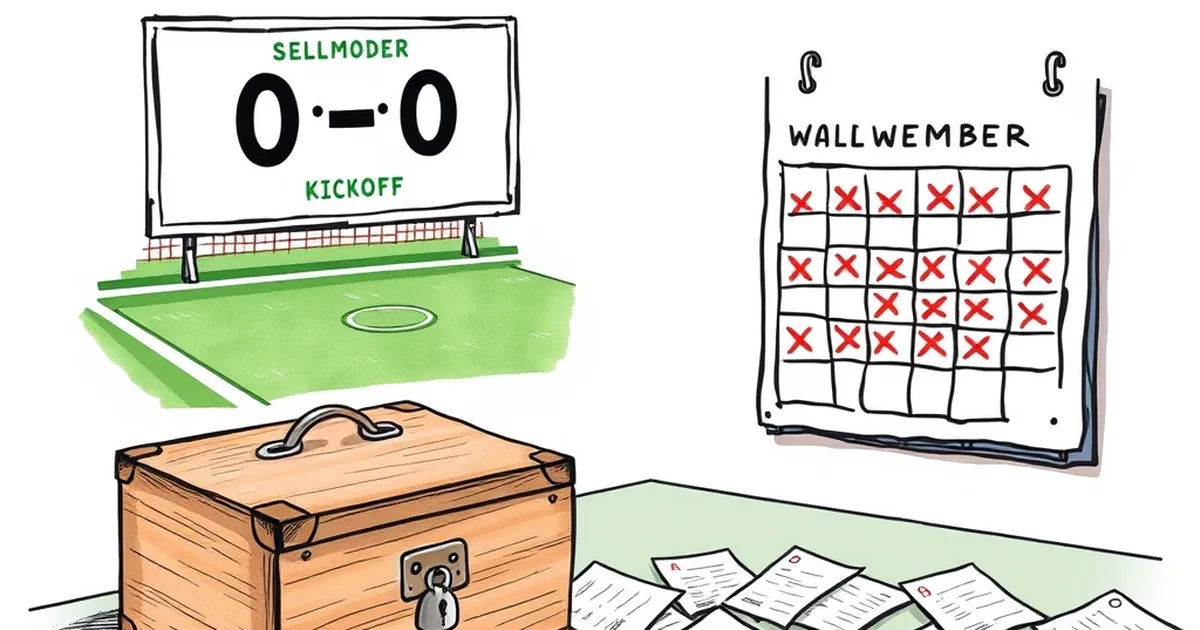
A standard "odds boost" on a football match looks like free money until you read the terms: the enhanced price is valid until kickoff, but if you use it, your stake is typically frozen for five days afterward. That gap — a few hours of boosted odds against 120 hours of locked capital — is the actual product being sold, and it's worth understanding before you treat the boost as a straight upgrade on your usual bet.
The mechanism isn't hidden, exactly. It's just buried in a terms sheet most people scroll past. Here's what's actually happening, why bookmakers structure it this way, and what it costs you if you're running more than one or two bets a week.
What "stake locked" actually means
A normal pre-match single settles in a few hours. You back a 3pm kickoff, the match ends around 4:50pm, and by evening your balance reflects the result. The money is either gone or back in your account, free to redeploy.
A boosted bet often isn't. The promotion terms state that the boosted stake is held for a fixed period — five days is the common figure, though I've seen seven and I've seen 72 hours — during which it can't be withdrawn, and in some cases can't even be used to place another bet. It sits there, visible, unusable.
This matters most for anyone who treats a betting balance as working capital rather than a one-off entertainment spend. If you place six boosted bets across a weekend and each locks its stake for five days, you've parked a meaningful chunk of your bankroll until the following Thursday or Friday — through a full midweek card you can't touch.
The boost itself is usually modest. A typical football enhancement moves a price from, say, 2.10 to 2.30, or a two-way market from 1.85 to 1.95. On a $50 stake, that's an extra $10 or $5 in potential return. Against five days of locked capital, the trade is less obviously favourable than the headline number suggests.
The maths of a five-day lock
Run the numbers on a simple case. You stake $100 at boosted odds of 2.30 instead of the standard 2.10. If it wins, you collect $230 rather than $210 — a $20 improvement. If it loses, you lose $100 either way, but in the losing scenario the lock is irrelevant because the money's gone.
So the boost only pays off on winners, and only by the margin of the enhancement. Meanwhile the $100 is frozen for five days regardless of outcome — on a losing bet the stake is gone anyway, but on a winning one you wait until day five to see it.
Now scale it. Ten boosted bets at $100 each across a week, with a realistic 50% strike rate, means five winners. Each of those five winning stakes is locked for five days. That's $500 unavailable for most of the week, in exchange for roughly $100 in aggregate enhancement across the five winners — assuming the boosts are all at the generous end.
The comparison that actually matters is against not using the boost at all. If you'd placed those same bets at standard odds with no lock, you'd have $500 more liquidity and $100 less expected return. Whether that's a good trade depends entirely on how much you value having the money available — which is a personal question, not a mathematical one.
Why bookmakers structure it this way
The lock serves two purposes, and neither is primarily about the odds themselves.
First, it discourages arbitrage and matched betting. If you're backing the boosted side and laying it off on an exchange, the lock breaks your cycle. You can't recycle the same capital through multiple boosts in a week if each one holds the stake for five days. The promotion becomes far less attractive to anyone treating it as a systematic edge rather than a punt.
Second, it keeps money on the book. A locked stake is a liability the operator controls, and it reduces the chance you withdraw and move to a competitor midweek. It's a retention mechanic dressed as a pricing mechanic, which is fine — that's the business — but it's worth naming.
There's a third, quieter effect: locks interact badly with bonus terms. If you're clearing a wagering requirement and a chunk of your balance is locked, your effective staking capacity drops. On a 35x rollover against a $200 bonus, you need $7,000 in qualifying turnover. Locked stakes don't contribute to that turnover while they're frozen, so the clock on the bonus keeps running while your usable balance doesn't.
Timing traps around kickoff
The "expires at kickoff" half of the deal creates its own problems.
Boosts usually appear 24 to 48 hours before a match and vanish at the whistle. That window pushes people toward early decisions on lineups they don't have — a striker's fitness, a manager's rotation, weather. Standard odds stay live until kickoff and often move with the news. A boost that expires at 3pm forces you to commit at 11am, before the team sheet drops at 2pm.
That's a real cost, and it's rarely priced in. If the player you're backing gets rested, you've locked a worse bet and a five-day stake freeze. Two penalties for one decision.
There's also a stacking problem. Many operators limit you to one active boosted bet at a time, or one per market. If you've already got a locked stake from Saturday, a Sunday boost may be unavailable — or available but with the lock period running concurrently rather than resetting, which is better but still means two frozen stakes at once.
Check whether the lock applies per bet or per account. It's usually per bet, which is the worse version for anyone running volume.
What to check before you take one
Four things, in order:
The lock length and whether it's the stake or the whole return. Some terms lock only the stake; others hold the full potential payout. The second is materially worse.
Whether locked funds count toward wagering. If you're clearing a bonus, this determines whether the lock costs you time or just liquidity.
The expiry time, in your timezone. "Kickoff" is unambiguous, but operators display times in account-local settings that don't always match your actual location.
The enhancement size relative to your normal stake. A 5% price bump on a $10 bet is 50 cents. On a $500 bet it's $25, and the five-day lock on $500 is a genuine cost. The boost scales with stake; so does the lock.
None of this makes odds boosts bad. For a casual bettor placing one or two bets a month, a five-day lock is close to irrelevant — the money wasn't going anywhere anyway. The problem is that boosts are marketed as universally good, and they're not: they're a trade of liquidity for a small expected-value bump, and the exchange rate gets worse the more active you are.
The open question is whether operators will ever price the lock honestly — offer a slightly smaller boost with no freeze, say, and let customers choose. So far almost none do. That tells you something about which side of the trade they think is more valuable.