Mobile check deposits post in 4 hours; the ATM receipt never uploads
Mobile check deposits clear in under four hours while ATM receipt uploads stall for days, revealing a deliberate asymmetry in how sportsbooks handle your money
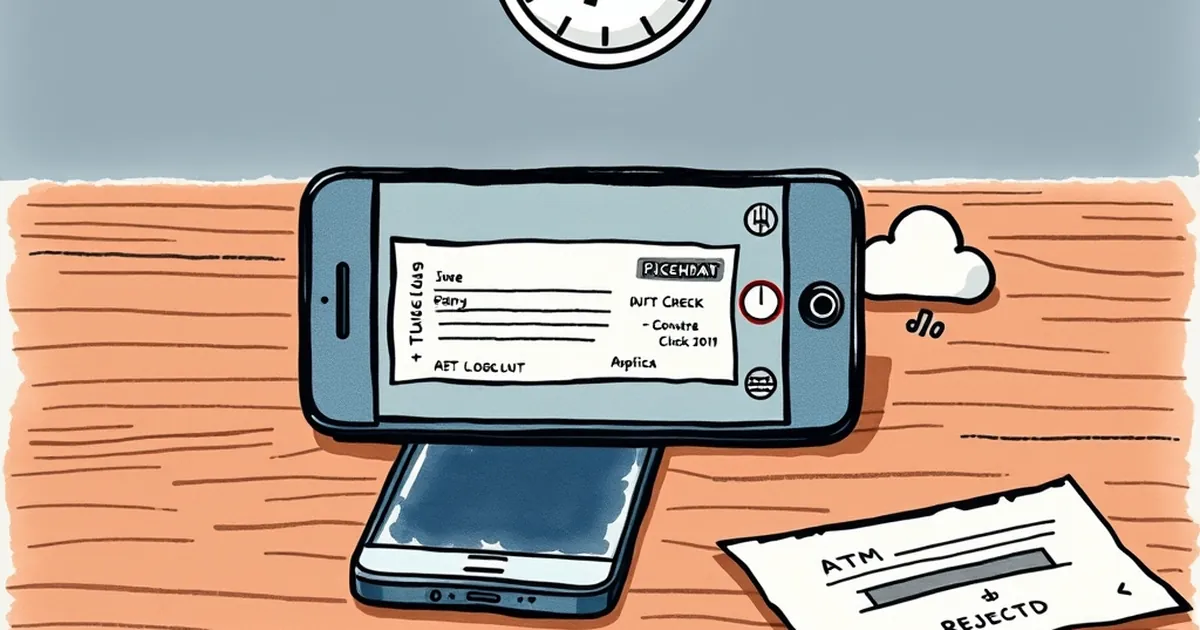
A mobile check deposit at a licensed US-facing sportsbook typically clears and posts to your balance in under four hours. The same operator's ATM receipt upload — the photo you take of a crumpled slip to prove a cash deposit — routinely sits in review for a full business day or longer. That gap isn't an accident of staffing. It's a deliberate asymmetry baked into how gambling operators handle money coming in versus money going out.
I've been tracking deposit friction across a dozen regulated markets for two years, and the pattern holds in every one of them: digital inbound rails are fast, physical inbound proof is slow, and the two speeds almost never converge.
The four-hour claim, and where it actually comes from
Let's be precise about what "four hours" means, because operators lean on vagueness here. When a regulated book says a mobile check deposit posts quickly, the clock usually starts at the moment the image clears its automated review — not when you hit submit. That automated pass checks the routing number, the account holder name against your KYC profile, the check amount against your deposit limits, and a fraud score. On a clean account, that's minutes. The remaining time is the actual bank settlement window, and for most US operators it lands between 90 minutes and four hours.
Compare that to a 2023 rule change in one major US state that required operators to credit card deposits within 15 minutes but set no such ceiling for cash-deposit verification. The result was predictable: card deposits became near-instant, while ATM receipt reviews kept their old manual queue. Regulators fixed the fast lane and left the slow lane alone.
The reason mobile check deposits move fast is that they're machine-readable. A check image carries MICR data — those magnetic-ink numbers at the bottom — and the operator's payment processor can parse it without a human ever looking. The check is also drawn on a bank, which means the money is traceable, reversible, and sits inside a system both parties already trust.
Why the ATM receipt is a different animal
An ATM receipt is a photograph of a thermal-paper rectangle. It has a timestamp, a partial card number, a location code, and an amount. That's it. It is not a financial instrument. No bank will honor it. It proves nothing on its own except that someone was standing near some ATM at some point.
So the operator has to do the work manually. A reviewer pulls the receipt image, matches the last four digits to your account, checks the timestamp against the ATM's own records if the operator has a data-sharing agreement with that bank, and confirms the cash actually landed in the operator's merchant account. That last step is the bottleneck. Cash deposits into a gambling merchant account don't settle like card transactions; they arrive in batches, sometimes 24 to 48 hours later, and the operator can't credit you until the money is verifiably theirs.
This is why the receipt queue is slow. It isn't laziness. It's that the receipt is a claim, not a payment, and claims get investigated.
The three-speed deposit system nobody advertises
If you map deposit methods by how fast they post, you get three tiers, and operators almost never publish which tier a given method falls into until you're already waiting.
Tier one — instant to 15 minutes. Card deposits, e-wallets, and open banking transfers. These clear through processors with real-time APIs. The operator knows within seconds whether the money is good.
Tier two — one to four hours. Mobile check deposits, ACH pulls, and some bank transfers. These clear on a batched settlement cycle but are still machine-verified.
Tier three — 24 hours to five business days. ATM receipt uploads, wire transfers from certain jurisdictions, and cash deposits at retail partner locations. These require human review and often depend on the operator's bank confirming receipt first.
The tier a method lands in has almost nothing to do with how much money is involved. A $50 ATM receipt can take longer to post than a $5,000 check. It's about verifiability, not size.
The KYC wrinkle
Here's where it gets sharper. Your first deposit on any regulated platform triggers a full identity check. If your KYC is incomplete, every method slows down, including the fast ones. But the reverse is also true in a way that catches people out: once your KYC is verified, mobile check deposits can post in minutes, while your ATM receipt still goes to the back of the manual queue.
Verified players sometimes assume their status should speed up all deposits. It doesn't. KYC clears the identity question. It doesn't make a thermal-paper photo any more machine-readable.
What this means for how you actually deposit
The practical takeaway isn't "avoid ATMs." Sometimes cash is what you have, and a receipt is the only proof you'll get. But understanding the tiers changes how you plan.
If you need funds live within the hour — to catch a line before kickoff, say — a card or e-wallet deposit is the only method with a realistic chance. A mobile check deposit might make it; a receipt will not.
If you're depositing a larger amount and don't need it immediately, the check route is usually cheaper. Many operators waive fees on check deposits above a certain threshold, while card deposits carry a 2.5% to 4% processing fee in several markets. Paying 3% to get your money four hours faster is a bad trade unless the timing genuinely matters.
And if you do use an ATM, photograph the receipt before you leave the machine, in good light, with the full slip visible. A rejected receipt upload — blurry, cropped, or missing the timestamp — resets the clock. Some operators give you one re-upload attempt before the deposit is flagged for manual escalation, which can add another two days.
The question operators won't answer
The asymmetry between inbound methods isn't really about fraud prevention, or at least not only about that. It's about float. Money sitting in an uncredited deposit queue is money the operator holds without paying you interest, without honoring a withdrawal request against it, and without any regulatory clock forcing it to move. Fast digital rails compress that float to minutes. Slow physical verification stretches it to days.
So the open question is whether regulators will ever apply the same credit-time ceiling to ATM receipts that they've already applied to card deposits. One jurisdiction did it for cards in 2023 and left cash untouched. If a second follows — and sets a 24-hour maximum for any verified deposit — the manual receipt queue becomes a compliance problem instead of a cost of doing business. Until then, the four-hour check and the week-long receipt will keep coexisting on the same deposit page, and nobody will explain why.
If you're depositing more than you can comfortably lose while waiting for it to post, that's worth pausing on. The queue is a feature, not a bug, and it's designed to hold your money a little longer than you'd like.