Micro-invest round-ups average $4.80 but feel like $40
Micro-invest round-ups average just $4.80 yet feel like $40 decisions, revealing how payment design quietly shapes everyday spending behavior
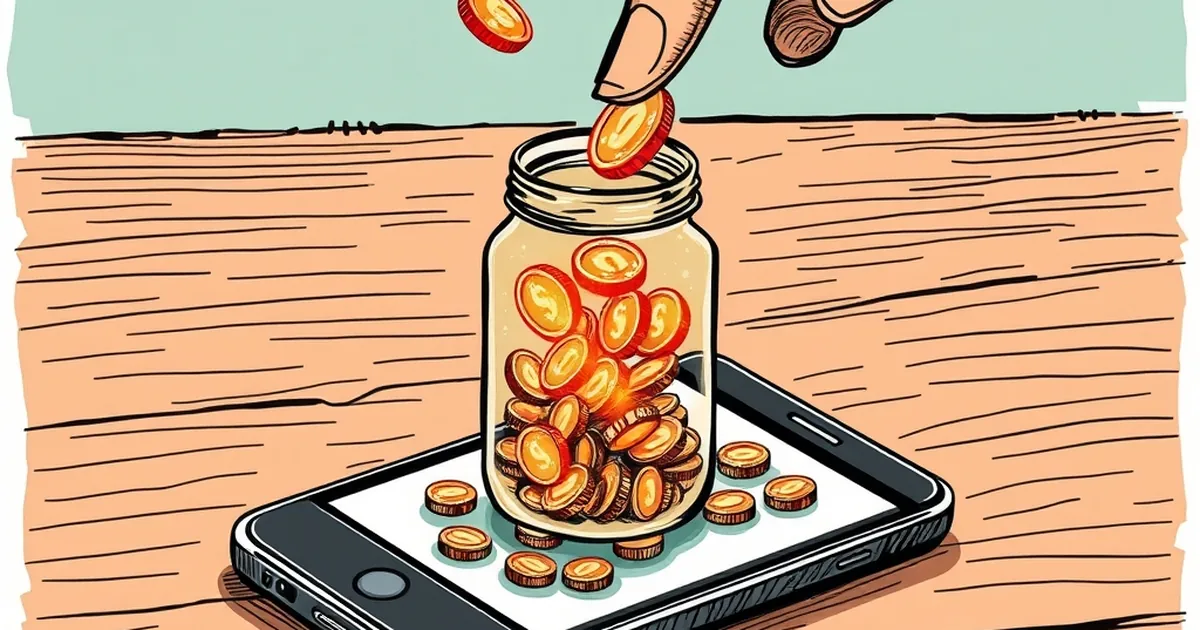
Why does a $4.80 round-up feel like a $40 decision? The number is small enough to ignore and psychologically large enough to matter, and that gap is where some of the most interesting work in consumer finance is happening right now. If you have ever hesitated over a round-up toggle — or tapped it without thinking — you have already participated in an experiment about how payment design shapes behavior.
The rounding trick your brain plays on you
Classic mental accounting, the term Richard Thaler developed across decades of behavioral economics research, says we sort money into separate buckets rather than treating it as fungible. A round-up does something clever inside that system: it converts a purchase you have already justified into a second, tiny transaction that feels like tidying up rather than spending.
Consider the arithmetic. You buy coffee for $3.20. The app rounds to $4.00 and moves $0.80 into an investment account. Multiply that across a month of ordinary card use and you land near the $4.80 average that round-up providers commonly report per active user per week — a figure that varies by country, card mix, and how aggressively the feature is surfaced at checkout. Four dollars and eighty cents is less than a sandwich in most cities. Yet surveys of round-up users consistently show they feel like they are saving far more, often estimating their contributions at several times the real amount.
That perceptual multiplier is not a bug. It is the product.
Why the felt value runs so far ahead of the ledger
Three forces stack on top of each other.
Loss aversion, inverted. Kahneman and Tversky showed that losses hurt roughly twice as much as equivalent gains feel good. Round-ups sidestep the pain entirely because the money never sits in your checking balance long enough to be missed. You do not experience a loss, so there is no loss to weigh against the gain. The whole transaction registers as pure upside.
Variable-ratio reinforcement. B.F. Skinner's work on intermittent reward schedules found that unpredictable payoffs produce the most persistent behavior — more persistent than predictable ones. Investment returns are inherently variable, and round-up balances compound that variability because the contribution amounts themselves fluctuate with your spending. Some weeks you round up $2, some weeks $11. You cannot predict the number, and that unpredictability keeps the feature engaging in a way a fixed $25 monthly transfer never quite manages.
The completion instinct. Rounding to a whole dollar closes a loop. Behavioral researchers studying goal completion have repeatedly found that unfinished units create low-grade tension, and closing them delivers a small, reliable hit of satisfaction. Your statement shows $3.20; the app makes it $4.00; something in you relaxes. You paid $0.80 for that relaxation, and it was a bargain.
The $40 feeling, examined
Where does the inflated sense of value come from? Partly from narrative. Micro-investing apps are extraordinarily good at showing you a number that grows. A balance that ticks from $312 to $318 overnight reads as momentum, and momentum is emotionally louder than magnitude.
There is a concrete illustration worth knowing. Researchers studying prize-linked savings products — where deposits earn entries into a periodic cash draw instead of (or alongside) interest — found that participation rose sharply among people who had never maintained a savings habit, even when the expected financial return was lower than a plain savings account. The draw was not the point. The feeling of participation was. Round-ups work on the same lever: they make an abstract activity (investing) feel like a concrete, recurring event with a visible scoreboard.
Payment networks have quietly built the plumbing for this. Card rails now support transaction-level enrichment, which means an issuer or fintech can attach a round-up instruction to a specific authorization in real time rather than batching it overnight. That technical detail matters more than it sounds. Instant round-ups feel like a reflex; batched ones feel like a bill. The same $4.80 lands completely differently depending on whether it leaves your account in 200 milliseconds or on the first of next month.
The risk side nobody puts on the splash screen
Here is where the psychology cuts the other way, and it deserves more attention than it usually gets.
Round-ups are marketed as frictionless saving. But frictionless entry into markets is still entry into markets. A user who has never thought about asset allocation, expense ratios, or drawdown risk is now holding a portfolio, however small, and the interface has spent months training them to associate investing with pleasant, painless, sub-dollar increments. That association does not survive a 20% market decline intact.
There is also a subtler issue: the round-up can function as a permission slip. Spending $3.20 and investing $0.80 feels responsible, and that feeling of responsibility can license spending you would otherwise have questioned. Behavioral economists call this moral licensing, and it shows up wherever a good deed is bundled with an indulgent one. The feature is not neutral. It changes the calculus of the purchase it is attached to.
What the design gets right, and what it should borrow next
The genuinely impressive thing about round-ups is that they solved a real behavioral problem: the activation energy of starting. Asking someone to open a brokerage account and transfer $500 is asking them to make a decision under uncertainty with a meaningful stake. Asking them to round up their coffee is asking them to make a decision with no perceived stake at all. The second request gets a yes from people the first request never reaches.
The next generation of these products is likely to borrow from a different branch of decision science: precommitment. Rather than letting the round-up multiplier float, users could set a rule — "round up by 2x, but never more than $15 in a week" — and let the constraint do the deciding. Automatic escalation, where the round-up amount steps up after a balance threshold is crossed, is another obvious move, and a few providers already run it. These are Ulysses contracts, and they work precisely because they move the decision to a moment when you are calm and informed rather than a moment when you are standing at a register.
There is also room for honest disclosure design. If a user's round-up balance is $4.80 a week, the app could show what that becomes in ten years at a stated, conservative return — and, just as prominently, what it becomes in a bad ten years. The variable-ratio loop that makes the feature sticky is the same loop that makes it easy to oversell.
Where this leaves the payment stack
The interesting frontier is not the round-up itself. It is the idea that a payment authorization can carry a behavioral instruction alongside its financial one — invest this, save this, offset this — and that the instruction can be tuned to the person rather than the product. Card networks are already experimenting with merchant-level and category-level controls; the natural extension is user-level behavioral parameters that travel with the card.
If that happens, the round-up stops being a feature and becomes a primitive. And the $4.80-that-feels-like-$40 gap stops being a marketing quirk and starts being a design parameter that issuers, fintechs, and regulators all have to reason about explicitly. The question worth asking now is not whether micro-investing works. It clearly does, for activation. The question is what happens when the same psychological machinery is pointed at larger sums — and whether the industry builds the guardrails before or after it finds out.