Loss aversion flips at $20: small fees feel like theft
Why a $20 card fee feels like theft while a $200 interest charge goes unnoticed, and what that $20 threshold reveals about how we judge fees
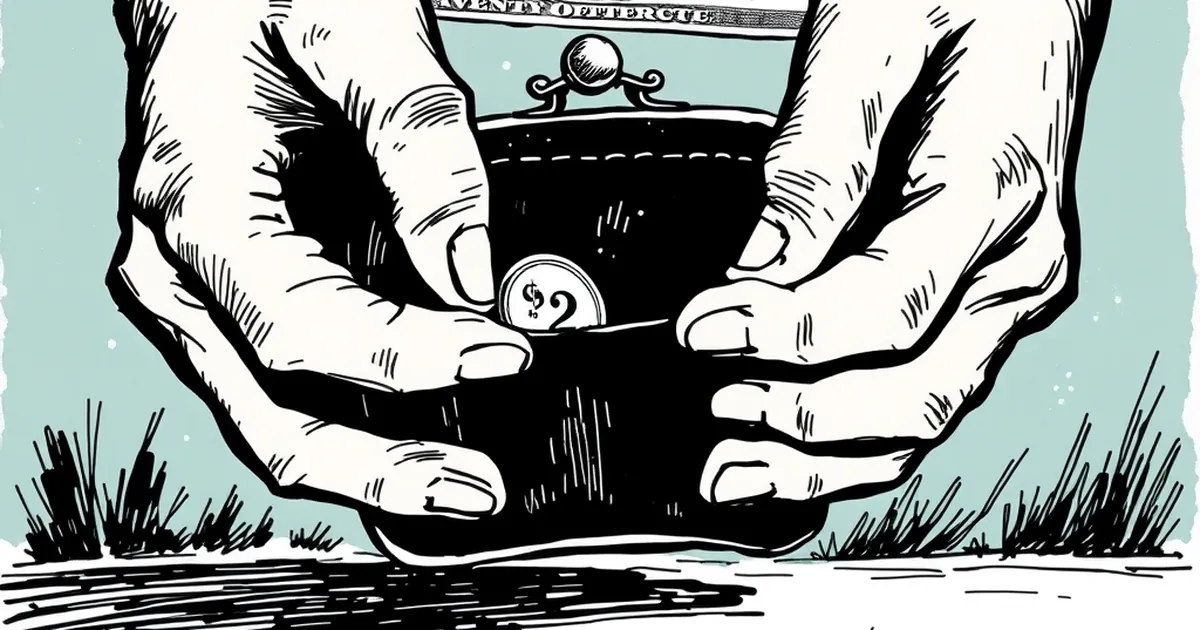
Why does a $20 annual card fee feel more outrageous than a $200 interest charge you barely notice? The amount is trivial; the reaction isn't. Somewhere around the price of a takeaway lunch, our brains stop doing arithmetic and start doing moral judgment — and payments is one of the few industries where that switch gets flipped dozens of times a month.
The $20 Threshold: Where a Fee Becomes an Insult
Kahneman and Tversky's prospect theory gave us the foundational asymmetry: losses loom roughly twice as large as equivalent gains. But the part that matters for payments is subtler. The pain of a loss isn't proportional to its size — it's filtered through a question of legitimacy. A charge we expected and understood slides past. A charge that appears without a story attached registers as a small violation, and violations have a floor price.
Twenty dollars is a useful marker because it sits near a cultural fault line. It's roughly the cost of a streaming subscription, a couple of coffees, a cheap phone case. It's an amount most cardholders in developed markets can absorb without any change to their lives. And yet it's also large enough to be noticed — large enough that a line item on a statement prompts a squint and a "wait, what's this?"
Below that line, fees get absorbed into the noise. Above it, they get audited. Right at it, they get resented.
The Ratio Does More Work Than the Number
Here's where behavioral economics earns its keep. People don't evaluate fees in absolute terms; they evaluate them against a reference point, and the reference point is usually whatever they think the service "should" cost.
A $20 fee on an account with a $400 average balance reads as a 5% charge. A $20 fee on the same account with a $4,000 balance reads as half a percent. Same twenty dollars, radically different emotional weight — because the second one is clearly a rounding error and the first one is clearly a tax on being small.
This is why flat fees are so politically combustible. They're regressive by design: the customer with the least money pays the highest effective rate, and feels it most sharply. The bank sees a fixed cost recovery. The customer sees a percentage of their own liquidity being skimmed, and the ratio does the emotional math before the rational brain gets a word in.
Loss aversion amplifies this. The $20 isn't just $20 gone; it's $20 that the customer now has to mentally re-earn, and the mental ledger records it as a loss against a reference point of "I had this money and it was mine." The ratio tells them whether that loss was fair. The amount tells them whether it was worth fighting about.
Why Small Fees Trigger Disproportionate Action
If you've ever watched a customer spend forty minutes on hold to contest a $12 charge, you've watched loss aversion in a suit.
There are three forces stacking here.
First, the fee is legible. Interest charges are actuarial fog. Annual percentage rates, compounding, statement cycles — most people can't reconstruct their interest charge from first principles, so they don't try. A flat fee is a single number on a single line. Legibility invites scrutiny.
Second, the fee feels extractive rather than earned. Interest is the price of borrowing money, and everyone understands that transaction at some level. A fee for having an account or receiving a statement or not maintaining a balance has no obvious counterpart. It reads as a toll on inertia. Researchers studying consumer responses to bank fees have consistently found that fees framed as penalties for inaction generate far more anger than fees framed as payment for a service — even when the amounts are identical.
Third, small amounts are cheap to litigate. Nobody disputes a $340 interest charge in a phone queue, because the expected value of winning doesn't cover the time. But a $20 fee is small enough that the principle dominates the arithmetic. The customer isn't optimizing for money anymore; they're optimizing for fairness. And fairness has no price ceiling.
This is the flip. Above a certain size, people behave like economists. Below it, they behave like moral philosophers.
The Design Problem Nobody Talks About
For anyone building payment products, this creates a genuinely awkward constraint.
Fee structures are usually designed for cost recovery and risk management. Behavioral responses are usually designed by nobody — they emerge. And the two don't line up. A fee that's perfectly rational on a spreadsheet can be catastrophic on a customer's emotional ledger, because it lands in the zone where the amount is small but the ratio is ugly and the framing is extractive.
The practical implication is that how a fee is presented often matters more than how much it is. A few patterns that consistently soften the blow:
- Bundle rather than itemize. A single monthly account price that covers everything reads as a subscription. The same total split into four line items reads as a series of small thefts.
- Name the service, not the penalty. "Account maintenance" sounds like a toll. "Includes fraud monitoring and instant replacement" sounds like a purchase.
- Give the customer a path. Fees that can be waived by an action the customer controls — a direct deposit, a balance threshold — convert a loss into a choice. Choice defuses loss aversion almost entirely.
- Front-load disclosure. A fee the customer expected is a cost. A fee that appears is a betrayal. The amount is identical; the neuroscience isn't.
None of this is about hiding charges. It's about recognizing that a $20 line item is processed by a different part of the brain than a $200 one, and designing accordingly.
What to Watch Next
The interesting frontier is that payment rails are getting faster and more transparent, which cuts both ways. Real-time settlement means customers see charges the moment they happen — no monthly statement to soften the blow through aggregation. That's likely to make small fees more salient, not less, because each one arrives as an individual event rather than a line in a total.
At the same time, subscription-style bundling is becoming the default mental model for recurring payments. Customers increasingly expect a single predictable number rather than a menu. Products that cling to itemized micro-fees are going to keep generating the same disproportionate backlash — not because the fees are large, but because they're legible, they're framed as penalties, and they land right at the $20 line where the ratio starts to sting.
The forward-looking question for anyone in payments isn't "how do we reduce fees." It's "which of our fees are structured so that a rational customer would feel cheated by them, even though the math is fine?" Those are the ones that generate the calls, the churn, the chargebacks, and the Reddit threads. And they're usually the small ones.