Logging in takes 2 taps; recovering a locked account takes 9
The hidden cost of fast logins in online gambling: why a nine-step account recovery path shapes player behaviour more than any bonus term
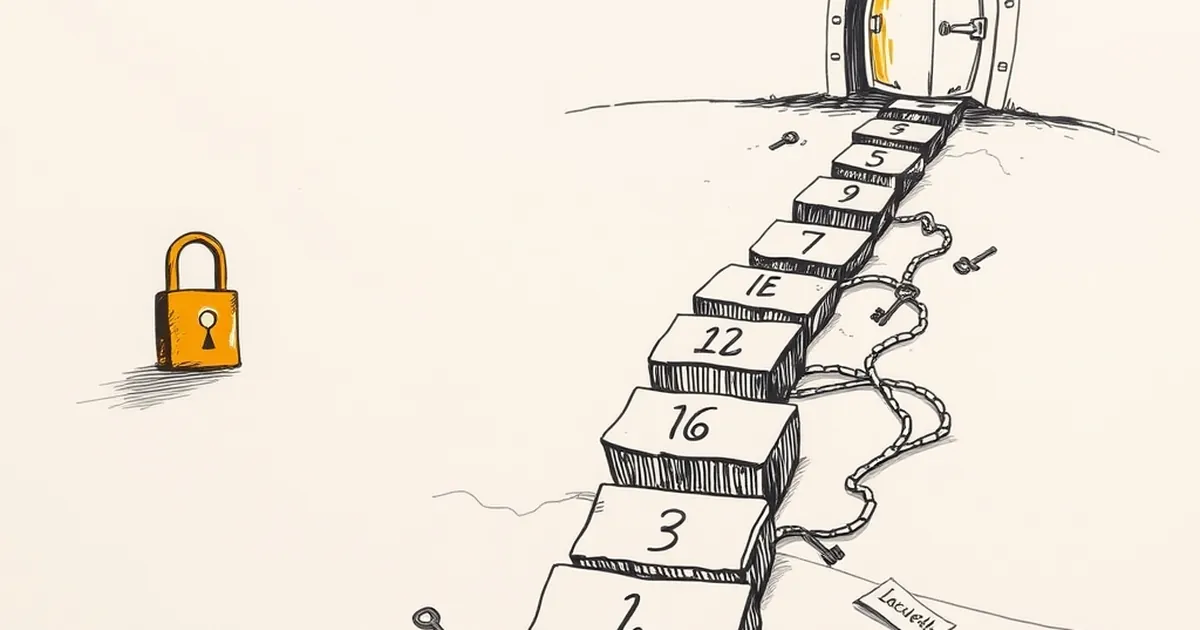
Two taps to get in. Nine steps to get back in after a lockout. That asymmetry is the single most under-discussed number in online gambling, and it shapes how players behave far more than any bonus term. Below is a walkthrough of where those nine steps come from, what they cost, and why operators keep the recovery path long even when the login path keeps getting shorter.
The nine-step figure is not a rhetorical flourish. It's a reasonable median for a locked account at a mid-sized licensed operator in 2024: password reset, email verification, two-factor re-enrolment, identity document upload, selfie or liveness check, proof of address, source-of-funds questionnaire, a support ticket that has to be manually cleared, and a cooling-off window before the account unlocks. Some operators compress it to five or six. Very few get below four. Meanwhile, on a device with a saved session and biometrics enabled, daily login is genuinely two taps — open app, face or fingerprint.
That gap is the article.
Why the login side collapsed to two taps
The login experience has been optimised for a decade because it sits directly on the revenue path. Every additional tap between a player and a bet is measurable in conversion, and operators know the number. Industry benchmarks put mobile login abandonment somewhere between 20% and 30% when a password has to be typed manually; with biometrics and a persistent session, that falls to single digits. So the pressure has all been one-directional: make entry frictionless.
The result is a stack of shortcuts most players never think about. Saved sessions that persist for 30 to 90 days depending on the operator and jurisdiction. Face ID or fingerprint replacing the password entirely. Magic-link logins. Device trust tokens that quietly re-authenticate you when you switch from phone to laptop. A player who has been on the same handset for six months may not have typed a password since they registered.
This is good UX. It's also, from a security standpoint, a stack of assumptions — that the device is yours, that the biometric is yours, that nobody has your unlocked phone. Regulators have largely accepted those assumptions because the alternative is a login funnel that leaks players to unlicensed sites. But the assumptions are exactly why the recovery path can't be short.
Where the nine steps actually come from
The recovery path is long because it's doing a different job. Login is an authentication problem: are you who you say you are? Recovery is an identity problem: prove you are who you say you are, to a standard that satisfies a regulator, an anti-money-laundering (AML) officer, and a payments provider who will be on the hook if the account turns out to belong to someone else.
The regulatory floor
Under most licensing regimes — the UK Gambling Commission, the Malta Gaming Authority, several US state regulators — an operator cannot simply hand back access to an account holding a balance without re-verifying identity if there's any doubt about the account holder. The UK's rules, tightened through 2023 and 2024, require source-of-funds checks at thresholds that vary by operator but commonly trigger somewhere between £2,000 and £5,000 in deposits over a rolling period. If an account gets locked mid-review, the recovery flow has to accommodate whatever the review needs, not just a password reset.
The fraud and bonus-abuse layer
Operators also use lockouts as a soft fraud control. Account takeover attempts, multi-accounting, and matched-betting rings all show up as anomalous login patterns, and a lock followed by a manual review is cheaper than a chargeback. From the operator's side, nine steps is a filter. From the player's side, it's a wall — and the player usually has no idea which of the nine steps is the one holding things up.
The support bottleneck
Here's the part that rarely gets mentioned: several of those nine steps aren't automated at all. Document review, source-of-funds assessment, and manual ticket clearance are human tasks, and support queues at peak times run 24 to 72 hours. A player who fails the selfie liveness check on a Friday may not see the account move until Tuesday. The "nine steps" number is optimistic in the sense that it counts steps, not days.
The asymmetry is a design choice, not an accident
It would be technically possible to build a recovery flow that's faster — say, four steps — using the same biometric and device-trust infrastructure that powers the two-tap login. Some fintechs do exactly this. Gambling operators mostly don't, for three reasons that have nothing to do with technology.
First, the cost of a false positive (letting the wrong person in) is much higher than the cost of a false negative (making the real player wait). A mistaken unlock can mean a drained balance, a regulatory finding, and a payments dispute. A delayed unlock costs the operator a support ticket and some goodwill.
Second, the lockout is sometimes the point. If an operator suspects bonus abuse or problem gambling, a slow recovery path is a feature — it creates a natural pause. That's legitimate in the responsible-gambling context and less legitimate when it's used to discourage a player from withdrawing.
Third, and least comfortably: a player locked out during a review is a player who can't withdraw. The balance sits there. Interest doesn't accrue to the player. There's no evidence operators deliberately stretch recovery to hold funds, but the incentive gradient points one way, and players notice.
What players can actually do about it
The practical advice is boring but real. Enable two-factor authentication before you need it — it reduces the chance of a lockout triggered by a suspicious-login flag. Keep your registered email and phone number current, because a stale contact detail is the single most common reason a recovery stalls at step two. Complete verification, including source-of-funds, while your account is healthy rather than during a withdrawal request, when the queue is longer and your leverage is lower.
And if you're locked out, ask the support agent a specific question: which step is currently pending, and what's the expected turnaround? A vague "we're reviewing your account" is not an answer. The nine steps are defensible; an indefinite timeline for any one of them is not.
Responsible gambling tools — deposit limits, time-outs, self-exclusion — are a separate lockout system with their own recovery rules, and they're worth understanding before you need them. A self-exclusion that takes 24 hours to lift is doing its job. A withdrawal review that takes nine days and won't say why is doing something else.
The open question is whether the gap between two taps and nine steps is a security necessity or a convenience for the operator. Regulators have spent a decade pushing on the login side to reduce friction; almost nobody has pushed on the recovery side to reduce delay. If a licensed operator can verify you with a fingerprint in under a second to take a bet, the same infrastructure could plausibly return your own money in less than 72 hours. The fact that it usually doesn't is the number worth watching.