KYC clears in 20 minutes; the document re-upload waits 6 days
Why a KYC check clears in 20 minutes while a document re-upload waits six days, and what that gap reveals about compliance queues
5 min read
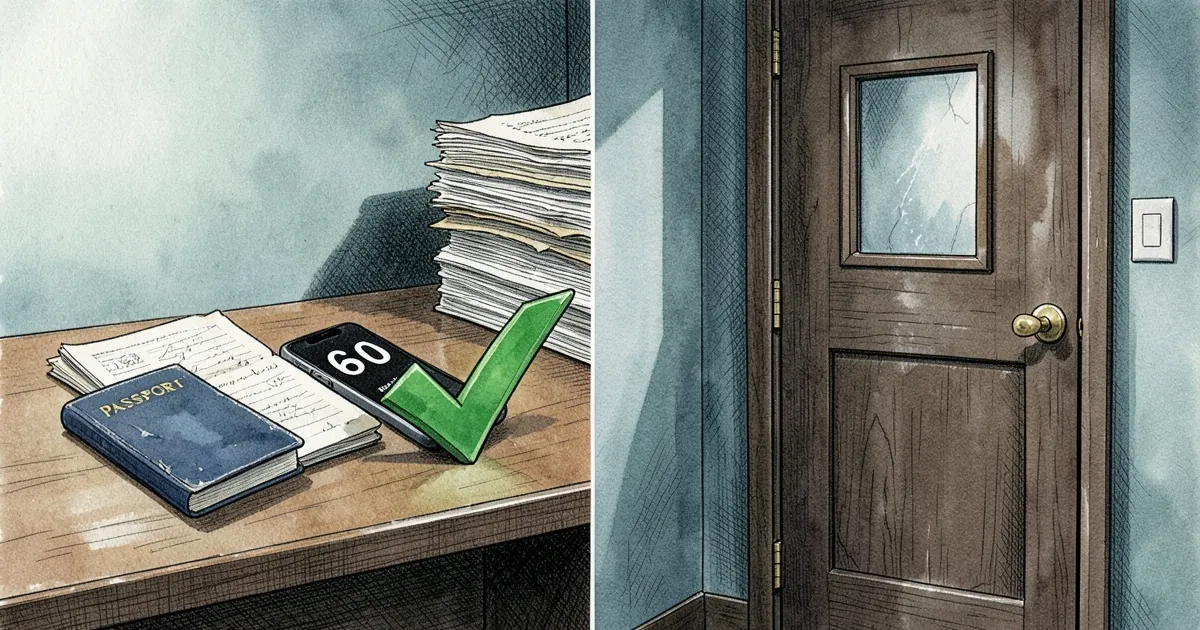
A routine identity check at a licensed operator can clear in around 20 minutes — ID uploaded, face matched, sanctions list pinged, account unlocked — and then the same customer gets an email asking for a clearer copy of their utility bill, uploads it, and hears nothing for six days. Both timings sit inside the same compliance department. One is built for speed; the other is built to be defensible when an auditor asks why a payout went out to the wrong person. Understanding which queue you're in, and why, is the difference between a frustrating week and a solvable one.
What the 20-minute check actually verifies
The fast KYC pass is narrow by design. It confirms three things: that the document is probably genuine, that the face on the selfie matches the face on the ID, and that your name isn't on a sanctions or politically exposed persons list. Automated document forensics do the first, liveness detection does the second, and an API call to a screening provider does the third. Most of it happens before a human sees anything.
That's why it can finish in 20 minutes at 3am. There's no queue — there's a threshold. If the confidence score on your document comes back high enough, the system auto-approves and moves on.
The 20-minute figure isn't a promise, and it isn't uniform. It's roughly what you get when the document is a clean, flat photo of a chip-and-PIN ID, the selfie lighting is decent, and the name matches across every field. Flip any of those — a laminated card catching a glare, a hyphenated surname spelled two ways, a passport photo taken at 11 — and you fall out of the automated lane and into the one where a person has to look.
Worth saying plainly: speed here isn't the casino being generous. It's the casino having decided that a certain error rate is acceptable on low-risk accounts, and having priced the fraud losses accordingly.
Why the re-upload takes six days
Here's the part that stings. You send a second document, the system accepts the upload instantly, and the status sits on "under review" for the better part of a week. Nothing is broken. You've simply moved from a machine queue to a human one, and the human queue is where the boring, unavoidable economics of compliance live.
Three things stretch it out.
Batching. Re-uploads are often reviewed in batches rather than one at a time, because the marginal cost of opening a case, cross-referencing it against the original submission, and writing a decision note is much higher than the cost of the first automated pass. A reviewer working through 200 cases doesn't triage yours to the front because you're impatient.
Escalation rules. A second upload is itself a signal. If the first document failed, the file may get flagged for a second reviewer, and two-person sign-off on an account that's already been queried is standard practice at larger operators. That's a second queue behind the first.
The clock that isn't yours. Under most anti-money-laundering regimes, the operator has to be satisfied about identity before it processes a withdrawal — but the regulations rarely specify how fast a re-review must happen. So the operator's internal service level becomes the real deadline, and internal service levels are written to be met on average, not on your worst day.
This is the same structural gap we've written about before: the address match that trails a three-minute KYC clear by five days, and the game history export that takes 30 days after a six-hour check. Fast front door, slow back office.
The document you upload has its own expiry
One detail people miss: the document you finally get approved doesn't stay approved forever. Many operators re-verify on a cycle, and a proof of address is often treated as stale after 90 days. So the six-day wait buys you a document with a shelf life, and if you're re-verified later you may be back in the same queue with a fresher bill. We covered that cycle in KYC clears in 3 days; the document you uploaded expires in 90.
What you can actually control
You can't speed up someone else's review queue. You can avoid landing in it twice.
- Match the document to the request exactly. If they ask for a utility bill, don't send a bank statement because it was closer to hand. A mismatched document type is an automatic bounce.
- Check the name string. Your ID, your proof of address, and your account name should read identically — same middle initials, same accents, same order. A missing middle name is one of the most common causes of a failed match.
- Photograph flat, in daylight, no flash. Glare on a laminate is the single most frequent reason a document fails automated forensics.
- Send the whole page. Cropped bills with the address cut off, or a screenshot of a PDF rather than the PDF, get rejected.
- Ask for the reason in writing. If a re-upload is requested, ask the support agent which field failed. A specific answer ("the address line is illegible") tells you what to fix; "please resubmit" doesn't.
One more: don't submit a second document while the first is still under review. Duplicate submissions can reset your place in the queue or trigger a fraud flag, which is a much slower process — the fraud check that clears in two minutes but leaves you filling in an appeal form for nine days is the version of this where the wait is measured in weeks.
The asymmetry is the product
Step back and the pattern across the industry is consistent. Anything a machine can decide gets decided in minutes, sometimes seconds. Anything that needs a human signature — a re-upload, an address match, a dispute, a loss-limit reduction — runs on a business-day clock set by staffing levels. We've written about the same split in live chat replying in 40 seconds while the dispute email waits three days, and it holds for limits too: a deposit limit typically applies the moment you set it, while a loss-limit reduction can take a week to take effect.
That asymmetry isn't a conspiracy. Automated decisions are cheap and auditable; human decisions are expensive and legally exposed. But it does mean the customer experience of "compliance" is really the customer experience of two different cost centres, and you only ever notice the slow one.
The open question is whether regulators will ever put a number on it. Right now, an operator can be fully compliant while leaving a verified customer waiting six days for a document review, because the rules govern whether identity is established, not how fast a re-check happens. If a supervisor somewhere decided that a re-upload had to be resolved within 48 hours, the staffing model would change overnight — and the 20-minute number would stop looking like a boast and start looking like the baseline it probably should be.
Until then, the practical advice is unglamorous: get it right the first time, because the second time is a different department. And if the wait is costing you money you can't afford to have tied up, that's worth knowing before you deposit, not after.