Instant reward loops fire in 0.4s, savings goals take 30 days
Instant card rewards fire in 0.4 seconds while savings goals take 30 days, exposing the core design tension shaping every consumer finance product decision
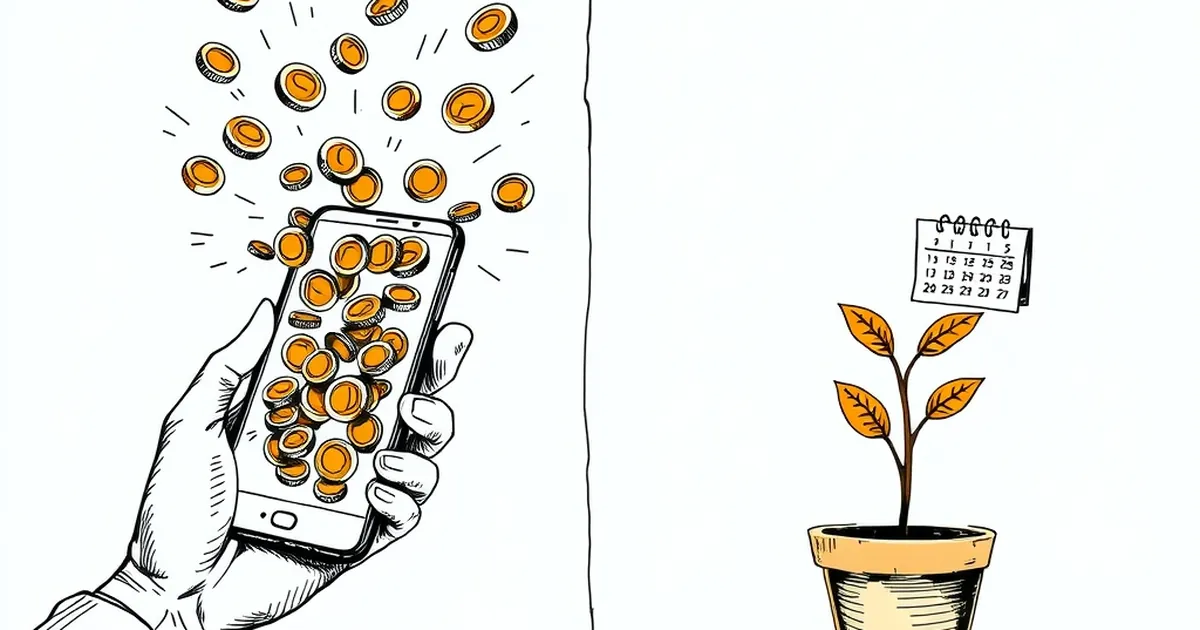
Your bank wants you to feel something the moment you tap your card. Your savings account, by contrast, is designed to make you feel almost nothing for a month. That asymmetry isn't a bug in how modern payments work — it's the central design tension in consumer finance, and it shows up in every product decision from contactless limits to round-up features. So the real question is this: if reward circuitry fires in under half a second, can a goal that takes thirty days to register ever compete?
The 400-millisecond problem
When you tap a card at a terminal, the authorization comes back in roughly a second or less, and the emotional payoff — the small hit of "done," the dopamine-linked anticipation of the purchase — starts well before that. Behavioral researchers have measured reward anticipation responses in the sub-500-millisecond range using EEG and fMRI paradigms; the brain's mesolimbic pathway doesn't wait for your statement to close. It fires on the prediction of reward, not the reward itself.
This matters enormously for payments. A credit card doesn't just move money; it collapses the temporal gap between desire and resolution. You want the coffee, you tap, you have the coffee, and the neural account is settled instantly — even though the financial account isn't settled for weeks.
Savings, by contrast, is a product built on deferred resolution. You move $200 into a high-yield account. Nothing happens. No confirmation buzz, no merchant smiling, no sensory completion. The reward — interest, security, a future purchase — is 30 days or more away. From a reinforcement-learning standpoint, you've just asked a human brain to prefer a delayed, abstract reward over an immediate, concrete one. That's the exact trade-off Kahneman and Tversky showed we systematically fail at.
Variable-ratio reinforcement is everywhere in card design
B.F. Skinner's work on variable-ratio reinforcement schedules — where a reward arrives after an unpredictable number of actions — produced the most persistent response patterns in his experiments. The organism keeps pressing because it can't predict which press pays off.
Now look at how card issuers and payment networks structure rewards. Points that post unpredictably. Rotating bonus categories that change quarterly. "Surprise" cashback offers delivered via app notification. Limited-time multipliers. None of these are random in the Skinnerian sense — they're deliberately engineered — but from the cardholder's perspective, the reward schedule is genuinely unpredictable. You don't know if this purchase earns 1x or 5x until you check.
That uncertainty is the point. A predictable 2% back on everything is a rational product. A rotating 5% category you have to activate is a behavioral product. It generates checking behavior, app opens, and the small anticipatory thrill of "did I get it?" — all of which increase engagement and, empirically, spend.
The payment networks understood this decades before the term "gamification" existed. Loyalty programs are reinforcement schedules wearing a marketing hat.
Loss aversion is the quiet engine behind instant payments
Here's where it gets interesting. The instant-payment push — FedNow in the US, UPI in India, Pix in Brazil, SEPA Instant in Europe — is often framed as pure efficiency. Faster settlement, lower fraud window, better cash flow. All true.
But there's a behavioral layer too. When a payment is instant, the loss is also instant. The money leaves your account and you feel it immediately. With a credit card, the loss is deferred to statement day, which is why credit spending reliably outpaces debit spending in behavioral studies — the pain of paying is delayed and therefore discounted.
Loss aversion, per Kahneman and Tversky's prospect theory, means losses loom roughly twice as large as equivalent gains. Instant debit rails remove the delay that softens that asymmetry. Some fintechs have leaned into this deliberately: real-time balance notifications, "you just spent $47 at..." alerts, spending heatmaps. The theory is that making the loss vivid will curb spending.
The evidence is mixed. Some studies show real-time alerts reduce discretionary spend by 5–10%. Others show users simply habituate to the alerts within weeks and the effect decays. The brain is remarkably good at tuning out a stimulus that fires 40 times a day.
The thirty-day gap is a design choice, not a law of nature
Savings products have historically been passive because the technology made them so. Monthly interest postings, monthly statements, monthly transfers — all artifacts of a batch-processing era that's now mostly gone. But the product design never caught up.
A few institutions have started to close the loop. Some neobanks now show a daily "interest earned so far" ticker. Others send a push notification when you hit a savings streak — seven days without a discretionary withdrawal, say. One UK building society experimented with rounding up every card purchase to the nearest pound and moving the difference into savings instantly, with a small animation on each transaction. The animation was the product. It turned a thirty-day reward into a 400-millisecond one.
That's the design lesson: you can't change the underlying economics of saving, but you can change the feedback latency. And feedback latency is what the reward system actually responds to.
What the round-up studies show
Round-up savings programs have been studied enough now to say something useful. The consistent finding is that the automaticity matters more than the amount. Users who round up every purchase save more than users who manually transfer the same total, because the decision cost is zero and the feedback is immediate. The round-up is a micro-reward — small, frequent, and tied to an action you were already taking.
It's the same principle as variable-ratio reinforcement, just pointed at a prosocial behavior instead of a purchase. The mechanism doesn't care what it's reinforcing.
Where this is heading
The next wave of payment products will compete on feedback design, not just rates or fees. We're already seeing it: cards that vibrate differently for different spend categories, apps that visualize a savings goal filling up in real time, instant-transfer rails that let you move money between "spend" and "save" buckets with a single gesture.
The interesting question isn't whether these features work — some will, some won't. It's whether the industry can build reward loops that point at saving as effectively as the ones that currently point at spending. The 400-millisecond window is open to whoever designs for it. The thirty-day window is a legacy constraint that technology has already made optional; the only thing keeping it in place is that most institutions haven't yet decided the feedback loop is worth building.
Watch the products that ship in the next 18 months. The ones that win won't be the ones with the best APY. They'll be the ones that figured out how to make a savings goal feel like a tap.