Haptic taps land 0.2s after the confirm, the receipt at 3 days
The 0.2-second tap vibration and the 3-day settlement gap reveal how payment systems separate confirmation from consequence
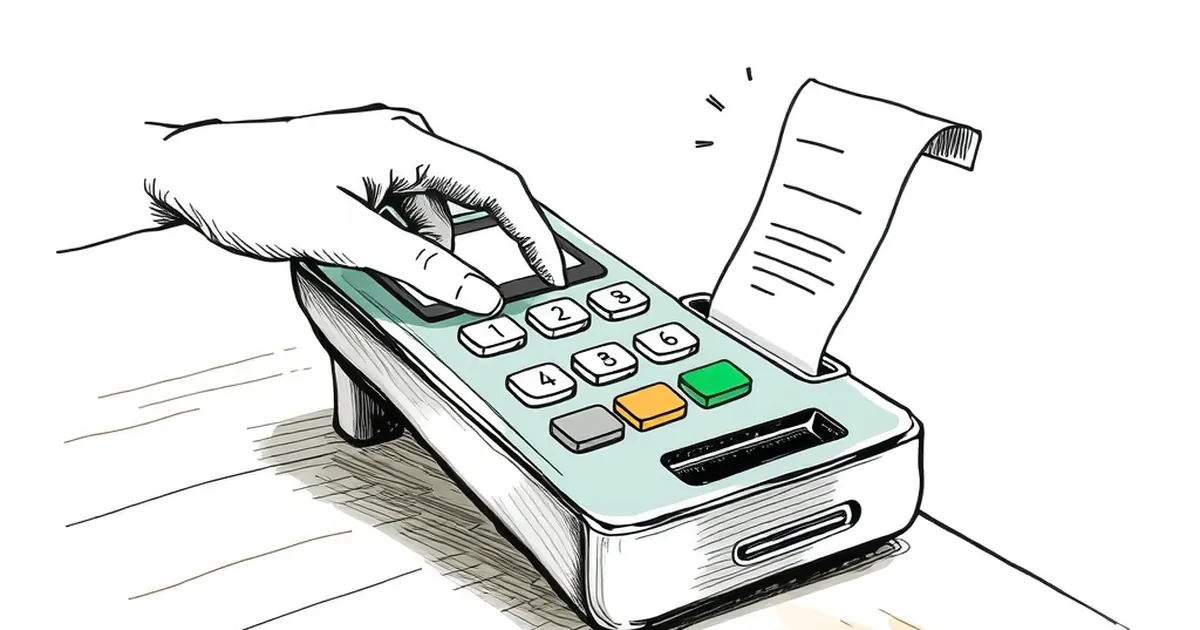
When you tap your card at a coffee shop, the terminal buzzes before the barista has finished turning away. That little vibration is the only receipt you get in the moment, and it lands roughly 0.2 seconds after the authorization request leaves your card. The actual transaction record — the line item you can dispute, categorize, or forget — settles into your account up to three days later.
So here's the question worth sitting with: what happens to a payment system when the confirmation and the consequence are separated by a gap that the human brain is not built to bridge?
The 200-millisecond handshake
Payment networks have spent decades optimizing for one thing at the point of sale: speed. A contactless tap on Visa or Mastercard has to feel instantaneous, because hesitation at the terminal reads as failure. If the reader doesn't beep, the customer taps again, and now you have a duplicate authorization to clean up.
What the network actually does in those 200 milliseconds is send an authorization request to the issuer, which checks the balance, applies fraud rules, and returns an approval code. That's not a settlement. It's a promise to pay, contingent on the merchant batching the transaction and the acquirer submitting it for clearing later. The money moves days afterward.
This two-phase design — authorize now, settle later — is a piece of financial plumbing most people never think about. But it's also a behavioral design decision, whether anyone framed it that way or not.
Why the gap exists at all
Batch processing is cheap. Real-time settlement between thousands of institutions is expensive, and for most of card history, nobody demanded it. The lag was invisible to consumers because the receipt was physical: a printed slip, a carbon copy, a line on a monthly statement you opened once every thirty days.
Mobile banking collapsed that distance. Now the authorization appears in your app within seconds, flagged as "pending," and the settled amount replaces it days later — sometimes for a different number, if the merchant added a tip or a hotel placed a hold.
The reward that arrives before the cost
Behavioral economists have a term for the pattern where a reward is immediate and the cost is delayed: it's the engine behind a lot of decisions we later regret. B.F. Skinner's work on variable-ratio reinforcement showed that unpredictable rewards produce the most persistent behavior — the pigeon keeps pecking because it can't predict which peck pays off.
Card payments don't pay off randomly, but they do something adjacent. The tap gives you an immediate, satisfying confirmation — a sound, a light, a vibration — while the deduction is deferred. You get the reinforcement now. You get the accounting later.
Richard Thaler's work on mental accounting is relevant here too. People don't track a single running balance in their heads; they keep separate ledgers and update them at irregular intervals. A three-day settlement window means the ledger entry lands when the emotional context of the purchase is already gone. You're not deciding whether to buy the thing anymore. You're just reconciling.
The 2019 study on payment friction
There's a well-known field experiment from the University of Chicago and the London School of Economics, published in 2019, that looked at what happens when you remove the moment of payment friction entirely. Researchers gave shoppers a mobile payment app and tracked spending against a control group. The treatment group spent more — meaningfully more — and the effect was strongest for purchases that were small and frequent.
The mechanism wasn't the money. It was the pause. When you hand over cash, you feel the bill leave your hand. When you tap, you feel a buzz. Both are feedback. Only one of them is proportional to what you just gave up.
What the haptic tap is actually optimizing for
It's worth being precise about who benefits from that 0.2-second confirmation. The merchant benefits from throughput — shorter queues, fewer abandoned baskets. The network benefits from transaction volume. The issuer benefits from interchange on every authorization.
The cardholder benefits from convenience, which is real and not trivial. Nobody wants to stand at a register waiting for a batch file to clear.
But the design has a side effect: it trains you to treat the tap as the transaction. The buzz becomes the receipt. And when the actual settlement arrives three days later, it's easy to miss — buried in a list of pending charges that all look similar, on a screen you check while doing something else.
Loss aversion doesn't fire on a pending charge
Kahneman and Tversky's work on loss aversion established that losses feel roughly twice as painful as equivalent gains feel good. That asymmetry is what makes people careful with money in the first place. It's a useful instinct.
The problem is that loss aversion needs a loss to react to. A "pending" line item isn't a loss yet. It's a placeholder. Your brain files it under "probably fine" and moves on. By the time it settles, the sting has been amortized into a number that's smaller than any single purchase felt at the moment you made it.
This isn't a conspiracy. It's an emergent property of a system optimized for speed and a brain optimized for immediate feedback, and the two happen to align in a way that makes spending feel lighter than it is.
Where the industry is heading, and why it matters
Real-time settlement is coming. Several markets have already moved to near-instant interbank transfers, and card networks have been rolling out faster clearing rails for years. The Fed's FedNow service in the US, launched in 2023, pushes in that direction. The UK's Faster Payments has been live since 2008.
If settlement catches up to authorization, the three-day gap closes. That sounds like a pure improvement, and in most ways it is — fewer overdraft surprises, less float for merchants, cleaner reconciliation.
But it also removes the last remaining buffer between the buzz and the balance. If the two land in the same second, the haptic tap stops being a stand-in for the transaction and becomes the transaction. Which raises a design question nobody has had to answer yet: what should the feedback feel like when it's telling you, in real time, exactly what you just spent?
Some issuers are already experimenting with this. Notifications that include the amount, not just the merchant. Haptics that vary in intensity. Apps that group the pending charge with the purchase context while you still remember it.
The interesting frontier isn't speed. It's whether the confirmation can carry information proportional to the decision — so that the 0.2 seconds after the tap tells you something you'll still recognize three days later, or three seconds later, or whenever the money actually moves.
That's a solvable design problem. It's also a behavioral one, and the two have never been separated as cleanly as they are at a payment terminal.