Geo-fencing blocks your login 9 miles from the border
Geofencing blocks logins based on IP location guesses, not your real position, so a valid account can fail just miles from the border
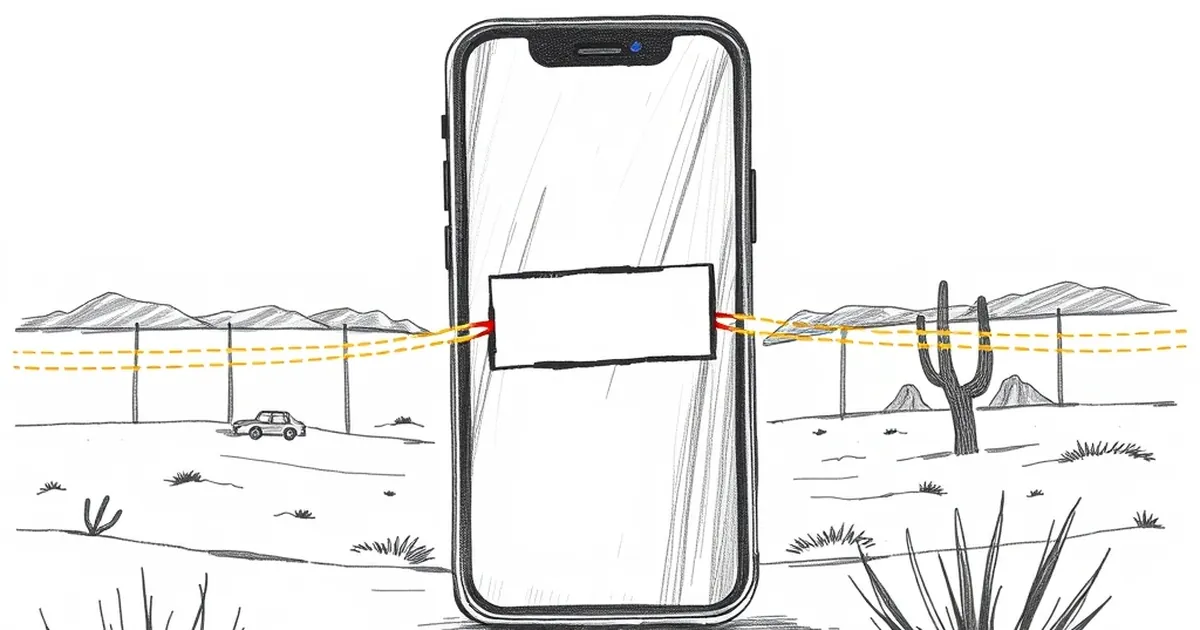
A licensed operator in Ontario will reject your login if your IP resolves to Buffalo, 9 miles away across the Niagara River. Same account, same password, same device that worked in Toronto an hour earlier. The block isn't a bug, and support can't override it. Geofencing isn't about where you are standing. It's about what the network says about where you are standing, and those two things disagree more often than most players expect.
Your IP is a guess, not a location
Every geolocation check starts with an IP lookup. The operator asks a database — MaxMind, IP2Location, a handful of others — what it thinks your address means. That database returns a coordinate, usually the centroid of a city or an ISP's regional hub. It is not your house. It's not even reliably your city.
The accuracy numbers are worse than the marketing suggests. Independent audits of commercial IP geolocation put country-level accuracy in the high 90s, city-level accuracy somewhere between 50% and 80%, and anything finer than that close to a coin flip. An IP registered to a Verizon block in Newark might resolve to a point in lower Manhattan. An IP from a small rural ISP might resolve to the state capital because that's where the ISP's registered address sits.
Mobile is the worst case. Carriers route traffic through centralized gateways, so a phone physically in Windsor can exit the network in Detroit. CGNAT — carrier-grade NAT — makes it worse: thousands of subscribers share a single public IP, and the geolocation database has to pick one location for all of them. If that location is on the wrong side of a border, everyone behind that IP gets treated as foreign.
VPNs and corporate networks add another layer. A split-tunnel VPN that routes only work traffic can still leak a foreign exit node for everything else. Some enterprise DNS setups resolve through servers in another country entirely.
What the border actually does to a login
The nine-mile figure in the headline is not arbitrary. Niagara Falls, Ontario to Buffalo, New York is roughly 20 miles. Windsor to Detroit is under a mile. But the more instructive case is the stretch between Vancouver and the US border, where Point Roberts, Washington sits below the 49th parallel and is reachable by road from Canada only by crossing into the US twice. Players in Tsawwassen, BC — about 9 miles from the Point Roberts line — have reported exactly this problem.
Here's what happens mechanically. You open the operator's site. A geolocation script fires before the login form even renders. It checks your IP against the licensing jurisdiction's permitted regions. If the result falls outside Ontario, or New Jersey, or whichever market the operator is licensed for, the session is killed. Some operators show an error. Others silently fail the login, which is worse — you assume your password is wrong and start resetting it.
The block is not a judgment about your physical location. It's a judgment about a database entry you have no control over and no visibility into. You cannot appeal it. Support agents can see the same flag you can't, and their scripts generally don't include an override path because the regulator requires the check to be automated and logged.
Why operators can't just make an exception
Under Ontario's regulated framework, which launched April 4, 2022, operators must verify that a player is physically located in the province at the time of each wager. The Alcohol and Gaming Commission of Ontario requires geolocation compliance, and operators face penalties for failures. The same pattern exists in New Jersey, Pennsylvania, Michigan, and every other US state with legal online casino or sportsbook activity.
The regulator doesn't accept "the player said they were home" as evidence. It wants a technical control. So operators buy geolocation services, set strict thresholds, and accept false positives as the cost of avoiding fines. A player wrongly blocked in Buffalo is an annoyance. An operator caught accepting bets from a prohibited jurisdiction is a licensing problem.
That asymmetry explains everything about how these systems behave. They are tuned to fail closed.
The workarounds that don't work, and the ones that might
Turning on a VPN to "fix" a geolocation block is the most common move and the most likely to make things worse. If your real location is legitimate and your VPN exit node is in a prohibited region, you've just converted a solvable problem into an actual violation. Operators also flag VPN usage, and some will suspend accounts rather than just block the session.
What does help, sometimes:
Switch networks. If you're on mobile data and getting blocked, try Wi-Fi, or vice versa. The IP changes, and the new one may resolve correctly. This is the single most effective fix and it costs nothing.
Restart your router. Residential ISPs reassign IPs on reconnect. If your current address is misregistered, a fresh one might not be. Not guaranteed, but worth thirty seconds.
Check for a stale VPN profile. Old VPN clients sometimes leave a virtual adapter active even when the app is closed. Disable it in your network settings.
Use the operator's own location check. Some operators publish a geolocation test page. Run it before you log in, so you know whether the problem is the check or your credentials.
What doesn't help: clearing cookies, changing browsers, incognito mode, or contacting support with a screenshot of your GPS. None of those touch the IP lookup, which is the actual gate.
The GPS layer
Some jurisdictions require a second check using device GPS, not just IP. Where that applies, the browser or app requests location permission, and the coordinates are compared against the licensed boundary. This is more accurate but introduces its own failures — indoor GPS drift, denied permissions, and the fact that a laptop on Wi-Fi often has no GPS at all and falls back to Wi-Fi positioning, which is essentially the same database problem in a different costume.
If you're within a few miles of a border and the GPS check is the one failing, moving to a different room won't help. The fix is usually to get further from the line, or to use a device with a proper GPS chip rather than relying on network positioning.
The people this actually hurts
The population affected isn't small. Millions of people live within 30 miles of a US state line, an international border, or both. The Detroit–Windsor corridor, the Niagara region, the Vancouver–Blaine stretch, the El Paso–Juárez area, and the entire Delaware Valley all sit inside that band. For those players, geolocation isn't an occasional glitch. It's a recurring tax on using a legal product.
There's a second group: anyone behind CGNAT, which is most mobile users and a growing share of home broadband as IPv4 addresses run short. If your carrier assigns you a shared IP that's registered to a different city, you inherit that city's eligibility rules. You didn't choose it, you can't see it, and you can't change it without changing carriers.
Regulators know about the false-positive rate. The industry number that circulates is somewhere between 1% and 5% of legitimate login attempts failing geolocation checks, though nobody publishes clean figures because operators don't want to advertise friction and regulators don't want to advertise that their controls are blunt. That range, applied to a market the size of Ontario's, is tens of thousands of blocked sessions a month.
What happens when the map is wrong
The uncomfortable question is what geolocation compliance is actually enforcing. The stated goal is keeping regulated gambling inside jurisdictional lines. The practical effect, at the margins, is that a player standing in their own living room gets treated as an offshore bettor because a database put them in Buffalo, while someone with a well-configured VPN and a clean residential IP on the right side of the line sails through.
That's not a hypothetical loophole. It's the predictable output of a system that verifies IP addresses rather than people, and IP addresses were never designed to encode physical location. They encode network topology, and network topology doesn't care about the Niagara River.
The next regulatory move is likely more GPS and device-level verification, which shifts the failure mode rather than eliminating it. Indoor drift, permission denials, and Wi-Fi positioning will produce their own false positives, just in different postcodes. Whether any of that gets meaningfully more accurate — or whether the industry accepts a permanent few-percent error rate as the price of a licensing regime — is still open.