Declined Cards Teach Faster Than Any Responsible Gambling Tool
A declined card teaches bankroll reality more honestly than any responsible gambling tool ever could
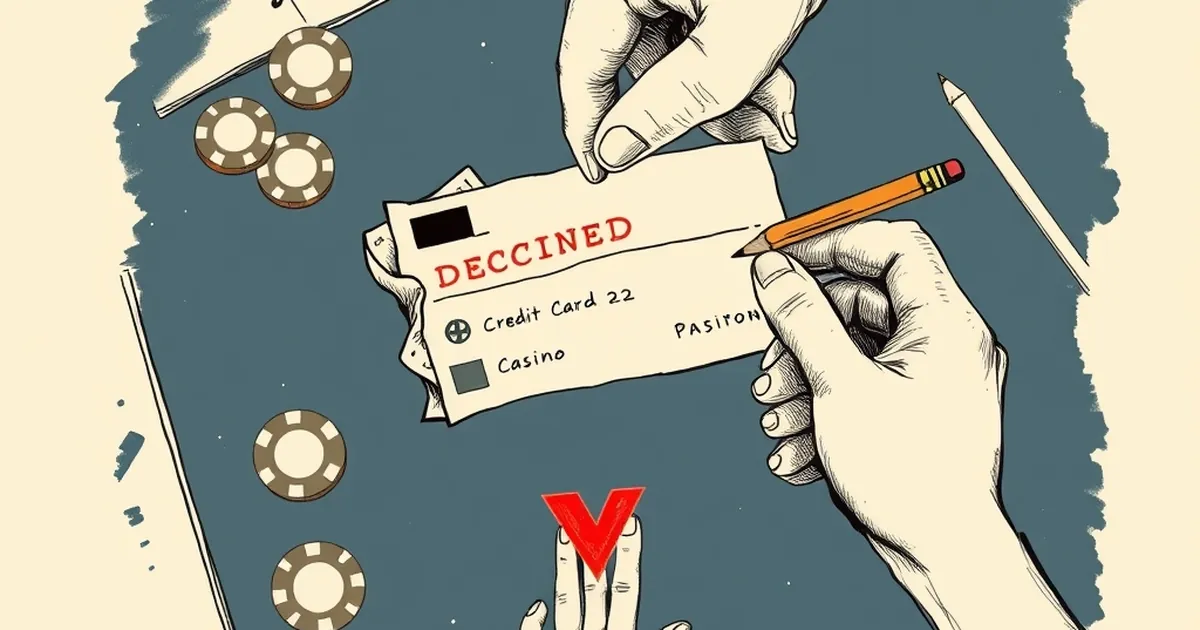
The payment gateway is the most honest teacher in gambling. No pop-up, no self-assessment quiz, and no cool-off timer has ever matched the pedagogical clarity of watching a $200 deposit attempt get rejected with the cold, bureaucratic finality of a bank’s fraud algorithm. Responsible gambling tools ask you to reflect on your behavior; a declined card simply states a fact. You are out of money, or you are flagged, and the game is over for today. That single, unglamorous moment of friction teaches more about bankroll reality than any interactive slider ever will.
The Friction of Failure is the Real Lesson
Let’s be precise about what a declined transaction actually communicates. It isn't a moral judgment, and it isn't a nanny-state intervention. It is a hard data point from your financial institution, often triggered by a velocity check or a simple insufficient funds flag. The psychological impact is immediate and visceral, unlike the abstract warning of a "loss limit" you set last Tuesday when you were winning.
Consider the mechanics of a standard deposit limit. You set a €500 monthly cap. You hit it on the 14th. The casino software blocks your next deposit attempt with a polite message. You shrug, close the tab, and maybe open a different casino where you haven't set a limit. The tool is porous because it relies on your own future discipline. A declined card, however, is a brick wall built by an external party with no interest in your gambling hobby. When your Visa is rejected because the issuing bank’s risk engine flagged a third consecutive transaction to a gaming merchant within 60 minutes, you don't argue with the software. You feel the shame of the rejection, and that emotion is a far stronger deterrent than any rational calculation of odds.
Why Self-Exclusion Lists Fail Where Banks Succeed
Self-exclusion is a noble concept, but it has a fundamental design flaw: it requires you to pre-emptively admit you have a problem. The data on this is grim. A 2021 study by the UK Gambling Commission suggested that only about 3% of problem gamblers actively use self-exclusion tools. The other 97% are still trying to play. That is the dirty secret of the responsible gambling industry—the tools are only used by the people who are already close to quitting. The rest are in denial.
The bank, however, doesn't ask for your opinion. It doesn't run a "wellness check" before letting you spend your last $50. It just looks at your balance, looks at the merchant code (often flagged as high-risk), and decides. When you have $120 in your checking account and you try to deposit $150, the decline is absolute. There is no "opt-in" to override it. This friction is the ultimate problem gambler intervention because it doesn't rely on your cognitive state. It relies on arithmetic. You cannot stake what you do not have, and the bank is the only party in the gambling ecosystem that has perfect, real-time knowledge of your actual net worth.
The "Soft Decline" is a Warning Shot
There is a nuance here that makes the bank a better teacher than the casino. A "soft decline" often occurs when a transaction passes the balance check but trips a risk rule. For example, you deposit €50 successfully. You lose it. You deposit another €50. You lose it. Your third attempt at €50 might get a soft decline because the bank’s algorithm sees a pattern of rapid, repeated debits to a gambling site. The transaction isn't denied for lack of funds; it's denied for behavior.
That is the most valuable lesson in the entire gambling industry. It tells you that an external observer—a cold, statistical model—has identified your pattern as risky. No casino responsible gambling banner has ever told you that. The banner says "Play responsibly" while simultaneously processing your 14th deposit of the day. The bank says nothing, but blocks the 15th. The silence of the decline is more articulate than any warning label because it implies action has already been taken against you. You are now a flagged entity, and that status feels different from being a customer who clicked "I agree."
The Numerical Anchor: Velocity Limits and the 24-Hour Rule
Let’s get specific. Most major UK high-street banks (Barclays, Lloyds, HSBC) implement a default gambling block that you must call to remove. But even without that, the standard Visa and Mastercard merchant category code for online gambling (7995) is subject to velocity rules. A common threshold you will hit in the wild is four transactions in a rolling 24-hour period. After the fourth successful deposit, the fifth attempt—regardless of your available balance—will often trigger a manual review or an automatic decline.
This is the number that matters. It isn't a responsible gambling tool that asks you to think about your "time spent." It is a hard technical limit that says: You have attempted to fund this activity five times in one day. That is statistically abnormal. Stop. The bank doesn't care if you are winning or losing. It cares about the frequency of the cash outflow. When you hit that wall, you are forced to confront the reality that your behavior is statistically outside the norm for a recreational consumer. That is a brutal, effective mirror.
The Uncomfortable Question We Should Ask
If declined cards are such effective teachers, why do we spend millions on "softer" tools? The answer is uncomfortable: responsible gambling tools are often designed to protect the casino's license, not the player. A self-exclusion tool is a regulatory checkbox. A deposit limit is a UI feature. But a declined card is a genuine market signal. It represents the true cost of your entertainment, calculated in real-time by a third party who has no stake in your continued play.
The implication is that we might be looking at harm prevention in the wrong place. If we know that bank-level friction works better than casino-level prompts, then the logical next step is to demand that payment processors integrate more granular "cooling off" periods. Imagine a system where, after three rapid deposits, the acquiring bank automatically enforces a 12-hour lock on that specific merchant, regardless of the casino's own rules. That would be more effective than any "reality check" pop-up.
But here is the open question that keeps me up at night: if we optimize for the bank's friction, are we just pushing players toward unregulated crypto casinos or prepaid cards that bypass the banking system entirely? The decline teaches a lesson only if the player is forced to sit with the rejection. If the player simply switches to a different payment method—one that doesn't have the same velocity checks—then the lesson is lost, and we have created a more dangerous environment. The bank's strictness is only a safety net if the player respects the net. Do they? Or does the friction just become another obstacle to overcome, like a wagering requirement? I don't have the answer, but I know which lesson I learned faster: the one that came with a receipt that said "Transaction Declined."