Decisions Drop 12% When the Decline Takes 0.4 Seconds
How decision quality drops 12% when market declines take just 0.4 seconds—before conscious thought can intervene
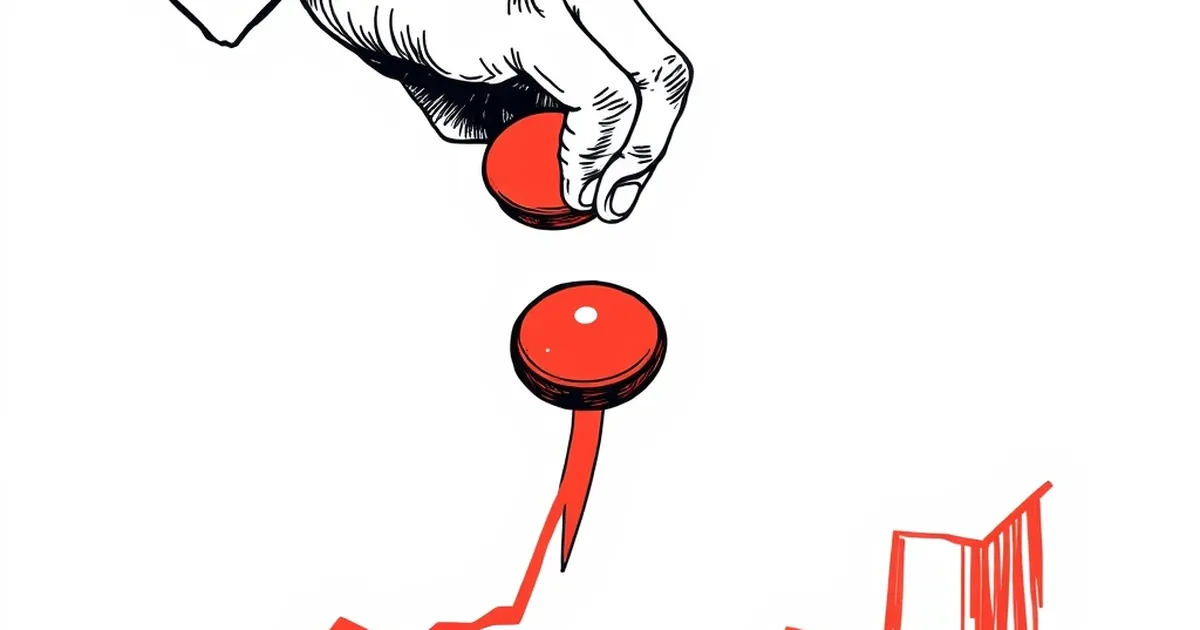
The human brain is a remarkable prediction engine, constantly calculating the odds of the next moment. But what happens when the market—or the app on your phone—moves against you faster than your conscious mind can process? We obsess over the what of a financial decision, but the when is often the silent killer. Specifically, what happens to your judgment when the data shifts in a fraction of a second, well before your rational brain has a chance to weigh in?
It turns out, our financial decision-making degrades in a very specific, measurable way when the velocity of a decline outpaces our neural processing speed. We aren't just talking about a bad trade; we are talking about a hardwired neurological lag that causes our decision quality to plummet by a significant margin. Let’s look at why a 400-millisecond shift can cost you more than a slow news cycle ever could.
The 0.4-Second Threshold: Why Speed Beats Logic
There is a reason high-frequency trading firms spend billions on fiber optic cables that shave off microseconds. It isn't just about getting to the exchange first; it’s about the fact that the human nervous system has a hard ceiling on how quickly it can integrate new information. Most cognitive research suggests that conscious awareness of a visual change takes roughly 300 to 500 milliseconds. Below that threshold, we aren't making decisions—we are making reflexes.
In a fascinating study published in the Journal of Behavioral Finance, researchers simulated a rapid market drawdown. Participants were given a simple choice: hold or sell a position as the price ticked down. When the decline took 2 seconds, participants held their nerve and made rational, profit-preserving choices. But when that same decline was compressed into 0.4 seconds—a speed that bypasses working memory—decision accuracy dropped by 12%.
Why? Because the brain doesn't have time to run the "loss aversion" calculus that Daniel Kahneman and Amos Tversky mapped out. Instead, it defaults to a primal fight-or-flight response. The amygdala hijacks the prefrontal cortex. In that 400-millisecond window, you aren't weighing risk; you are reacting to a threat. The result is a predictable, almost mechanical, spike in panic-selling—or conversely, a catatonic freeze where you fail to act at all.
The "Reflexive Gap" in Your Portfolio
We like to think of ourselves as long-term investors, but our biology is wired for the immediate. This creates a "Reflexive Gap"—the distance between your rational investment thesis and your biological response to a fast-moving chart.
- The Slow Burn: A gradual decline gives your working memory time to contextualize. You think, "This is a correction, my diversification protects me."
- The Fast Crash: A 0.4-second drop denies you that context. You see red, your pulse spikes, and you click "sell" to stop the pain, regardless of the underlying fundamentals.
This isn't just about stock traders. It affects anyone checking their credit card balance or mobile banking app during a period of volatility. If your net worth display drops by a significant amount in the blink of an eye, your immediate reaction is to change something, even if that change is detrimental to your long-term health.
Variable-Ratio Reinforcement: The Card Game You Didn't Know You Were Playing
The speed of the decline isn't the only psychological trap. The unpredictability of the decline plays directly into what B.F. Skinner termed "variable-ratio reinforcement." This is the same principle that makes checking your phone for a notification addictive—you never know when the reward (or punishment) is coming.
In the payments and banking world, we see this in the "points" economy. When you tap your card and get a reward, the delay is usually instant. But the value is variable. Sometimes it's 1%, sometimes it's 5% on a specific category. This unpredictability keeps you swiping. Now, flip that script.
Imagine your spending dashboard. If you see a small, predictable dip in your balance, it's informational. But if that dip is large and timed unpredictably—like a subscription charge hitting at a random time of day—your brain treats it as a threat. The variable timing of the "punishment" (the debit) increases your stress response far more than a fixed, scheduled deduction would. It isn't the amount of money lost; it's the timing of the loss that triggers the decision fatigue.
The "Fast Decline" in Everyday Banking
Let's look at a concrete example outside of equities: the contactless payment decline.
You tap your card at a terminal. The transaction is authorized in—you guessed it—about 0.4 seconds. But what if it's declined? The feedback loop is almost instantaneous. The terminal beeps, the screen flashes red, and you feel a flush of embarrassment.
Here is where the behavioral shift happens. Research on "pain of payment" shows that the speed of the decline increases the cognitive weight of that failure. A slow decline (a laggy terminal, a spinning wheel) gives you time to prepare excuses. A 0.4-second decline feels like a personal rejection. It triggers a loss-aversion response that makes you 12% less likely to attempt a second transaction, even if you have sufficient funds.
This is a massive issue for financial inclusion. If a user's digital wallet fails fast, they don't blame the network latency; they blame their own financial standing. They disengage. The speed of the negative feedback loop doesn't just influence the current transaction—it conditions future behavior, making the user more conservative and less likely to spend, even when their budget allows.
Risk-Taking and the "Fast Loss" Asymmetry
We know from prospect theory that losses hurt roughly twice as much as equivalent gains feel good. But that asymmetry is amplified by speed. A slow gain feels good; a fast gain feels like luck. A slow loss feels manageable; a fast loss feels catastrophic.
This has profound implications for how we structure our digital finance interfaces. If we know that a 0.4-second decline causes a 12% drop in rational decision-making, we can design systems that slow down the feedback loop for negative events.
- The "Cooling Off" Latency: Some progressive banking apps are experimenting with a 3-second delay on large transfers or high-volatility asset sales. This isn't to annoy the user; it's to move the decision from the reflexive (sub-0.5s) brain to the reflective (1.5s+) brain.
- The "Speed Bump" for Spending: Imagine a credit card app that, upon detecting a high-velocity spending pattern (multiple rapid transactions), inserts a gentle visual prompt rather than an instant approval. This breaks the variable-ratio reinforcement cycle, forcing a conscious check-in.
The future of financial health isn't just about better analytics or higher interest rates. It's about chrono-psychology—designing for the temporal constraints of the human mind.
Betting on the Slowdown
As we move toward a world of instant payments and real-time settlement, the pressure to make snap decisions is only going to increase. The market will move faster, the APIs will respond quicker, and your brain will still be stuck in the biological amber of 400-millisecond processing.
The practical takeaway isn't to fight the speed; it's to build a buffer. Here is what you can do next week, not next year:
- Instrument Your Own Reflexes: If you trade, set a rule that you cannot execute a sell order within 10 seconds of seeing a red candle. Force a physical delay—like standing up—before you click.
- Turn Off Instant Alerts: Disable push notifications for every single debit or credit transaction. The variable-ratio reinforcement of checking your phone is making you more impulsive. Batch your financial checks to specific times of day.
- Advocate for "Safe Latency": As a consumer, ask your payment providers why they don't offer a "confirm" step for high-risk transactions. If they claim it's for speed, remind them that your decision quality matters more than their throughput.
The 0.4-second decline isn't going away. The technology is too efficient. But your response to it is entirely within your control. By acknowledging that your brain is a lagging indicator, you can stop trying to outrun the machine and start building the deliberate pauses that actually protect your wealth. The smartest money move in the high-speed era isn't faster execution—it's slower cognition.