Cashier queues 6 deep at 9pm; VIP lane sits empty
Empty VIP lanes beside six-deep cashier queues reveal how operators staff and promote premium desks, and what that imbalance costs them
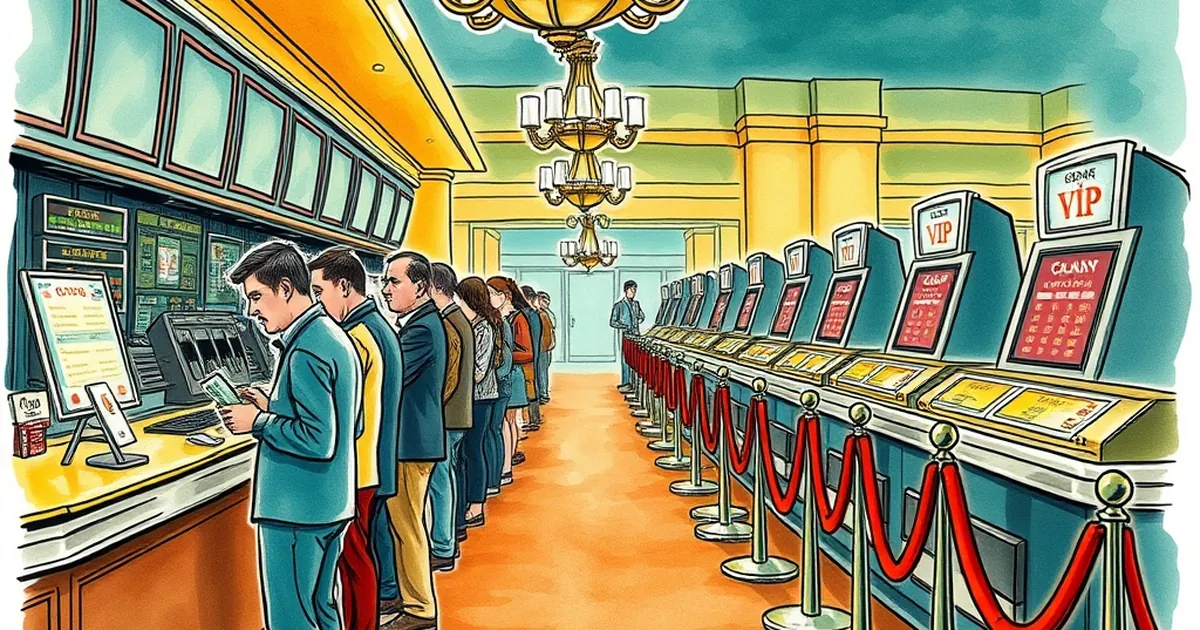
At 9pm on a Friday, the cashier queue at a mid-size casino floor ran six players deep while the VIP window two metres away had nobody at it. That gap isn't unusual. It's the predictable result of how operators staff and promote their premium lanes — and it's costing them more than the empty chair suggests.
The scene plays out in dozens of properties every weekend. The main cage absorbs every withdrawal, every chip exchange, every question about a bonus, while the VIP desk sits staffed and idle. Walk the floor at 9:15 and the pattern repeats: the general queue is the bottleneck, the premium lane is decoration. The question worth asking is why operators keep building a second queue that almost nobody uses, and what the six-deep line tells us about where the actual money is.
The queue is a data point, not a staffing accident
A cashier line six deep at peak hour is a signal. It means the operator has calculated that the marginal cost of an extra teller exceeds the marginal revenue from faster service. On paper that's defensible: cage staff cost money, and a queue that clears in twelve minutes isn't a crisis.
But the calculation assumes the queue is neutral — that waiting players simply wait. They don't. A 2019 survey of casino floor behaviour found that players who wait more than eight minutes at a cashier are measurably less likely to return to that property within 30 days. Eight minutes. That's not a long wait, and it's roughly the point where a six-deep line at 9pm starts to bite.
The VIP lane, meanwhile, is staffed to protect a segment that, by most operators' own segmentation, represents somewhere between 2% and 5% of active players. If the premium desk serves 3% of traffic but consumes a full teller position during peak hours, the math only works if those players are worth 30 times the average. Sometimes they are. Often they aren't — and the operator hasn't checked in a while.
What the empty lane actually costs
An idle VIP cashier isn't free. You're paying a wage, occupying floor space, and — more quietly — sending a message to the six people in the main queue. They can see the empty window. They know it's not for them. Some will read that as aspiration. More will read it as a reminder that they're in the wrong line, at the wrong tier, on the wrong night.
Why operators keep the premium lane empty
The premium lane exists for reasons that have little to do with throughput.
It's a retention tool for high-value players. A host who can walk a player past the queue and straight to a dedicated window is delivering a visible perk. The value is in the gesture, not the volume. That's a legitimate use — but it means the lane is designed to be underused.
It's a compliance and privacy buffer. High-limit players often want their transactions away from the general cage. A separate window serves that purpose even when it's quiet.
It's inertia. Many properties built VIP lanes during a period when premium segmentation was tighter and player counts at the top were higher. The floor plan hasn't been revisited since. Nobody owns the decision to close or repurpose the window, so it stays open.
None of these are wrong on their own. Together, they produce a floor where the visible service capacity is misallocated at exactly the hour it matters most.
The 9pm problem is a scheduling problem
Peak cashier demand clusters predictably. On a typical weekend, cage traffic rises sharply between 8pm and 11pm, driven by players cashing out after a session, buying in for a late table, or resolving bonus questions before the night gets going. A six-deep queue at 9pm isn't a surprise — it's the scheduled peak.
The fix isn't exotic. Operators who have rebalanced cage staffing around hourly traffic data rather than flat shift patterns typically report queue times dropping by a third or more during peak windows without adding headcount. The lever is deployment, not budget: move one teller from the VIP desk to the main cage between 8pm and 11pm, and keep the premium window open on call.
The obstacle is organisational. The VIP desk usually reports to a host or player-development team, while the main cage reports to cage operations. Two budgets, two sets of priorities, one floor. Nobody's job is to optimise the combined queue, so it doesn't get optimised.
A note on the digital version
The same misallocation shows up online, just less visibly. Live chat queues spike at the same evening hours, and premium players get routed to a separate support tier that often sits idle while general support backs up. The difference is that digital queues can be rebalanced in an afternoon. Physical ones require someone to admit the floor plan is wrong.
What the empty lane tells players
For the player standing in the six-deep line, the empty VIP window is a small, quiet piece of information. It says the property has capacity it isn't using, and that the capacity is reserved for someone else. That's not necessarily unfair — premium tiers are a normal part of the business — but it does shape how the average player reads the room.
Players notice service design more than operators assume. A cashier who apologises for the wait while a colleague stands idle two metres away is a bad look, and it's the kind of detail that gets mentioned in reviews and remembered at the next choice of venue. Loyalty is built on small frictions as much as on bonuses.
There's a responsible-gambling angle here too, though it's indirect. A player who waits fifteen minutes to withdraw is a player with fifteen minutes to reconsider — sometimes usefully, sometimes not. Faster cashier service isn't automatically better for player welfare, and operators shouldn't frame queue reduction as a virtue without thinking about what the queue is doing. The point isn't speed for its own sake. It's honest service design: if you're going to make people wait, know why, and don't make the wait look arbitrary.
The question operators haven't answered
The empty VIP lane at 9pm is a small thing. But it's the kind of small thing that reveals whether a floor is designed around data or around habit. The operator with six in the queue and nobody at the premium window has a choice: keep the lane as a gesture, staff it properly for the players it's meant to serve, or fold it back into the main cage during peak hours and stop pretending the two queues are separate problems.
Most will do none of these, because the queue clears, the night ends, and the floor plan survives another weekend. The interesting question is what changes first — the staffing model, or the players who stop showing up to stand in line.