Bet limits reset at midnight; the loss cap waits 90 days
Online betting limits reset daily while loss caps stay locked for 90 days, leaving players with fast protection and slow safeguards
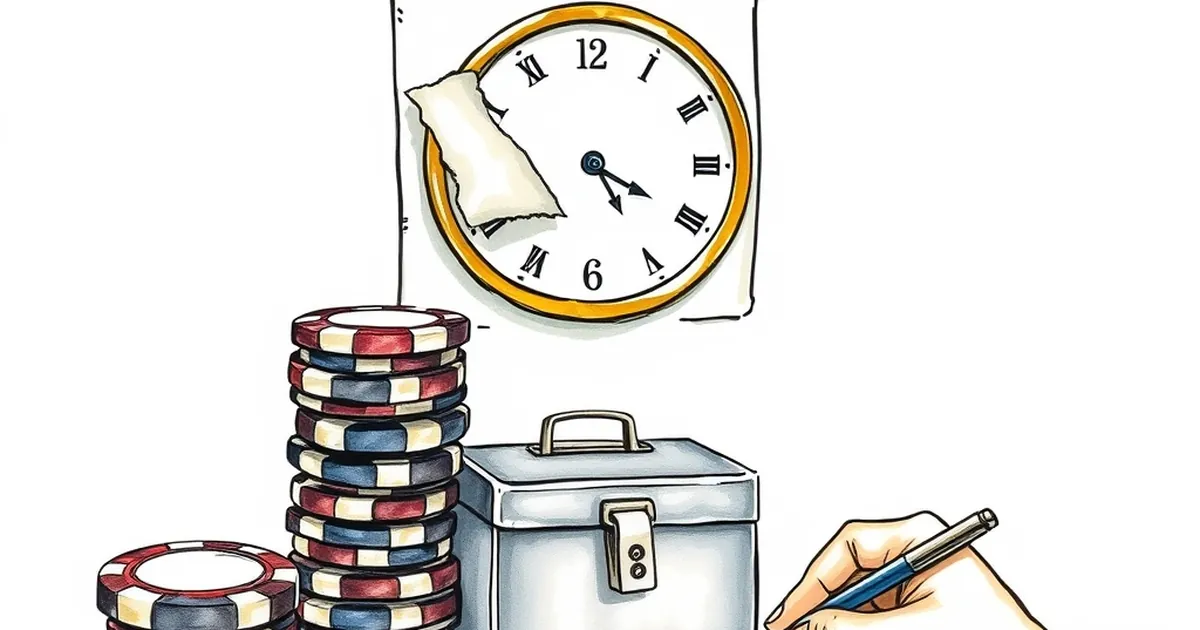
Two clocks govern a modern online betting account, and they don't run at the same speed. Your deposit, loss, and stake limits reset on a 24-hour cycle — cross midnight and the counter is back at zero. The self-imposed loss cap that actually protects you from a bad month, meanwhile, is stuck on a 90-day cooling-off period in most jurisdictions that offer it at all. The result is a system where the fast limit is the one you'll hit first and the slow one is the one you probably need.
That asymmetry isn't an accident, and it isn't purely cynical either. It's what happens when you bolt player-protection tools onto a product engineered for instant re-engagement.
Why the daily reset exists
Daily limits are the oldest responsible-gambling tool in the book, predating apps by decades. Land-based operators used them, regulators codified them, and when betting moved online the 24-hour cycle came along unchanged. It's the default because it's administratively simple: at 00:00 local time, every account's used-allowance field clears.
The problem is what a 24-hour window actually measures. It doesn't measure a session, a mood, or a losing streak. It measures a calendar day, which is a unit of convenience for the operator's back office, not a unit of harm for the player.
Consider the practical shape of it. A player sets a £200 daily deposit limit. On a Tuesday that's fine. On a Friday, after a rough week, they hit £200 by 9pm, get blocked, and then — because the reset is only three hours away — wait it out and deposit again at 00:01. Nothing in the system stopped them. The limit did its job for 180 minutes and then evaporated.
The midnight problem
There's a second wrinkle: whose midnight? If you're betting with an operator licensed in one country while sitting in another, the reset may fire on the operator's server time, your local time, or UTC. Players in New Zealand and Australia routinely see resets land at odd hours. It's a small thing until you're the person refreshing the page at 11:58pm wondering whether the counter is about to clear.
Some operators now offer rolling 24-hour windows instead of fixed midnight resets — your allowance returns 24 hours after each individual deposit rather than all at once. It's a strictly better design. It's also much rarer, because it's harder to explain in a marketing email.
The 90-day cap nobody mentions
Here's where the two clocks diverge sharply. A daily deposit limit is a speed bump. A loss cap — a hard ceiling on net losses over a defined period — is a wall. And in most regulated markets, if you want one that spans more than a day, you're looking at a 90-day commitment.
The 90-day figure shows up in several places. In Great Britain, the Gambling Commission's remote gambling rules require operators to offer a "time-out" of at least 24 hours and self-exclusion of at least six months, with financial limits typically settable daily, weekly, or monthly. Where a true net-loss cap exists, it's often monthly. But the structural cooling-off periods — the ones that prevent you from simply raising your own limit the moment you're losing — are the long ones. Operators in multiple jurisdictions are permitted, and in some cases required, to impose a waiting period before a limit increase takes effect. The UK's rules require that any increase to a deposit limit must not take effect for at least 24 hours. Some operators stretch that to 7 days for large increases. For self-exclusion reversals, the standard is 24 hours in the UK and up to 90 days in parts of Europe and Australia.
So the practical reality: you can lower a limit instantly. Raising it, or coming back from a break, takes days to months. That's the right direction — friction on the way back in, none on the way out. But it means the protective setting you actually want is the one that's hardest to put in place, because setting a genuine 90-day loss cap requires you to decide, today, what you'll be able to afford in three months.
What a real loss cap looks like
A daily deposit limit caps money in. A loss cap caps money gone. Those are different numbers, and the gap between them is where most of the damage happens.
Say you deposit £100 a day with a 96.2% RTP slot portfolio running at high variance. Over 90 days that's £9,000 deposited. If your actual return comes in near expectation — and it often doesn't over a 90-day sample — you'd lose roughly £342 in house edge. But variance means the realistic range over that many spins is wide, and a player chasing a bad week can turn £342 into four figures without ever breaching a daily limit.
A net-loss cap of, say, £500 over 90 days would have stopped that. A £100 daily deposit limit wouldn't have come close to noticing.
Where the two clocks actually collide
The design flaw is that the fast limit resets the counter that matters and the slow limit resets the counter that doesn't.
Daily limits are checked against deposits, which are voluntary. Loss caps are checked against net position, which is involuntary and driven by variance. The player who most needs protection is precisely the one whose daily deposits stay under the cap while their net losses compound across weeks.
There's also a reporting gap. Most operators show you a daily deposit meter prominently — it's in the cashier, front and centre. Net position over 30 or 90 days is usually buried in account history, if it's summarised at all. You can see the speedometer but not the odometer.
Some regulators have started pushing on this. The UK requires operators to conduct financial risk checks above certain loss thresholds — £500 net loss in a 24-hour period, £1,000 in 30 days, or £2,000 in 365 days trigger checks for customers aged 18–24, with higher thresholds for older customers. Note the structure: a daily trigger, a monthly trigger, and a yearly trigger. Three clocks, not one. That's closer to how harm actually accumulates.
The question worth asking
If a 24-hour reset is too fast to protect anyone and a 90-day cooling-off period is too slow to be adopted voluntarily, what's the right interval? A week? A rolling 30-day window that never fully clears?
The industry's answer so far has been to offer more limits with more granularity and let players choose. That sounds like empowerment. In practice, it pushes the hardest decision — picking a number that will still be right in three months — onto the person least equipped to make it in the moment, which is the person who just lost.
The more interesting question is whether a loss cap should be a setting at all, or a default. A daily deposit limit you never asked for would be intrusive. A 90-day net-loss ceiling that applies unless you actively opt out is a different proposition — and it's the one that would actually change outcomes, because the players who need it are the ones who'd never go looking for it.