A 5-second biometric check gates the 2-hour payout
Licensed operators promise two-hour payouts gated by a five-second biometric check, but the real story lies in what happens after that quick scan
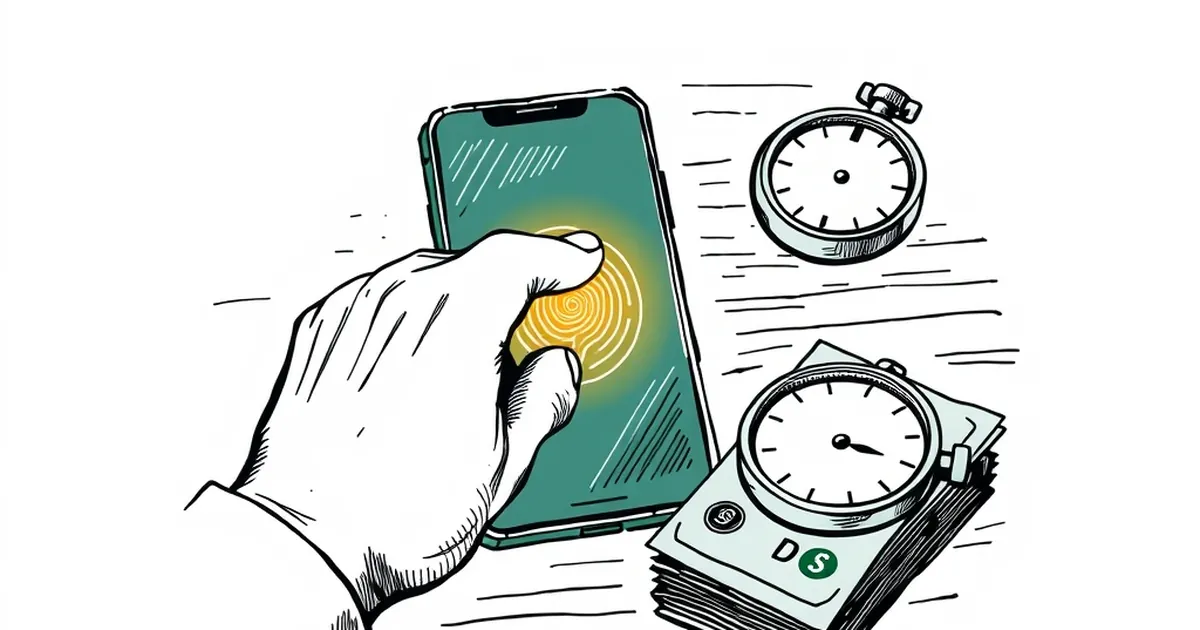
The pitch is simple: you pass a face or fingerprint check that takes roughly five seconds, and your withdrawal lands in your bank account within two hours. Not "within 24 hours pending review," not "3–5 business days." Two hours, gated by a biometric step most players barely notice. That's the claim several licensed operators have been making since early 2024, and it's worth pulling apart, because the five-second check is the least interesting part of the promise.
What the biometric step actually does
A liveness-detecting face scan or a fingerprint match against your device's secure enclave is doing one job in this flow: confirming that the person requesting the payout is the same person who registered the account. That's it. It is not verifying your identity against a government database, and it is not the reason the money moves fast.
The reason the money moves fast is that the operator front-loaded the slow part. Identity documents, address proof, source-of-funds checks, and payment-method ownership — all of that gets collected and verified at signup or first deposit, not at withdrawal. By the time you hit "cash out," the compliance file is already closed. The biometric is just the final handshake that says the account holder is present and consenting.
Where this gets murky is the word "biometric." In practice, most implementations aren't storing your face. They're generating a mathematical template, matching it, and discarding the image. Some operators use third-party vendors that keep the template for the life of the account; others re-verify from scratch each time. The difference matters if you ever want your data deleted, and it's rarely spelled out in the terms you click through.
The five seconds is a floor, not an average
Five seconds is a best case: good lighting, a phone made in the last four years, a stable connection. A face scan on a mid-range Android over hotel Wi-Fi can take twenty seconds and two retries. That's still fast enough not to matter, but the marketing number is doing some work.
Where the two hours come from
Payout speed is a chain, and the biometric is one link. The others:
Payment rail. Instant bank transfers in markets like the UK, Poland, and Brazil can settle in minutes. Card withdrawals often can't — many card networks still batch refunds on their own schedule, and no amount of operator-side speed fixes that. If your payout is going back to a Visa, "two hours" may mean two hours to approve, with the funds landing whenever the network gets around to it.
Operator-side risk checks. Most platforms run automated anti-fraud scoring on every withdrawal. A clean account with consistent play patterns clears instantly. An account that deposited €50, played one hand of blackjack, and requested €4,800 gets flagged, and a human looks at it. That human is not working at 3 a.m. on a Sunday.
Licensing jurisdiction. Operators licensed in Malta, Gibraltar, or the UK are held to payout-time expectations that the regulator can audit. Curacao-licensed sites face lighter scrutiny, which is one reason you see faster advertised times on some of them — the advertising isn't backed by the same enforcement.
The honest version of the claim: two hours is achievable and routine for verified accounts withdrawing via instant rails during business hours. It is not a guarantee, and any operator presenting it as one is overselling.
One number worth holding onto
The UK Gambling Commission's 2023 remote gambling participation data put the median withdrawal time reported by players at somewhere between one and three days depending on payment method — with e-wallets clustered at the fast end and card refunds at the slow end. Two hours isn't a small improvement on that. It's a different category. Which is exactly why it's being used as a marketing hook.
Why operators are racing on payout speed
Payout speed has become the most reliable differentiator left. Bonus terms are broadly similar across the market, game libraries are largely the same slots from the same four or five studios, and licensing is a commodity. What a player remembers is whether they got their money when they expected it.
There's a regulatory tailwind too. Several jurisdictions have moved toward requiring operators to complete verification before a player can deposit, precisely to eliminate the withdrawal-time document dump. When verification happens at the front door, the back door opens fast. The biometric check is a natural companion to that shift: it lets an operator confirm presence without asking for a passport photo for the fourth time.
The uncomfortable part is that fast payouts also make it easier to lose money quickly. A two-hour withdrawal cycle means a player can deposit, lose, withdraw what's left, and re-deposit inside an afternoon. Speed is a player-protection feature and a churn accelerator at the same time, depending on who's using it. That's not an argument against fast payouts — slow payouts are worse, and the "pending" period has historically been used to encourage reverse withdrawals, which is its own problem. It's just worth naming.
What to check before you believe the two hours
If a site advertises a two-hour payout, the questions that actually resolve it:
- Is the two hours from request or from approval? Some operators start the clock after their own review, which can take a day.
- Which methods qualify? Instant bank transfer and e-wallets usually do. Card refunds often don't.
- Are you fully verified before your first withdrawal? If not, the two hours doesn't apply to you yet.
- What's the minimum and maximum? A two-hour promise on withdrawals under €100 is a different offer than one on €10,000.
- Is there a fee? Some operators charge for instant payouts, which quietly converts a speed feature into a paid tier.
None of these are gotchas. They're the normal terms of a financial service, and a site that answers them plainly is telling you something about how it handles everything else.
The bigger question is where this goes next. If five seconds of biometric confirmation is enough to release funds in two hours, the same infrastructure could gate deposit limits, cooling-off periods, or self-exclusion with the same friction. A face scan that confirms you're you before a withdrawal is one design choice. The same scan confirming you're you before a deposit you set a limit against is a different one — and no operator has yet made that the pitch.