A 2-Second Decline Feels Worse Than a 30-Minute Queue
A 2-second payment decline stings more than a 30-minute wait, revealing the hidden psychology of expectation and perceived effort
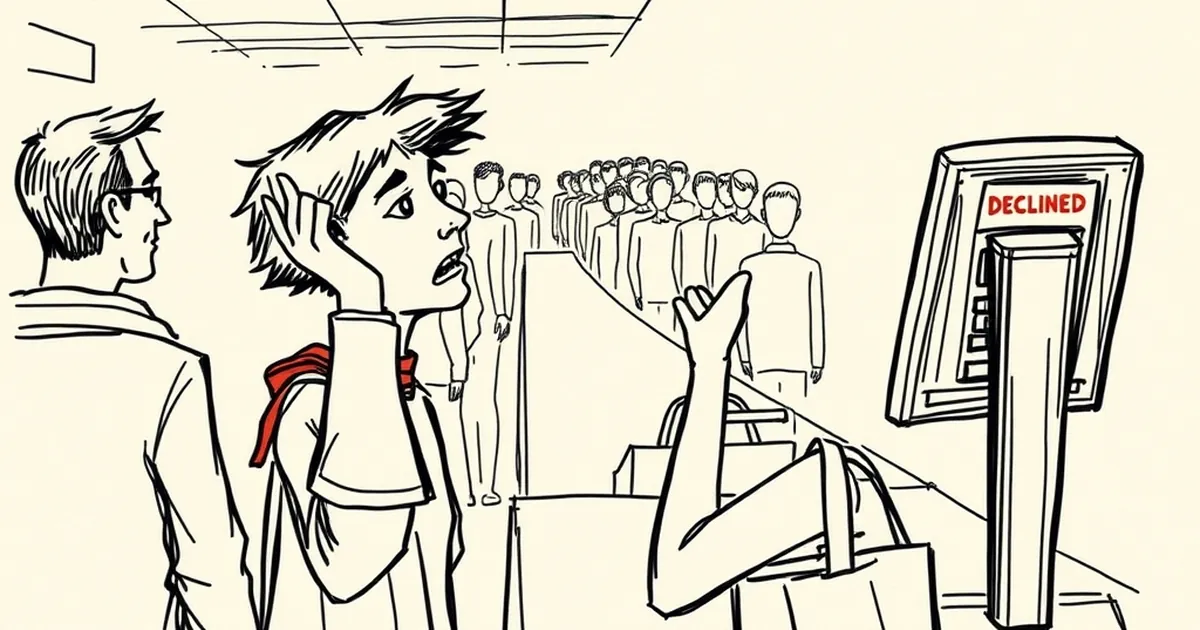
The other day, I watched a friend try to buy a pair of limited-edition sneakers. He spent forty minutes refreshing a website, fighting through a digital waiting room, and typing his card details twice. When the payment finally went through, he exhaled like he’d just finished a marathon. Later that week, he tried to pay for coffee with a new digital wallet. The terminal blinked, then displayed a generic error. He swore under his breath and said the app was "garbage." Same person, same amount of money involved, but wildly different emotional reactions. Why does a 2-second decline feel like a personal insult, while a 30-minute queue feels like a minor inconvenience?
The answer isn't about technology. It’s about the psychology of time, control, and perceived fairness. For those of us building payment systems, this asymmetry is the difference between a customer who shrugs and a customer who tweets angrily at 7 AM. Let’s unpack why our brains are wired to hate the quick rejection more than the slow grind.
The Tyranny of the Immediate "No"
Think about the last time a card was declined. It wasn't just a transaction failure; it was a micro-trauma. In that split second, your brain registers a social rejection. You’re not just being told "insufficient funds"—you’re being told "you don't belong here," or "you made a mistake." This triggers the anterior cingulate cortex, the same region that lights up when we experience physical pain.
Psychologists call this the "peak-end rule," but I think it’s simpler. A decline is a binary event: a hard stop. There’s no progress bar, no "please wait," no sense of movement. The queue, however torturous, is a process. It’s a narrative. You are in the story of getting the item. The decline is a full stop, and our brains hate unfinished narratives. We crave closure, and a decline gives us the worst kind of closure—a definitive, embarrassing "no."
The Variable-Ratio Trap of Approval
Here’s where it gets tricky for payment providers. We know that a decline feels awful, so we try to make approval feel amazing. But we’ve accidentally created a behavioral loop. Consider the mechanics of a loyalty app that gives you points for every purchase. That’s a fixed-ratio schedule—you get a reward every time. But when you add "surprise" bonuses, or when a payment goes through after a moment of suspense (like a spinning wheel), you’re tapping into variable-ratio reinforcement, the same mechanism that makes slot machines addictive.
The problem? We’ve trained users to expect a dopamine hit on approval. When that hit is denied—even for a valid fraud check—the letdown is amplified. The 2-second decline isn't just a failure; it’s a broken promise in a reward loop. That’s why a decline feels like a betrayal, while a queue feels like a challenge. The queue still holds the promise of the reward; the decline snatches it away.
The Illusion of Control vs. The Reality of the Queue
Let’s talk about the 30-minute queue again. Why is it tolerable? Because of agency. When you’re in a queue, you are making a choice to stay. You can leave at any moment. That decision to persist is yours. It’s an active choice, and active choices feel like part of a plan.
A decline, however, removes all agency. You are passive. The system looked at you and said "no," and you have no immediate recourse. This is a direct hit to our sense of autonomy. Kahneman and Tversky’s work on loss aversion tells us that losses loom larger than gains, but this is deeper than that. It’s about unexpected losses. A queue is an expected cost of doing business. A decline is an unexpected cost that we weren't prepared to budget for psychologically.
The "Fairness" Heuristic
There’s also a fairness component. A queue is egalitarian. Everyone waits. It’s the great equalizer. You might grumble, but you can see the system working. A decline is opaque and personal. You don't know if it's your bank, the merchant, or a glitch. This ambiguity triggers a fairness heuristic—we immediately assume we’ve been singled out for punishment.
I remember a study from a few years back on "service recovery." Researchers found that when a service fails slowly (e.g., a delayed flight with clear updates), customers rated their experience higher than when a service failed quickly (e.g., a cancelled flight with no explanation), even if the total delay time was identical. The key variable wasn't time—it was information and perceived effort. The slow failure felt like the company was trying. The quick failure felt like indifference.
Designing for the "Graceful Decline"
So what do we do with this? We can’t make declines feel good—that would be dishonest. But we can make them feel less personal and more process-oriented. The goal isn't to remove friction; it's to reframe the friction as a narrative.
Here’s a concrete shift in thinking: treat the decline like a queue. Instead of a stark "Transaction Failed," what if the system said, "We need to verify this with your bank. This will take 30 seconds."? You’ve just converted a 2-second rejection into a 30-second queue. You’ve given the user a timeline and a reason. You’ve restored agency because now they can decide to wait or not.
The "Soft Decline" and the Fallback Ladder
The most forward-looking payment systems are moving toward what I call the "fallback ladder." Instead of a hard decline, the system automatically tries a different funding source, or suggests a different card, or offers a "pay later" option. This is the opposite of the binary stop. It’s a branching path. The user is no longer stuck at a dead end; they’re at a fork in the road.
This isn't just about UX niceties. It’s about reducing churn. When a decline happens, the user’s brain goes into a defensive, risk-averse state. They’re more likely to abandon the cart entirely. But if you offer a graceful alternative—even if it takes longer—you’re keeping them in the "queue" mindset. You’re allowing them to remain an active participant in the transaction.
The Future: Making Delay the Feature, Not the Bug
Looking ahead, I think we’ll see a shift in how we frame latency. Right now, speed is king. But we’re realizing that perceived speed is more important than actual speed. A 50-millisecond approval that feels robotic is less valuable than a 2-second approval that feels thoughtful.
Imagine a payment interface that shows you a tiny, animated "checking with your bank" indicator, even if it’s fake. Why? Because that tiny delay signals effort. It signals that the system is doing something on your behalf. It’s the psychological equivalent of a human cashier looking up at you and saying, "Let me just double-check this for you."
The 30-minute queue works because it tells a story: "This is worth waiting for." The 2-second decline fails because it tells no story at all. The next generation of payment design isn’t about making things faster—it’s about making the inevitable moments of friction feel like chapters in a story, not dead ends. Give the user a reason to wait, and they’ll wait. Give them silence and a red "X," and they’ll take their business—and their bruised ego—somewhere else.