A 1.2-Second Decline Feels Like a Wrong Input
Why a 1.2-second payment delay triggers panic, and what it reveals about trust in digital finance
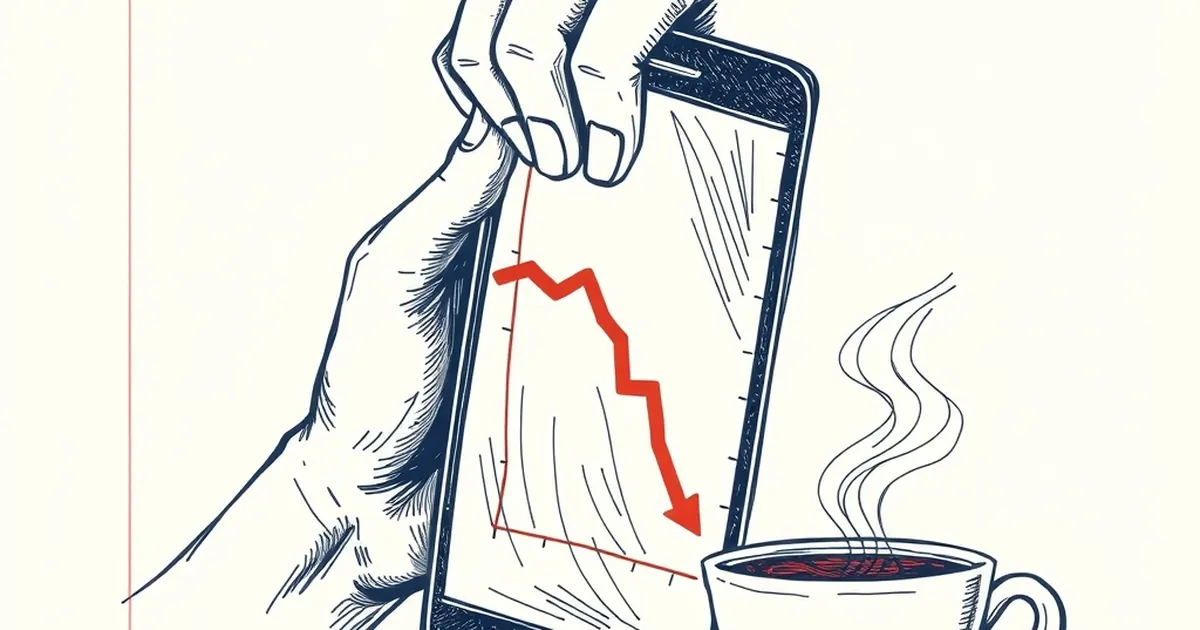
The other day I was tapping through my banking app, checking a transfer I’d made, and I noticed something odd. The screen took about 1.2 seconds to confirm the transaction—long enough for my thumb to hover nervously over the "cancel" button, long enough for my brain to whisper, "That didn't go through, did it?" It made me wonder: why does a delay that is objectively trivial feel like a catastrophic error? And more importantly, what does that split-second of panic tell us about how we interact with the invisible, high-stakes world of digital payments?
We tend to think of finance as a purely rational domain—a place of spreadsheets, APR calculations, and cold, hard numbers. But the reality is that every swipe, tap, and click is processed through a very old, very emotional brain. The intersection of behavioral psychology and payment infrastructure isn’t just about user interface design; it’s about the fundamental architecture of trust. Let’s pull back the curtain on that 1.2-second gap and see what it reveals about decision-making, risk, and the reward loops we’ve built into our daily financial lives.
The Tyranny of the Instant
We live in an era of instant gratification, and nowhere is that more pronounced than in the payments ecosystem. Visa and Mastercard have spent decades engineering networks to process transactions in milliseconds. The industry’s unofficial mantra is "the faster, the better," and for good reason—speed reduces friction, and friction kills conversion. But there’s a dark side to this velocity.
The Expectation Gap
The problem is that our brains have not evolved to process digital speed. We’ve evolved to process physical cause-and-effect. When you hand a cashier a $20 bill, the feedback loop is tactile and immediate: you see the bill leave your hand, you see the change return. There’s no lag. But with a card or a phone, the feedback is abstract. The only signal we get is the screen’s response.
When that response takes longer than about 400 milliseconds—the threshold for what neuroscientists call "perceived immediacy"—our brains start to fill in the gaps. And what do they fill them with? Anxiety. This is where loss aversion, a concept popularized by Daniel Kahneman and Amos Tversky, kicks in. We are wired to feel the pain of a loss roughly twice as intensely as the pleasure of a gain. In that 1.2-second window, your brain isn't thinking, "The system is processing." It’s thinking, "I’ve lost control, and something is wrong."
The Architecture of Uncertainty
This brings us to a fascinating paradox: the payment networks themselves are designed to be resilient, but that resilience often translates into user-facing uncertainty. When you make a purchase, the transaction isn't just a single ping. It’s a complex handshake between your bank, the merchant’s bank, and the card network—often bouncing across multiple servers and fraud-detection algorithms.
The Fraud-Detection Dance
Here’s where it gets interesting. The very systems we rely on to keep our money safe are the ones introducing the "lag." A 1.2-second delay often isn't a network bottleneck; it’s a risk-assessment engine running a thousand variables simultaneously. It’s checking your location, your spending habits, the merchant’s category code, and the velocity of your recent transactions.
This is a classic example of a variable-ratio reinforcement schedule, a concept from behavioral psychology that’s usually associated with dopamine hits. In this case, the "reward" isn't a payout—it's the confirmation of a successful transaction. But because the delay varies (sometimes it’s 0.3 seconds, sometimes it’s 1.2), we become hyper-vigilant. We never know when the "reward" (approval) is coming, so we pay excessive attention to the process. This uncertainty is the price we pay for security, but it’s also a direct line to our stress response.
Competitive Play and the "Near-Miss" Effect
Think about the last time you used a contactless payment at a turnstile or a vending machine. There’s a subtle gamification to it. You tap, and you wait. If the light flashes green quickly, you feel a tiny surge of satisfaction—a win. If it takes a beat longer, or worse, if it flashes red, you feel a disproportionate sense of failure.
This is remarkably similar to what psychologists call the "near-miss" effect in competitive play. It’s the feeling you get when you almost achieve a goal. In behavioral economics, a near-miss increases the motivation to try again. For payment systems, a slow confirmation acts as a near-miss for a successful checkout. It makes you more likely to re-tap, to check your balance, to obsess over the details.
But here’s the twist: in the world of high-stakes finance, this near-miss effect can be dangerous. It can lead to "click fatigue" or, worse, to double-charging because you tap again in frustration. The payment networks know this, which is why they spend billions on latency reduction. But they’re fighting a losing battle against our evolutionary wiring.
The Certainty of Uncertainty
So, what do we do with this knowledge? The future of payments isn’t just about making things faster; it’s about managing the perception of speed. The industry is already moving toward "smart receipts" and real-time push notifications, but the real innovation will come from addressing the psychological gap.
Designing for the Brain, Not the Server
Forward-looking solutions are starting to borrow from behavioral design principles. For example, some apps now use "progress skeletons"—those ghost-like placeholders that show a layout before the content loads. This isn't just a visual gimmick; it’s a psychological hack. By showing the structure of the result (e.g., "Payment to: John Doe, Amount: $50"), the brain is given a pre-emptive signal that the action is being processed. It shifts the narrative from "is it broken?" to "it’s on its way."
Another emerging trend is the "temporal buffer." Instead of hiding the latency, some fintech apps are starting to embrace it. They’re turning the 1.2-second wait into a moment of proactive information display—showing the steps of the security check in real-time. This converts an opaque delay into a transparent process, effectively handing control back to the user.
The practical takeaway for you, the user, is to recalibrate your own internal clock. The next time you see that spinning wheel for a second or two, don't interpret it as a sign of failure. Recognize it as a sign of work—a complex system doing its due diligence. It’s the equivalent of a bank teller double-checking your ID, but in microseconds.
As we move toward a future of embedded finance and invisible payments, the friction won't disappear; it will just become more subtle. The challenge for the industry—and for us as consumers—is to build a relationship with time that isn't based on panic. We need to accept that a little bit of uncertainty is the price of security. The next time your payment hangs for a moment, take a breath. That pause isn't a wrong input; it's the sound of the system thinking on your behalf. And that’s a feature, not a bug.