A $10 table bet settles in 2s; the tilt lasts 3 hours
A $10 blackjack hand resolves in two seconds, but the tilt can last three hours. That mismatch between money speed and human reset is the real product problem
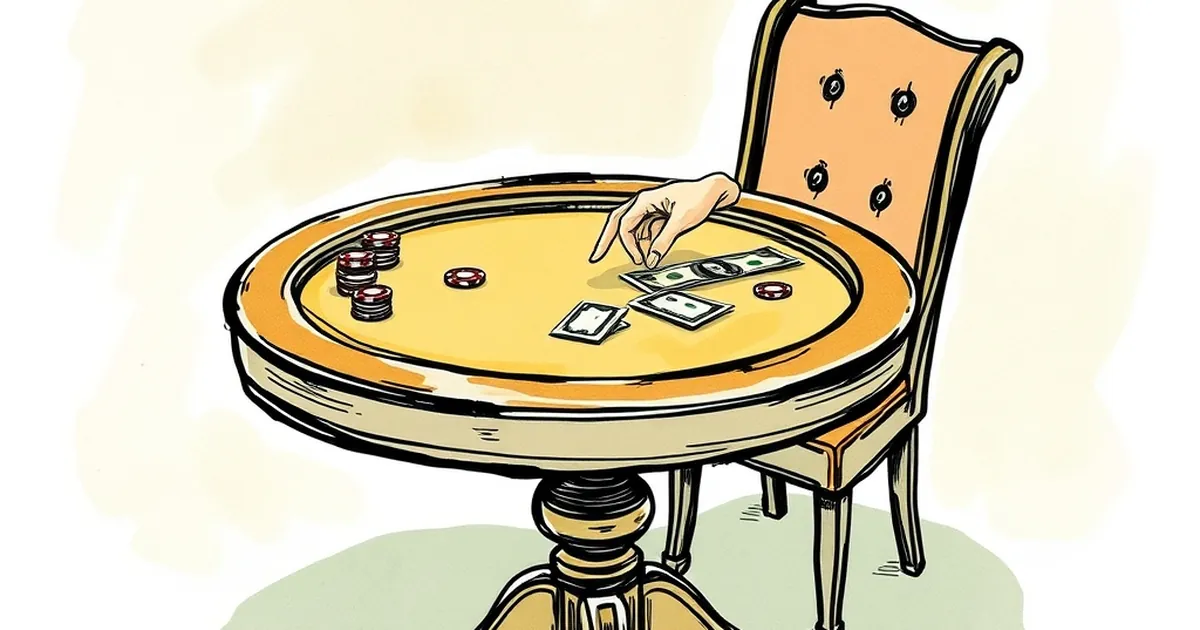
A single hand of blackjack at a $10 table resolves in about two seconds — shuffle, deal, decision, done. The emotional aftermath of a bad beat at that same table can run for three hours, sometimes longer. The bet and the tilt operate on completely different clocks, and almost nothing in the interface between you and the game acknowledges that.
That mismatch is the real product problem in online gambling. Not RTP. Not house edge. The gap between how fast money moves and how slowly a human nervous system resets.
The two-second bet is a design choice, not a fact of nature
Live dealer blackjack streams run on a physical table with a physical dealer, so the pace is bounded by human movement: roughly 40 to 60 hands per hour at a full table, faster at heads-up. RNG blackjack is unbounded. A skilled player clicking through decisions can clear 300 hands an hour. At $10 flat, that's $3,000 of handle per hour and an expected loss of around $15 at a 0.5% house edge with basic strategy — or $60+ if you're playing badly at 2%.
Slots are worse on this axis. A modern video slot spins in under two seconds with turbo enabled. At 600 spins an hour and $1 per spin, a 96.2% RTP game bleeds about $23 an hour in expectation, but the variance means a single session can swing $400 either direction in twenty minutes. The money doesn't leave in a trickle. It leaves in clumps, and each clump lands in the same nervous system that just watched it happen.
This is the part regulators and operators rarely say out loud: speed is a feature. Turbo spin exists because players asked for it. Auto-play exists because clicking 600 times an hour is tedious. The product optimizes for hands-per-hour and spins-per-hour because handle is the revenue line, and handle scales with speed.
What actually happens in the three hours after
The tilt doesn't look like a movie. It looks like this:
- Minute 0–15: "I'm getting it back." Bet sizing creeps from $10 to $25 to $50. The justification is always specific — the dealer's on a run, the shoe's due, the slot just paid so it's hot.
- Minute 15–60: Loss chasing with a plan. Usually a Martingale variant. The plan has a mathematical ceiling that the bankroll doesn't reach, and you find that ceiling at the worst possible moment.
- Hour 1–2: The math stops mattering. Bets get rounder and bigger. $100 hands. Max bet on the slot. The original $10 is a rounding error in a session that's now down four figures.
- Hour 2–3: Exhaustion, then either a stop or a bigger deposit.
None of this is a character flaw unique to gamblers. It's the same loss-aversion loop that makes people hold losing stocks and sell winners — Kahneman and Tversky territory, well-documented since the late 1970s. Gambling just compresses the feedback loop from months to minutes. A stock portfolio gives you overnight to cool off. A $10 table gives you two seconds.
The bankroll math nobody runs mid-tilt
If you sit with $200 at a $10 table and play basic strategy at 60 hands an hour, your expected session length is somewhere north of 20 hours before the house edge grinds you out — assuming you don't tilt. With tilt, that number collapses. Doubling bet size after every loss cuts it by roughly two-thirds. The house edge doesn't need to beat you. Your own escalation does.
Why the tools that exist don't catch it
Operators and regulators have built a real apparatus around problem gambling: deposit limits, session timers, reality checks, self-exclusion registers, in some jurisdictions mandatory loss limits. The UK Gambling Commission requires operators to intervene at certain markers of harm. Sweden's Spelpaus register has over 100,000 active self-exclusions. Australia banned credit card deposits for online gambling in 2020.
These tools share a structural weakness: they're set in advance, by the calm version of you. A deposit limit of $500 a week is a rational commitment device when you set it on a Tuesday. It's an obstacle when you're three hours into a tilt on a Saturday and the limit blocks the deposit that would "get it back."
The friction is real, and it works — mostly. But there's a category of tilt that sits under every threshold: sessions that never trip a flag, never hit a limit, never trigger an intervention, and still cost $800 and a night's sleep. The harm is real, the metrics don't see it, and neither does the operator's risk model.
Reality checks are the wrong shape
A popup every 60 minutes saying "You've been playing for an hour" is a speed bump on a road that already has a cliff at the end. It reports time, not money, and time is the least useful variable in a tilt. A player down $600 in 45 minutes doesn't need to know it's been 45 minutes. They need to know they're down $600 and their next 20 bets at current sizing will cost another $400 in expectation.
Some operators have moved to loss-based reality checks — popups triggered by net loss thresholds rather than elapsed time. That's directionally right. It's also the kind of feature that reduces handle, which is why it shows up in licensed markets with regulatory pressure and rarely anywhere else.
The asymmetry no product fixes
The bet settles in two seconds because the operator wants it to. The tilt lasts three hours because the brain is wired that way. Between those two facts sits everything interesting about online gambling as a consumer product: the speed is engineered, the emotional aftermath is not, and the tools meant to bridge the gap are built for the calm player, not the tilted one.
The open question isn't whether operators can build better interventions. They can, and a few are. The question is whether an industry whose revenue scales with hands-per-hour has any structural incentive to slow the clock down to match the human one — or whether that job will keep falling to regulators, and to whatever's left of a player's judgment at hour two.