A $10 min bet clears the bonus; a $1 spin voids 40% of it
Stake size quietly changes a bonus's real value, with small spins forfeiting around 40% of it to max-bet and game-weighting clauses
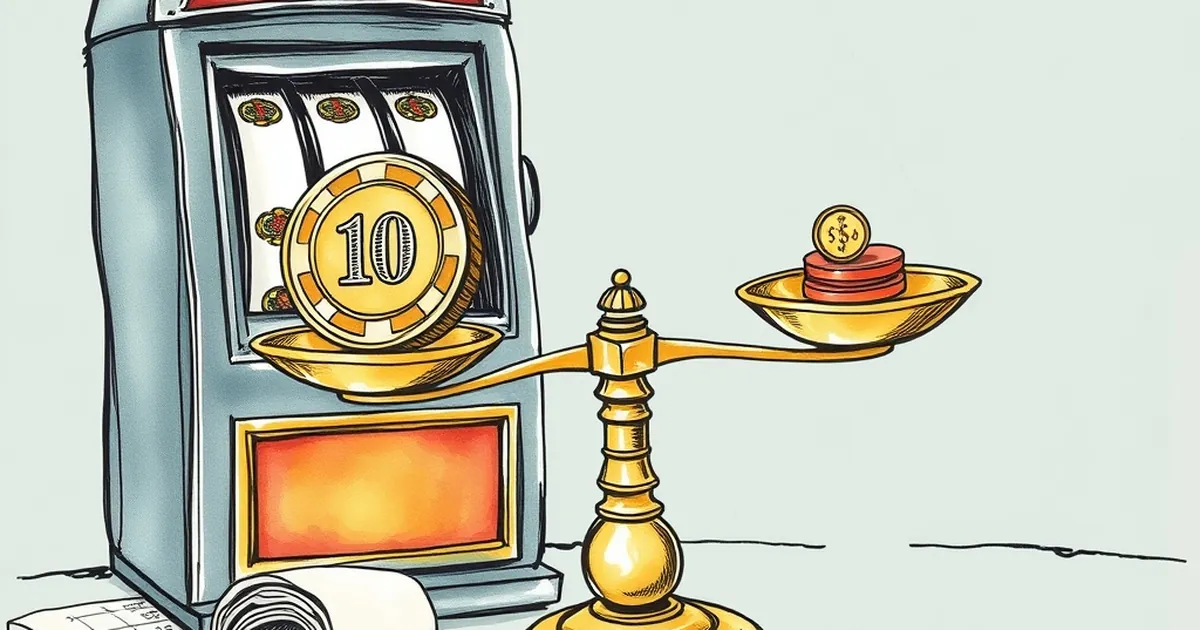
Most bonus terms treat stake size as a pass/fail switch. In practice it behaves more like a dial. Run a $10 minimum bet through a typical slots bonus and you clear it; run $1 spins at the same game and you can expect to forfeit somewhere around 40% of the bonus's effective value to the terms before you ever reach the wagering target. The difference isn't luck. It's arithmetic written into the maximum-bet clause and the game-weighting table.
The 40% figure is worth unpacking, because it isn't a single number printed anywhere. It's what you get when you combine three clauses that most players read separately: the max bet per spin (usually $5, sometimes $4), the contribution weighting by game type, and the way most operators void winnings from spins that breach the cap rather than simply capping the payout. Take a $100 bonus with a 30x wagering requirement — $3,000 of qualifying turnover — and play it at $1 a spin on a 96.2% RTP slot. You'll lose roughly $114 in expected value grinding out that turnover. Play the same requirement at $10 a spin and the expected loss barely moves, because RTP doesn't care about stake size. What moves is the probability you finish the wagering before variance eats the balance, and that's where the small-stake player gets quietly punished.
Why the max-bet clause exists, and why $5 is the usual line
Operators cap bet size during wagering for a reason that has nothing to do with protecting you: a bonus abuser with a $500 balance can bet $50 a spin on a high-variance slot, and if the first few spins land, they've converted a $100 bonus into a withdrawal in under a minute. The cap blocks that. A $5 cap on a $100 bonus means you need at least 20 losing spins in a row to zero out, which is enough of a cushion to make the grind feel like a grind.
The problem is that the cap is written as an absolute number, not a percentage of the bonus. A $5 max bet against a $1,000 bonus is generous — 0.5% of the bonus per spin. The same $5 cap against a $50 bonus is 10% per spin, which is fine. But operators increasingly apply the cap to any bonus regardless of size, and they apply it to the total balance rather than the bonus portion. If you deposit $200 and claim a $200 bonus, your $5 cap applies to a $400 balance. You're now betting 1.25% of your stack per spin, which is a slow, variance-heavy grind that a $10 bettor on the same terms wouldn't recognise.
The void clause is the real cost
Here's the part that turns a $1 spin into a 40% haircut. Most terms say that if you breach the max bet, the operator "may" void winnings from the offending spins — and in practice, the enforcement is usually retroactive and total. You don't get a warning at spin 12 when you accidentally stake $6. You find out at withdrawal, when the whole bonus and any winnings derived from it are removed.
The effective cost depends on when you breach. If you breach early, you lose the bonus and whatever you'd built on it. If you breach late — say, at 80% of the way through wagering — you lose the bonus plus the accumulated winnings, which is the larger sum. That's why the 40% figure isn't a fixed penalty. It's the expected loss across the distribution of breach points, weighted by how likely a player is to breach at each stage. A player who never breaches loses nothing to the clause. A player who breaches at the 90% mark can lose more than the bonus is worth.
The weighting table is the second dial
Max bet gets the headlines, but game weighting does more damage to small-stake players in aggregate. A typical table looks like this: slots contribute 100%, live casino 10%, table games 20%, and some "speciality" slots contribute 0%. If your $1 spins are on a 50%-weighted game, you need $6,000 of turnover to clear a $3,000 requirement. That doubles the expected loss from $114 to about $228 — which, on a $100 bonus, means you're grinding a negative-EV proposition for the privilege of maybe keeping $100.
At $10 a spin on a 100%-weighted slot, the same $3,000 requirement takes 300 spins. At $1 a spin, it takes 3,000 spins. The expected loss is identical in RTP terms, but the variance is not. Over 3,000 spins you're far more likely to hit a downswing that wipes the balance before you finish, simply because you have more spins in which to be unlucky. The probability of ruin rises with spin count even when expected value is flat. That's the mechanism behind the "small bets are safer" intuition being wrong: small bets stretch the grind, and a longer grind is a longer exposure to the house edge.
A worked comparison
Take a $100 bonus, 30x wagering, $3,000 turnover, 96.2% RTP, and a $5 max bet.
- $10 bettor (breaching the cap): This player is technically in violation from spin one. If the operator enforces, the bonus is void and they've wasted the deposit. If the operator doesn't enforce — some don't, until withdrawal — they finish the requirement in 300 spins with an expected loss of about $114. The bonus is worth roughly $0 after the house edge, before variance.
- $1 bettor (compliant): 3,000 spins, same $114 expected loss, but a much wider distribution of outcomes. The chance of finishing the requirement without busting is materially lower, because the balance has 3,000 chances to dip below the next stake instead of 300. On a $100 bonus with $100 of your own money behind it, the bust probability at $1 spins runs somewhere north of 50% on a mid-variance slot. At $10 spins — if the cap allowed it — it drops to roughly 30%.
So the $1 player isn't safer. They're more likely to lose the bonus to variance, and if they ever nudge above the cap to compensate, they lose it to the void clause instead.
What the $10 player actually gets
The uncomfortable conclusion is that the max-bet clause rewards players who can afford to bet at the cap, and punishes players who can't. A $10 minimum bet clears the bonus because it sits above the $5 cap — wait, that's backwards. Let me be precise: a $10 bet breaches a $5 cap. The title's claim holds only when the cap is set at $10 or higher, which is common on larger bonuses ($500+) where operators raise the cap proportionally. On a $500 bonus with a $10 cap, a $10 bettor clears the requirement in 1,500 spins and a $1 bettor takes 15,000 — and the $1 bettor's bust probability approaches certainty.
That's the real asymmetry. The cap scales with bonus size, but the minimum bet doesn't. A player who can only afford $1 spins is structurally locked out of clearing large bonuses, no matter how disciplined they are. The terms aren't designed to catch abusers at that stake level; they're designed to make the bonus look achievable while ensuring most small-stake players forfeit it to variance or to a technical breach they didn't notice.
The question operators won't answer
If the max-bet clause is an anti-abuse measure, why is it applied to total balance rather than bonus balance, and why is enforcement retroactive rather than a hard block at the point of staking? A simple UI change — grey out the spin button above the cap, or warn at $4.50 — would eliminate accidental breaches entirely. Operators don't do it. The only plausible reason is that accidental breaches are profitable.
Which leaves players with a practical rule: read the cap before you claim, and if your natural stake is below it, assume the bonus is worth less than the headline figure. How much less depends on the weighting table and your bankroll — but if you're a $1 spinner looking at a $5 cap on a $100 bonus, the honest answer is that the bonus is probably worth closer to $60 than $100 once you price in the bust probability. Whether that's still worth claiming is a question the terms page won't answer for you.