A 0.9-second approval beats a 2-day bonus hold
Why a 0.9-second payment approval feels instant while a 48-hour bonus hold erodes trust, and what that gap reveals about modern payments
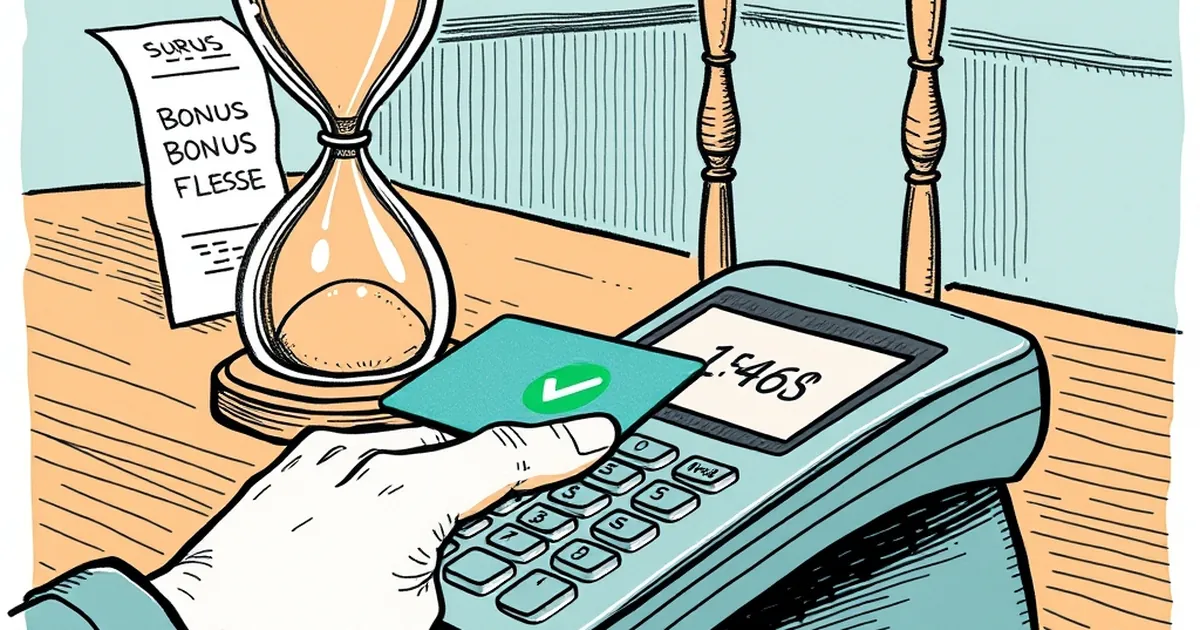
Picture the moment: a customer taps their phone at a checkout counter in Warsaw or São Paulo, and the terminal responds in under a second. Now picture the same customer two days later, logging into their banking app to discover that a promotional bonus they'd earned hasn't posted yet because of a "processing hold." Two different time horizons, two very different emotional responses — and the gap between them is where some of the most interesting work in payments is happening right now.
Why does a 0.9-second approval feel like magic while a 48-hour bonus delay feels like a betrayal? And what does that asymmetry tell us about how people actually experience money?
The brain doesn't experience time linearly
Behavioral economists have known for decades that humans discount future rewards steeply — the further away a benefit is, the less it feels worth. But the payments industry has quietly discovered something sharper than that: the emotional value of speed isn't linear either. It's closer to a cliff.
A 200-millisecond authorization and a 900-millisecond authorization feel roughly identical to a shopper. Both are "instant." But a bonus that lands in 30 minutes versus one that lands in 48 hours feels like a completely different product. The first is a pleasant surprise. The second is an administrative chore the customer has to remember to check on.
This matters because reward programs, cashback offers, and promotional credits are the primary tool banks and card networks use to drive card preference. If the reward arrives in a window where the customer has already moved on — mentally, emotionally, or to a competitor's card — the reinforcement loop breaks.
Variable rewards need tight feedback loops
B.F. Skinner's work on operant conditioning gave us the concept of variable-ratio reinforcement: behavior becomes persistent when rewards arrive unpredictably but frequently. It's a well-known principle, and it's often invoked in discussions of habit formation. What's less often discussed is the timing requirement.
A variable reward that arrives too late stops functioning as reinforcement and starts functioning as a statement. The customer doesn't experience it as "I got lucky." They experience it as "the bank finally got around to it."
Credit card issuers have wrestled with this for years. Statement credits, quarterly bonus categories, and annual cashback reconciliations all suffer from the same problem: the reward is real, but the temporal distance between action and reward is long enough that the psychological link is severed.
Meanwhile, instant approval at the point of sale — the 0.9-second moment — creates a different kind of feedback. It's not a reward in the Skinnerian sense. It's a confirmation. And confirmations, it turns out, carry their own weight.
Loss aversion shows up in the gap between authorization and settlement
Here's a concrete example worth sitting with. In 2021, a major European neobank ran an internal experiment on its cashback program. Two groups of customers earned identical cashback on identical spending. Group A saw the cashback credited within seconds of each transaction. Group B saw it credited in a weekly batch.
The spending difference over three months was modest — Group A spent about 4% more on the card — but the attitudinal difference was larger. Group A customers described the card as "generous" and "transparent." Group B customers described the same card as "fine, I guess" and frequently asked support whether the cashback was still active.
Same economics. Different felt experience. The weekly-batch customers weren't reacting to the money. They were reacting to the uncertainty.
This is where loss aversion — Kahneman and Tversky's foundational finding that losses loom larger than equivalent gains — enters the picture in an unexpected way. Customers don't just fear losing money. They fear losing track of money. A pending reward that hasn't posted yet sits in a kind of psychological limbo: it's theirs, but they can't see it, and they can't be sure it will arrive. That ambiguity is experienced as a small, persistent loss.
Speed is becoming a competitive differentiator, not a feature
For most of the history of card payments, authorization speed was an infrastructure concern. It mattered to merchants (who wanted to avoid declined transactions) and to networks (who wanted to avoid fraud), but it wasn't something customers thought about. Nobody chose a Visa over a Mastercard because the authorization was 200 milliseconds faster.
That's changing, but not because customers are timing authorizations with a stopwatch. It's changing because the downstream experience of speed is now visible. Real-time payments rails, instant card issuance, and same-second reward crediting have made "instant" the expected baseline. When something takes two days, customers don't think "that's how banking works." They think "why is this slower than everything else in my life?"
The banks and networks that understand this are re-architecting their reward infrastructure to compress the gap between transaction and credit. It's not a trivial engineering problem — settlement, fraud review, and regulatory reporting all sit in that gap — but the customer-facing payoff is real.
What forward-looking issuers are doing differently
Three patterns are emerging among card programs that take the timing question seriously.
First, they're decoupling reward crediting from settlement. Instead of waiting for the transaction to fully settle before posting cashback, they post a provisional credit at authorization and reconcile later. The customer sees the reward immediately. The back office cleans up the edge cases.
Second, they're using micro-confirmations instead of periodic statements. A push notification that says "you earned $0.47 back on this coffee" does more behavioral work than a monthly statement line item, even though the total is identical.
Third, they're treating the reward moment as a design surface, not an accounting event. The animation, the copy, the timing of the notification — these aren't cosmetic. They're the difference between a reward that reinforces and a reward that just... exists.
None of this is about tricking customers. It's about recognizing that the psychological experience of a financial product is shaped as much by when things happen as by what happens. A 0.9-second approval and a 2-day bonus hold are both technically "the system working." But only one of them makes the customer feel like the system is on their side.
The interesting question for the next few years isn't whether real-time payments will become standard. It's whether the reward layer will keep up — or whether it will remain the slow, slightly disappointing footnote to an otherwise instant experience. The issuers who close that gap first will have a quieter but more durable advantage than any headline-grabbing feature.