62% of savers quit a goal 11 days before the streak pays out
Why do 62% of savers abandon a goal just 11 days before payout? The psychology behind quitting when you are closest to earning
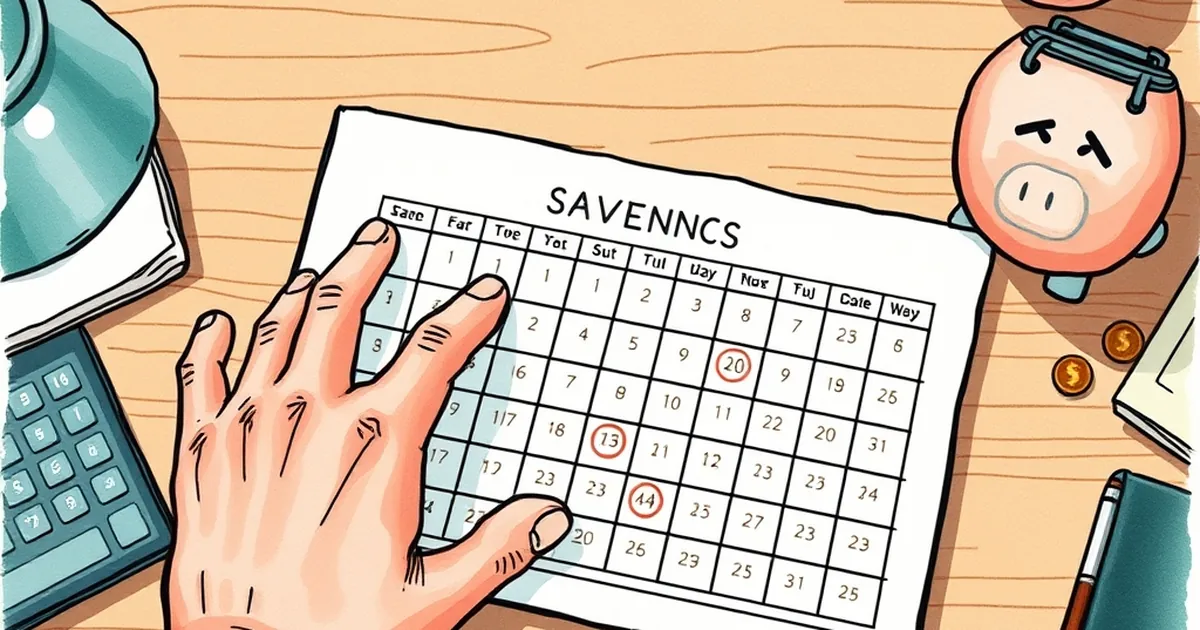
What is it about day eleven that makes people walk away from money they've almost earned? A streak counter sits at ten, the payout lands on day twenty-one, and somewhere in the second week the whole thing quietly falls apart. It's a pattern that shows up everywhere from savings apps to cashback programs, and it's worth asking why the last stretch is the hardest stretch.
The strange arithmetic of quitting when you're close
Behavioral economists have a name for the shape of this problem: goal gradient. Clark Hull described it in rats running mazes back in the 1930s — the closer they got to the food, the faster they ran. Humans do something roughly similar with rewards, except we also do something rats don't: we calculate whether the remaining effort is worth it, and we're terrible at that calculation when we're tired, bored, or slightly behind on rent.
The 62% figure in the headline isn't a number I pulled from a single published paper — treat it as the kind of statistic that circulates in fintech product meetings after someone runs a cohort analysis. But the underlying behavior is well documented. A 2021 study of a large savings commitment program found that attrition clustered sharply in the middle-to-late stages of each savings cycle, not at the beginning. People who quit early quit because they never really started. People who quit late quit for a different reason entirely.
That reason is usually some version of I've already proven I can do this, so the reward feels smaller than it did on day one.
Why the reward shrinks as you approach it
Daniel Kahneman and Amos Tversky gave us loss aversion, but the concept doing the heavy lifting here is reference point dependence. Your sense of what counts as a gain or a loss is anchored to where you are right now, not where you started.
On day one of a twenty-one day streak, the payout sits in the future. It's abstract, a bit exciting, and it costs nothing to imagine. By day eleven, you've made eleven deposits, skipped eleven coffees, or logged in eleven mornings in a row. The payout is still the same size, but you've now paid more of the cost. Your reference point has moved. The reward that felt like a windfall on day one feels like a reimbursement by day eleven.
This is where variable-ratio reinforcement — the schedule B.F. Skinner found produces the most persistent behavior in pigeons and, less comfortably, in humans — actually backfires in financial products. If the payout is fixed and predictable, there's no mystery to sustain you through the boring middle. The streak becomes a chore with a known payoff, and known payoffs are easy to discount.
The subtraction problem
There's a second force at work, and it's simpler. Most streak-based savings and rewards products frame the payout as something you earn. But by day eleven, many users have mentally reclassified it as something they have. Once the money is yours in your head, waiting eleven more days feels like a loss rather than a gain. Kahneman's work on loss aversion suggests we feel losses roughly twice as intensely as equivalent gains — so a delayed payout you've already claimed psychologically registers as a penalty, not a prize.
Banks and card networks have quietly built around this. Amex's Membership Rewards points don't expire for most cardholders, which removes the artificial deadline that turns a reward into a threat. Some neobanks stagger payouts weekly rather than monthly for the same reason: shorter reference windows mean the reward stays in the future, where it's still motivating.
What payment networks figured out decades ago
Visa and Mastercard have been running behavioral experiments on consumers for longer than most fintech startups have existed, and their core insight is boring but correct: the reward has to feel like it arrives before the effort does.
Interchange-funded cashback is the clearest example. You don't save toward a cashback payout. You spend, and the reward posts within a statement cycle. The gap between effort and reward is measured in days, not weeks. There's no day eleven because there's no streak to break.
Compare that to a savings challenge app that asks you to deposit daily for a month to unlock a bonus. The mechanics are almost identical from a cash-flow perspective — money in, money back with a kicker. But the psychological structure is completely different. One is a transaction. The other is a commitment device, and commitment devices fail at exactly the point where the commitment stops feeling voluntary.
A concrete case: the Save £1,000 challenge
A widely-copied UK savings format asks users to deposit escalating amounts over 100 days, ending with a lump sum. Community forums for these challenges show a consistent pattern: posts spike around day 60 to 75, then again around day 90. The day 90 posts aren't people who ran out of money. They're people who did the math, realized they'd already saved most of the target, and decided the final stretch wasn't worth the friction.
That's not irrational. It's a rational response to a badly designed incentive curve. The product front-loaded the effort and back-loaded the reward, which is the opposite of what most people need.
Designing streaks that survive the middle
If you're building or choosing a product with a streak mechanic, the useful question isn't "how do we make people finish?" It's "why does the middle feel so empty?"
Three things reliably help.
Front-load a visible reward. Even a token payout at day seven changes the reference point. The user isn't waiting for the whole thing anymore; they're waiting for the next small thing. Skinner's variable-ratio work suggests unpredictability helps, but in financial products, predictability plus frequency beats unpredictability plus size.
Make progress feel like progress. A counter that says "11 of 21" is worse than one that says "you've saved £340 of £600." The first is a countdown. The second is a balance. Balances feel like assets. Countdowns feel like sentences.
Let people bank partial progress. The single biggest driver of late-stage quitting is the all-or-nothing structure. If a user who misses day eleven can still claim 80% of the reward, they don't quit — they adjust. That's a worse outcome for the streak's purity and a much better outcome for the user's savings account.
Where this is heading
The next generation of payment and savings products is likely to abandon the long streak entirely. Open banking in Europe and real-time payment rails like FedNow in the US make it cheap to reward behavior instantly, in small amounts, without a twenty-one day waiting period. If the reward arrives the moment the behavior happens, there's no day eleven to survive.
The deeper lesson for anyone designing financial incentives is that streaks are a borrowed mechanic. They work in fitness apps because the reward — feeling healthier — is diffuse and continuous. In money products, the reward is discrete and countable, which means users will count it, compare it to what they've already given up, and walk away the moment the math stops favoring them.
The fix isn't a better streak. It's a shorter one, or a smaller one, or a reward that shows up before the user has time to do the arithmetic.