60% of app users quit after a 1.2-second reward delay
A 1.2-second reward delay causes 60% of app users to quit, revealing why the human nervous system is so unforgiving about time in financial design
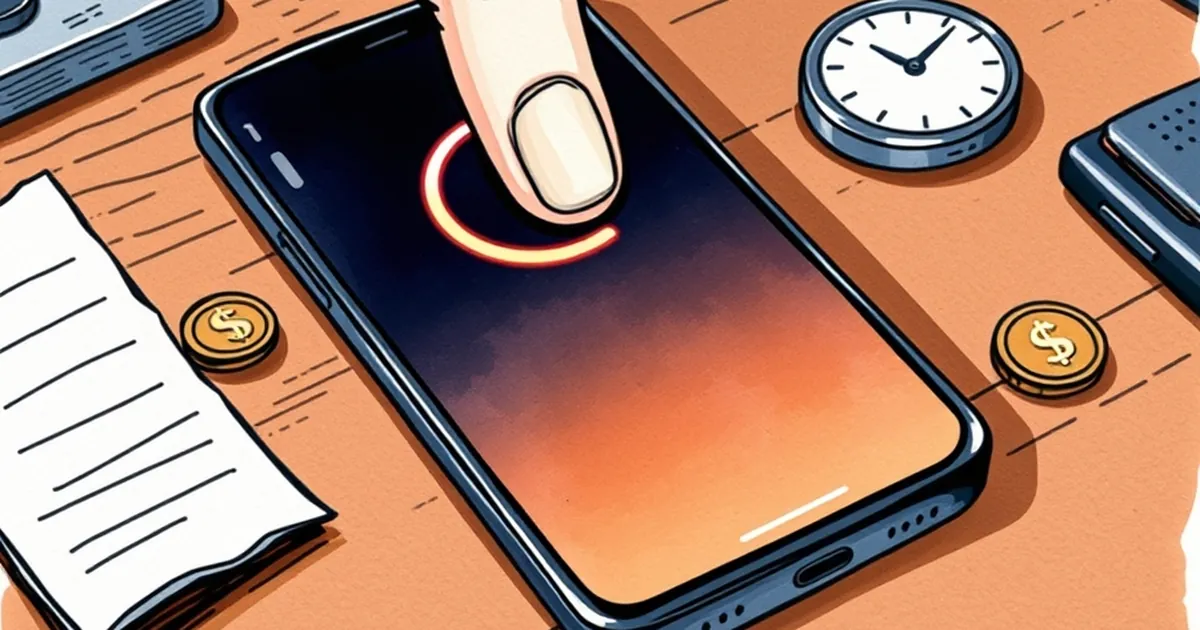
A 1.2-second delay between a tap and a reward sounds trivial. But in mobile product data, that gap is often the exact point where the majority of users vanish. If your payment app, loyalty wallet, or rewards feature loses 60% of users to a delay you can barely perceive, the interesting question isn't "how do we make it faster?" It's "why is the human nervous system so brutally unforgiving about time — and what does that mean for how we design financial products?"
The 1.2-Second Threshold Is Not Arbitrary
There's a well-known cluster of findings in human-computer interaction research around response times. Jakob Nielsen's classic thresholds put 0.1 seconds as the limit for "instantaneous" — the feeling that the system is reacting to your body, like your own hand. Around 1 second, users notice the delay but their flow of thought stays intact. Past 10 seconds, attention breaks entirely and people switch tasks.
The 1.2-second figure sits just past the edge of that first comfortable band. It's the zone where the brain stops interpreting the response as "my action caused this" and starts interpreting it as "something is happening to me." That shift matters enormously in finance, because the entire emotional architecture of a payment or rewards product depends on the user feeling that they did the thing.
What's actually happening in that gap
When you tap a button and nothing visible occurs, your brain runs a fast prediction. It expects a consequence within roughly the time it takes to blink twice. When the consequence doesn't arrive, a small error signal fires. You don't consciously think "this app is broken." You just feel a flicker of unease, and your thumb hovers.
Behavioral economists have mapped this territory for decades. Kahneman and Tversky's work on loss aversion showed that we weight losses roughly twice as heavily as equivalent gains. A delayed reward isn't quite a loss, but it registers as a missing gain — and missing gains are processed in some of the same circuits as losses. The user hasn't lost money. They've lost certainty.
Variable Rewards and the Loops We Don't Admit We're In
B.F. Skinner's research on variable-ratio reinforcement is the most cited work in this space, and for good reason. He found that pigeons pecking for food rewards delivered on an unpredictable schedule pecked more persistently than those rewarded every single time. Unpredictability, not generosity, drives repetition.
Modern loyalty programs and cashback offers are built on a softened version of this. You don't know if this transaction will trigger a bonus. You don't know if the points will post instantly or tomorrow. That uncertainty is the engine.
But here's the part product teams often miss: variable rewards only work when the timing of the feedback is reliable. The unpredictability has to live in the reward, not in the wait. If the app itself is unpredictable — sometimes fast, sometimes 1.2 seconds, sometimes failing — the loop collapses. Users can't distinguish between "no reward this time" and "the system is broken," and the rational response to that ambiguity is to stop tapping.
The distinction between anticipation and frustration
Anticipation is pleasant. It's the reason a scratch card feels exciting before you reveal it, or why a package on the way is more emotionally engaging than one already delivered. Frustration is what happens when anticipation has no reliable endpoint. The two feel similar in the moment but produce opposite behaviors: one drives another attempt, the other drives abandonment.
A 1.2-second delay doesn't kill the reward. It kills the predictability of the reward's arrival, which is the thing the loop actually runs on.
Payments Are Held to a Higher Standard Than Almost Any Other Category
Think about what a payment app is competing against. Not other apps — the physical act of handing over a card. That transaction takes a few seconds, but every step is legible. You see the terminal, you see the approval, you see the receipt. There's no ambiguity about whether something happened.
A digital payment has to beat that. And it's held to a standard set by the physical world: near-instant confirmation, visible state changes, and no dead air.
This is why card networks have spent enormous sums on authorization speeds measured in milliseconds. When a contactless tap clears in under a second, the user experiences it as magic. When it takes three, they tap again — which sometimes creates a duplicate charge, which creates a support ticket, which creates a churn event. The 1.2-second delay doesn't just lose the session. It can cascade into operational cost.
A concrete example worth studying
Stripe's public engineering writing has repeatedly emphasized perceived performance over raw performance — the idea that a progress indicator starting immediately matters more than the total load time shrinking. Google's own research on search latency found that delays of a few hundred milliseconds measurably reduced engagement, and that users who experienced artificially injected delays searched less in subsequent sessions. The effect persisted after the delay was removed.
That persistence is the part that should worry anyone building financial products. Users don't just react to slowness in the moment. They update their internal model of your product, and that update is sticky.
Decision-Making Under Uncertainty Is the Real Product
Here's where the behavioral psychology and the payments engineering actually merge. A user deciding whether to tap "pay" is making a decision under uncertainty. They don't know if the transaction will succeed, if the merchant is legitimate, if the funds will clear. Every millisecond of feedback is evidence they're using to resolve that uncertainty.
A fast, consistent response tells them: this system is competent, my money is safe, the outcome is knowable. A slow one tells them the opposite, regardless of what's technically true.
This is why trust in financial products is so fragile and so asymmetrical. It takes dozens of clean transactions to build, and roughly one confusing delay to dent. Loss aversion applies to trust the same way it applies to money.
Designing for the nervous system, not the spec sheet
The practical implication isn't "make everything faster." It's "make everything feel resolved faster." Those are different engineering problems.
- Immediate acknowledgment beats fast completion. A state change within 100ms — a button depress, a spinner starting, a color shift — buys you real tolerance for a longer backend process.
- Never let the user guess whether their action registered. Ambiguity is more expensive than delay.
- Keep reward timing consistent, even if reward size varies. Predictable delivery plus unpredictable value is the loop that works. The reverse is a churn machine.
Where This Goes Next
As real-time payment rails expand globally — instant settlement systems in dozens of markets, open banking APIs, embedded finance inside non-financial apps — the competitive floor for responsiveness is going to rise, not fall. Users will carry expectations formed by the fastest product they've ever used, and they'll apply those expectations to yours.
The interesting frontier isn't shaving another 200 milliseconds off an API call. It's designing interfaces that make uncertainty feel resolved before it technically is — provisional balances, optimistic UI, visible state machines that tell the user exactly where their money is at every moment. The behavioral research says people can tolerate a lot of waiting. What they can't tolerate is not knowing whether they're waiting at all.