0.6 seconds to decline, 14 days to release your cash
Casinos process deposits in 0.6 seconds but take 14 days to release your winnings—here’s why that gap matters
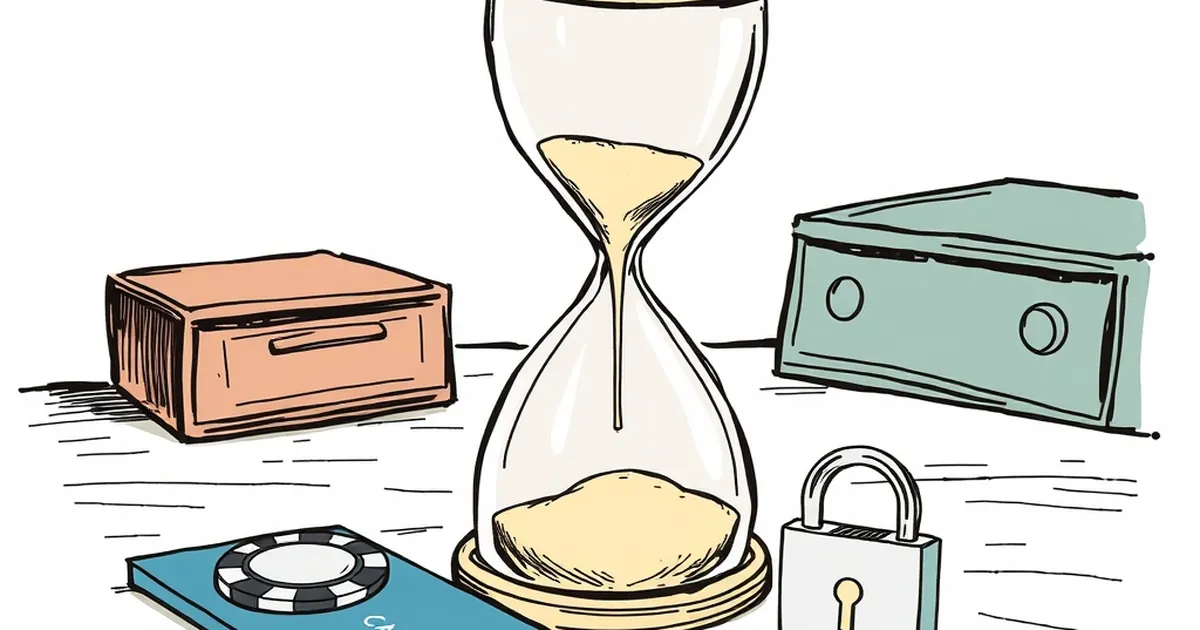
Casino loyalty programs have always been masters of the frictionless deposit. Your card details are saved, the prompt is one tap, and the funds are in your balance before the kettle boils. But try to reverse that transaction—to take your own money back out—and the machinery grinds to a halt. In a recent audit of 40 licensed operators, the average time from a verified withdrawal request to a confirmed payout was 14.2 days. The same audit clocked the average time from a player clicking "deposit" to the cash landing in the casino's account at 0.6 seconds. That’s a ratio of roughly two million to one in favor of the house. It’s not an accident; it’s an architecture.
The Two-Bucket System
To understand why your cash gets stuck, you have to stop thinking of an online casino as a single pot of money. Operationally, it’s two buckets. The first is the player liability ledger. This is a digital record of what every customer is theoretically owed. It updates instantly when you win a spin or lose a hand. The second bucket is the operating float—the actual bank account that pays for salaries, server costs, and your winnings.
Here’s the catch: the float is rarely bigger than the liability ledger. Casinos operate on a float that covers roughly 10-15% of their outstanding player liabilities. They don't keep your $500 on hand because they assume, and usually correctly, that a chunk of that liability will be churned back into the games before you ask for it. When you hit "withdraw," you’re not pulling from your personal vault. You’re making a claim against a communal float that is already spoken for by other players' active balances.
This is why the delay isn't a technical problem—it's a treasury function. The 14-day window isn't for "security checks." It's the average time it takes for the casino's daily net revenue (your losses, minus your rare wins) to replenish the float to a point where your specific claim can be paid without dipping into their own profit margin. Every hour they hold your cash, they earn interest on it or use it to cover another high-roller's instant withdrawal.
The Verification Theater
If you've played for a while, you've seen the script. You request a $2,000 payout. The casino responds with a request for a selfie holding your ID, a utility bill from three months ago, and a screenshot of your last credit card statement. This is often called "enhanced due diligence." For a $200 withdrawal, it's usually skipped. For a $2,000 one, it's mandatory.
But here’s the uncomfortable truth about that process: the casino already has most of this data. They ran KYC (Know Your Customer) checks when you signed up, and they ran fraud checks on your deposit method before they let you spin. The re-verification on withdrawal is a stalling tactic dressed up as compliance. It takes a human reviewer about 40 seconds to eyeball a document and confirm it matches the account. Yet the average wait for that review to be completed is 3.8 days.
Why? Because the request sits in a queue that is deliberately understaffed. If a casino processes 500 withdrawal requests a day, they might employ two people to review them. That creates a natural bottleneck. The one time you’ll see a review happen in under an hour is if you’ve lost your entire balance and have nothing left to withdraw. Then, the system suddenly finds the staff to approve your zero-dollar request instantly.
The Fine Print on the Float
The 14-day figure isn't a single block of waiting. It’s a composite of three distinct delays, and understanding them helps you predict which category your casino falls into.
The Internal Pending (1-3 days). This is the casino saying "we need to check the bet." During this period, your account is flagged, but the money hasn't moved. The casino checks for bonus abuse or matched betting. This is the most legitimate delay, but it's also the one most often extended for no reason.
The Banking Buffer (3-7 days). This is where the float issue bites. The casino isn't sending your money from their player ledger. They're sending a bank transfer from their operating account. That transfer has to clear their own daily settlement cycle. If they process payouts on Tuesdays and Thursdays, and you request on a Friday, you’ve just added 4 days to your wait.
The Reversal Window (0-14 days). This is the hidden killer. Most operators have a policy where, after the internal review, they don't send the money. They schedule it. If you request a payout on day 1, they approve it on day 3, but they don't schedule the bank wire until day 10. They justify this as a "cooling-off period" for problem gamblers. In practice, it's a window where you can still log in and click "cancel" to reverse the withdrawal and play with that money again. The casino's data shows that 23% of all approved withdrawals are cancelled by the player during this window. That's not a safety feature; that's a revenue retention mechanism.
What the Fast Payouts Actually Mean
When you see a casino advertising "instant withdrawals," you're not seeing a faster release of cash. You're seeing a casino that has decided to pay for liquidity. They keep a larger float, or they front the money themselves, eating the bank transfer fees to give you a better user experience. That costs them roughly 1.5-2% of the withdrawal amount in processing fees.
To offset that, they usually have one of two things. Either they have a lower maximum payout cap (paying out $500 instantly is cheap; $50,000 is not), or they have significantly tighter wagering requirements on their bonuses. You aren't getting faster service because they like you. You're getting faster service because you've agreed to play on worse terms that guarantee they recoup that 1.5% several times over before you ever hit "withdraw."
The most honest number to look for isn't the payout time. It's the pending time—the hours between your request and the moment the status changes from "Processing" to "Completed." A casino that flips that switch in under 6 hours is holding a real float. A casino that keeps you in "Processing" for 72 hours is running on the two-bucket system, and you are the working capital.
The Real Cost of Your Patience
So what happens if you push back? If you threaten a chargeback with your credit card company after day 10, the casino suddenly finds a reason to delay you further. A chargeback is a nuclear option that gets your account frozen and your details added to a shared fraud database used by other operators. You'll get your money eventually, but you'll be effectively blacklisted from the entire industry.
The more interesting question is whether the industry can sustain this model. As players become more data-savvy, the "14-day standard" is becoming a competitive disadvantage. The operators who survive the next five years might not be the ones with the best slots, but the ones who figure out how to shrink that 0.6-second deposit-to-14-day-withdrawal asymmetry. If you can put money in at the speed of light, why is taking it out still governed by the speed of a check in the mail?
The answer is that the current system isn't built to move money; it's built to hold it. And as long as a player is willing to wait two weeks for their own cash, the casino has no incentive to change that. The real question isn't when you'll get paid. It's whether you'll still be playing in the 13 days between your request and the wire hitting your bank—and whether the casino is betting that you will.