0.6-second declines sting like a failed combo input
A payment decline hits like a dropped combo in a fighting game—sharp, instant, and brutally indifferent to your intentions
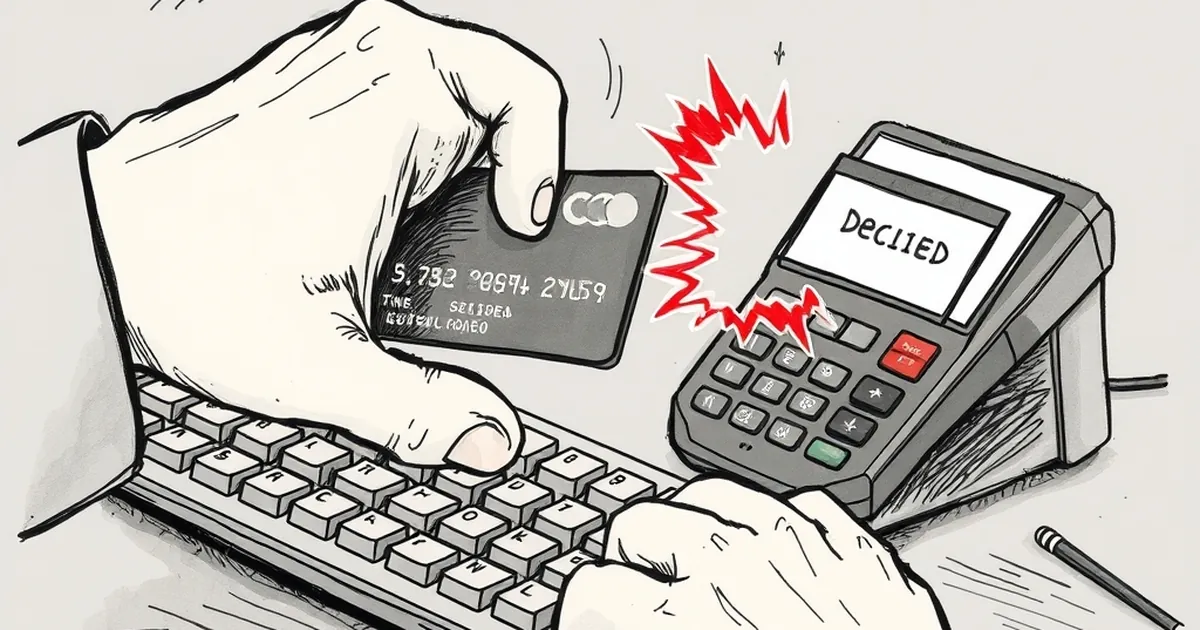
There’s a specific kind of sting that happens when you watch a payment decline on your phone. It’s not the same as being denied a loan or seeing a bank balance hit zero. It’s sharper, more immediate—a visceral thwack that feels almost physical. And if you’ve ever played a competitive fighting game, you know the exact sensation: the moment your carefully executed combo drops because you were off by a fraction of a second. The game doesn’t care about your intentions. The terminal doesn’t care about your available balance. Both just say no, and your brain registers that rejection with a speed that bypasses logic entirely.
Why does a 0.6-second decline feel so much worse than a 30-second credit application rejection? The answer lives at the messy intersection of payment rails and behavioral psychology—where the architecture of Visa and Mastercard meets the architecture of the human reward system.
The speed of the sting vs. the sting of speed
Here’s the paradox: faster financial feedback should be less painful, right? Less time to ruminate, quicker path to resolution. But research on decision-making under uncertainty suggests the opposite. When feedback is nearly instantaneous, our emotional response is amplified because the brain hasn’t had time to build a narrative around the event.
Think about the last time you typed a friend’s email address wrong. You hit send, the error message pops up in 0.4 seconds, and you feel a flash of irritation. Now imagine mailing a physical letter to the wrong address. The disappointment arrives three days later, diluted by time and context. You’ve already moved on.
Payment declines are the extreme version of this. The card network (Visa, Mastercard, or a local scheme) processes an authorization request in roughly 300 to 600 milliseconds. That’s faster than a human blink. When the response comes back as a decline code—whether it’s insufficient funds, a suspected fraud block, or a typo in the CVV—your brain treats it as an immediate, personal rejection.
This is where the fighting game analogy becomes uncannily precise. In competitive play, a dropped combo isn't a strategic failure. It’s a technical error—a missed input window, a timing miscalculation measured in frames (16.6 milliseconds per frame at 60fps). The punishment feels disproportionate to the mistake because your brain knows you knew the correct sequence. You didn’t lack skill; you lacked precision at a scale your conscious mind can’t even perceive.
Payment declines trigger the same cognitive dissonance. You know you have money in your account. You know you typed the card number correctly. But the 600-millisecond black box returned a no, and your brain interprets that as a failure of execution, not a failure of funds. The sting isn’t about the money. It’s about the mismatch between your internal model of reality and the external response.
Variable-ratio reinforcement and the cardholder’s itch
Let’s talk about why we keep swiping, tapping, and typing despite the occasional sting. Behavioral psychologists call it variable-ratio reinforcement, a schedule where rewards come after an unpredictable number of responses. It’s the same mechanism that keeps people checking their phones, refreshing feeds, and (in less healthy contexts) pulling levers.
But here’s the twist: payment approvals operate on a near-fixed schedule. If you have funds and the card is valid, approval comes 99.9% of the time. So why does the system feel so compelling?
Because the exceptions are unpredictable. You can’t predict when your bank’s fraud algorithm will flag a purchase as suspicious. You can’t predict when a merchant’s terminal will reject your chip because the contactless antenna is misaligned. You can’t predict when an international transaction will trigger a geo-block. These rare, unpredictable failures create a sense of uncertainty that actually heightens the dopamine response on successful approvals.
This is called reward prediction error—a concept from computational neuroscience. When an outcome exceeds your expectation, dopamine neurons fire more strongly than when the outcome is merely expected. Card approval feels routine, but because the failure points are invisible and unpredictable, each successful tap delivers a small, unnoticed spike of relief. The system has trained you to expect the unexpected, and every approval is a tiny victory against unseen forces.
The problem is that this same mechanism makes declines feel worse. A 0.6-second rejection isn’t just a denial; it’s a violation of your predictive model. Your brain expected approval (because it usually gets approval), and the error signal is proportionally larger. This is why a declined card in a foreign country feels personally insulting—not because you’re entitled to the purchase, but because your brain’s prediction error just fired at maximum intensity.
Loss aversion is faster than fear
Daniel Kahneman and Amos Tversky’s prospect theory taught us that losses loom larger than gains—roughly twice as large, in empirical studies. But what the classic research didn’t fully capture is the temporal dynamics of that asymmetry.
When you lose $50 in a stock market dip, the loss is abstract. It’s a number on a screen that changes over hours or days. But a declined payment isn’t a loss of money; it’s a loss of momentum. You were in the middle of a goal-directed sequence—buying coffee, paying for a ride, splitting a dinner bill—and the sequence was interrupted.
Interruption is a cognitive cost that feels like a loss, even when no money changes hands. Researchers call this process loss or task interruption cost. When you’re forced to stop, pull out a different card, or switch to cash, you’re paying a cognitive tax that has nothing to do with the transaction amount.
This is why micro-declines sting disproportionately. A declined $4 coffee triggers the same emotional machinery as a declined $400 hotel booking. The brain doesn’t process the dollar amount first; it processes the interruption. And because the feedback loop is so fast, the interruption feels like a physical blow to your current state of flow.
The combo metaphor: execution vs. strategy
Let’s return to the fighting game frame. In a game like Street Fighter or Tekken, a combo is a sequence of inputs that must be executed within strict timing windows. The strategic layer—choosing when to attack, when to block, when to bait—is separate from the execution layer. You can have perfect strategy and still lose because you dropped a combo.
Payments work the same way. The strategy of personal finance—budgeting, saving, choosing the right card for rewards—is a separate cognitive layer from the execution of a single transaction. When a payment declines, it’s rarely a strategic failure. It’s an execution failure. The card network’s risk engine made a decision based on variables you can’t see, and your input timing was irrelevant.
This distinction matters because it changes how we should design payment experiences. If declines are execution failures, then the recovery path should be forgiving. But current systems often punish execution mistakes as if they were strategic ones. A decline triggers a fraud alert, which freezes the card, which requires a phone call, which requires verifying your identity, which takes fifteen minutes. The punishment is calibrated for a strategic breach, not a technical hiccup.
Designing for the sting: what payment systems can learn from game design
Game designers have spent decades solving this problem. In competitive games, a dropped combo is followed by a brief recovery window—a few frames where you can still act, a buffer system that accepts slightly early inputs, or a visual cue that helps you re-sync your timing. The best games don’t eliminate mistakes; they make recovery feel fair.
Payment systems are starting to adopt similar principles, but slowly. Real-time transaction monitoring (like Mastercard’s Decision Intelligence or Visa’s Advanced Authorization) uses machine learning to reduce false declines. But the user experience of a decline hasn’t evolved much. You still get a generic “transaction declined” message with no explanation of why or what to do next.
The forward-looking fix is to treat declines as recoverable execution errors, not terminal verdicts. Imagine a payment interface that says: “Your bank declined this because it looks unusual. Try again in 30 seconds, or approve the transaction via your banking app.” That’s a recovery window. It doesn’t eliminate the sting—you still dropped the combo—but it gives you a buffer to re-engage.
Some fintech apps are already experimenting with this. Cards that connect to your phone can send a push notification before a decline happens, asking for confirmation. This shifts the timing from 600-millisecond rejection to a human-scale decision. The sting doesn’t disappear, but it becomes a choice rather than a verdict.
The deeper lesson is that speed without context amplifies pain. The 0.6-second decline is fast, but it’s also opaque. When we can’t see why we failed, we fill the gap with self-blame, frustration, or worse—we stop trying. The future of payment UX isn’t faster approvals; it’s faster clarity. Give the user the frame rate. Show them the input history. Let them see the missed timing.
Because the sting isn’t the decline. The sting is the silence that follows it—the empty space where an explanation should be. In games, you can watch the replay. In payments, you just get a no. The next great innovation won’t be a faster network. It’ll be a decline message that finally tells you which input you missed.