0.4 seconds of doubt costs more than any fee
The hidden cost of a 0.4-second payment delay reveals how our brains misjudge financial loss
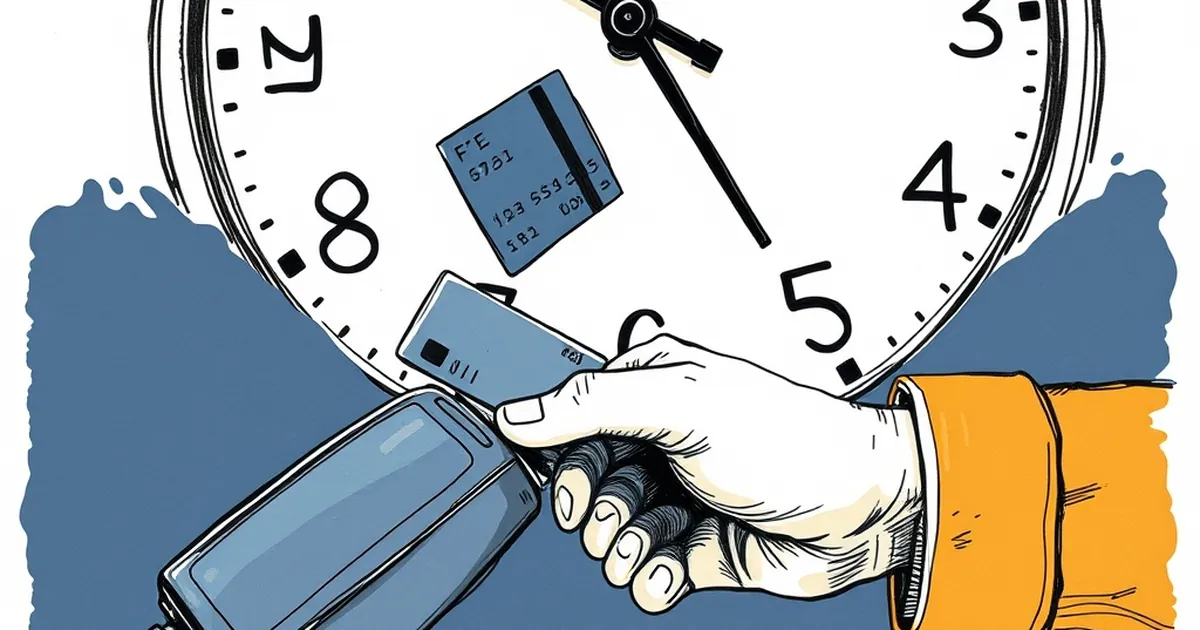
The checkout counter is a strange little theater of the mind. You’ve just spent forty minutes comparing the pros and cons of two nearly identical running shoes, yet the moment the payment terminal asks for a tip or flashes a "processing" screen, your brain goes quiet. Then it panics. That split-second hesitation—the famous 0.4-second delay before you confirm a contactless payment—isn't just a technical quirk of the chip. It’s a window into a deep behavioral chasm between how we think we value money and how our nervous system actually registers the loss.
We assume that the friction in a transaction is the fee. But the real cost is the cognitive tax of the doubt itself. In that half-second, your brain is running a risk assessment that has nothing to do with the purchase price and everything to do with your primal fear of being tricked. Let’s look at what actually happens in that gap, and why the most expensive thing you own might be your own hesitation.
The Terminal is a Trust Test
Every payment is a micro-contract of faith. You are handing over a claim on your future labor (money) in exchange for a present tangible good. The terminal is the neutral arbiter, but it’s also a mask. Is this the actual price? Is the merchant reputable? Is my card being cloned right now? These questions don't surface as conscious thoughts; they manifest as a physiological pause.
Behavioral economists call this the "ambiguity effect," a term first explored by Daniel Ellsberg in the 1960s. Ellsberg showed that people will consistently avoid a bet where the odds are unknown, even if the potential payout is mathematically identical to a bet with clear odds. Applied to payments, the terminal screen presents an ambiguous outcome. You know the price, but you don't know the hidden variables—the network fees, the currency conversion, the potential for a double charge.
This is why dynamic currency conversion (DCC) is such a sneaky profit center for banks. When you travel abroad and are asked, "Do you want to pay in your home currency?" at a foreign ATM or POS, that’s not a convenience. That’s a deliberate injection of ambiguity. They are asking you to make a rapid-fire calculation of exchange rates under time pressure. Your 0.4 seconds of doubt isn't about the fee; it's about your brain trying to compute a probability of being ripped off, and failing. That doubt is the actual cost—it drains your cognitive bandwidth and makes you more likely to accept the worst option just to end the stress.
The Dopamine of the "Approved" Buzz
Let’s flip the script. If the doubt is costly, why do we also get a tiny thrill when the payment goes through? That buzz is the result of variable-ratio reinforcement, a concept made famous by B.F. Skinner. When you tap your card, you don't know if it will beep "Approved" or flash a dreaded red light. The uncertainty is the hook.
In behavioral psychology, variable-ratio schedules are the most extinction-resistant form of reinforcement. You see this in the way we check our phones for notifications, or in the addictive pull of a slot machine (though we won't talk about that here). The payment terminal, however, is a more subtle version. The "reward" isn't the purchase—that’s a fixed outcome. The reward is the approval itself. It validates that you have sufficient funds, that your identity is intact, and that you are a functioning economic agent.
This is why contactless payments feel different from cash. With cash, the loss is immediate and tactile. You see the bill disappear. With a card, the loss is abstracted, and the feedback loop is skewed toward the success of the transaction rather than the depletion of resources. The 0.4-second delay creates a tiny spike of anxiety, followed by a dopamine release when the green checkmark appears. We aren't paying for the coffee; we are paying for the relief of not being rejected. The fee is irrelevant. The emotional reward of "approval" is the real currency.
Loss Aversion and the "Sunk Cost" of the Cart
We tend to think of abandonment as a failure of price. If a cart is abandoned, the product was too expensive. But research from the field of "pain of paying" suggests otherwise. Dr. Drazen Prelec and Dan Ariely have shown that the act of paying is often more painful than the amount paid, especially when the payment method is transparent.
In a standard retail scenario, the pain of paying is mitigated by the joy of receiving. But the 0.4-second doubt triggers a different mechanism: loss aversion. Kahneman and Tversky famously demonstrated that losses loom roughly twice as large as gains. In that split second, your brain isn't weighing the utility of the new jacket. It's weighing the potential loss of the money against the certain loss of the item if you cancel.
This is where the "sunk cost" of the shopping cart comes into play. You’ve spent time browsing, comparing, and adding items. If you hesitate now, you face a double loss: the time spent (sunk cost) and the item itself. To avoid that, you often hit "confirm" just to escape the cognitive dissonance. The fee that you might have avoided by shopping around is negligible compared to the psychological cost of accepting that your prior 20 minutes of browsing was a waste. The doubt is a trap that forces you to make irrational decisions to protect your ego, not your wallet.
The Psychology of the "Tap" vs. The "Pin"
There is a stark difference in behavior between a low-value tap and a high-value PIN entry. The 0.4-second delay is a feature of the contactless system, designed for speed. But notice what happens when you exceed a certain threshold (often $100 or €50). The terminal suddenly asks for a PIN. This isn't just a security measure; it’s a behavioral reset.
The PIN entry forces a deliberate, conscious act. It re-engages your prefrontal cortex, pulling you out of the automatic "tap and go" loop. This is why high-value purchases feel more "real." But here’s the kicker: the 0.4 seconds of doubt before the PIN request is where the real risk lies. If the terminal is slow, or if the amount seems higher than expected, you enter a state of "decision paralysis."
In competitive play—whether in chess or high-stakes trading—the concept of "tilt" applies. When you are forced to make a decision under time pressure with incomplete information, you default to the most aggressive or the most passive option. In payments, this manifests as either "fck it, I'll buy it" (impulse) or "this is too complicated, I'll leave it" (avoidance). The 0.4-second doubt is the trigger for tilt. It pushes you out of a rational cost-benefit analysis and into a binary fight-or-flight response. The fee structure of the card network is irrelevant here; the design of the *time pressure is what dictates your behavior.
Building a "Cognitive Fee" Budget
So, how do we move forward? As a consumer, you cannot change the terminal's speed. But you can change your internal protocol. The goal isn't to eliminate the doubt—that’s impossible. The goal is to schedule the doubt for a time when it isn't costly.
The practical takeaway is to separate the decision from the transaction. When you are shopping online, the 0.4-second doubt should occur at the "Add to Cart" button, not the "Pay Now" button. If you hesitate at the cart stage, that is the time to walk away. If you hesitate at the payment stage, you are already too late—your brain is compromised by the pressure of the moment.
For those of us in the fintech space, the implication is clear: we need to design for the post-doubt experience. The future of payment UX isn't about making the transaction faster; it's about making the decision to transact more transparent before the terminal is reached. We need to offer "pre-negotiated" limits, where the consumer sets a threshold for automatic approval, removing the ambiguity. Think of it as a behavioral firewall.
The 0.4 seconds of doubt is a signal. It tells you that your brain is trying to protect you from a decision you haven't fully processed. The most financially savvy move isn't to find a card with no foreign transaction fees. It’s to build a system where that doubt is rendered obsolete by prior, calm, and deliberate planning. Stop trying to win the argument with the terminal. Win the argument with yourself before you even walk into the store. That is the only fee you can truly avoid.